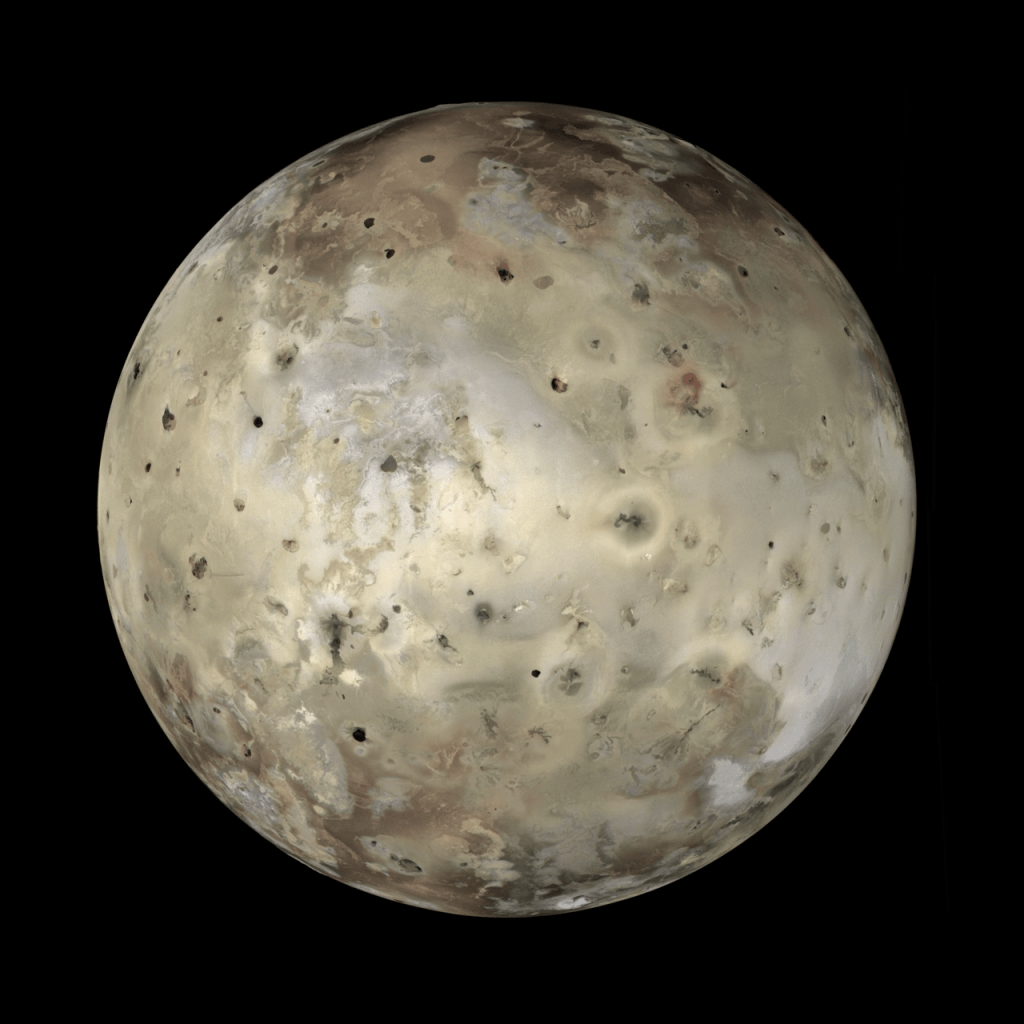
1 Greek mythology a priestess of Hera who was loved by Zeus. Trying to protect her from the jealousy of Hera, Zeus turned [her] into a heifer. Hera sent a gadfly to torture the heifer, which then fled across the world and finally reached Egypt, where Zeus turned her back into human form. 2 Astronomy one of the Galilean moons of Jupiter, the fifth-closest satellite to the planet, being actively volcanic and coloured red and yellow with sulphur compounds (diameter 3,630 km. — Oxford English Dictionary
The above entry in the Oxford English Dictionary defines what word?
Two
Cato Fong is the manservant of which fictional inspector?
Three
Which Swedish actress played Ilsa Lund in the classic film Casablanca?
Four
Which 2013 Dan Brown novel begins with Robert Langdon waking in a Florence hospital?
Five
What was the title of Carrie Underwood’s debut single?
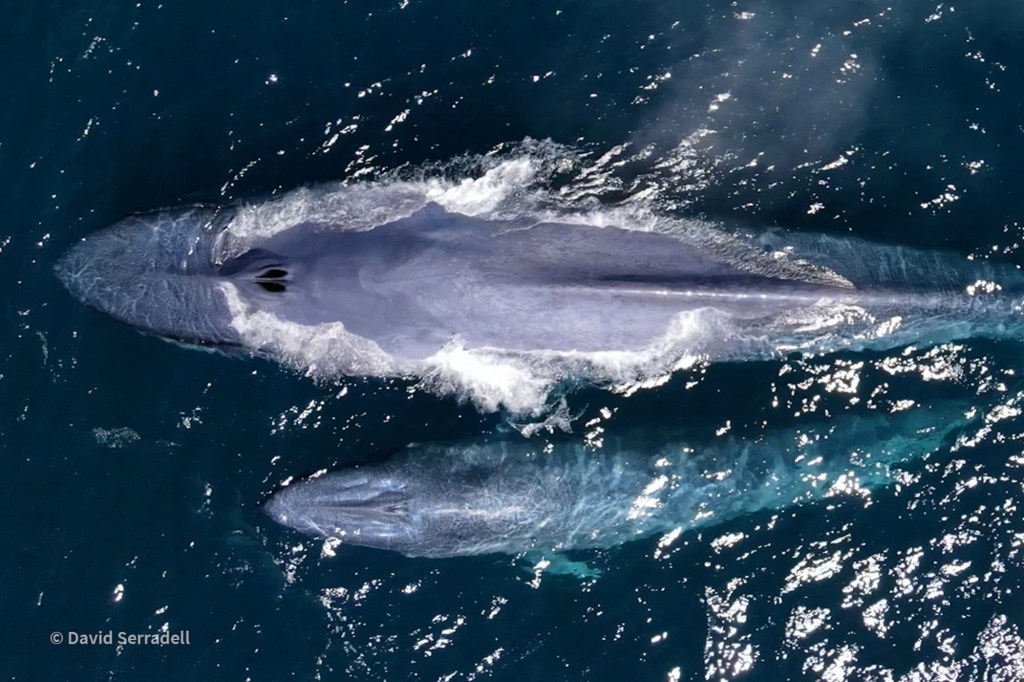
The term ’calf’, when referring to a young whale, is derived from the same root as the word for a young cow, which comes from Old English cealf and Proto-Germanic kalbam. This usage has been extended to marine mammals, where the adults are called bulls and cows, and the young are referred to as calves/calves.
Two
What were the first names of Mason and Dixon, after whom the Mason-Dixon Line is named?
Answer: Charles and Jeremiah.
The Mason-Dixon Line, surveyed by Charles Mason and Jeremiah Dixon from 1763 to 1767, initially served to resolve a land dispute between the Penn and Calvert families by marking the boundary between Maryland and Pennsylvania. It later became a symbolic boundary between slave and free states in the United States before the Civil War.
Three
What eight letter word means ‘the study of Chinese language, history, customs, and politics’, and from what does the first three letters of the word ultimately derive?
Answers: Sinology; Qin.
The terms sinology and sinologist were coined around 1838, Sinae, in turn from the GreekSinae, from the ArabicSin—which ultimately derive from Qin, i.e. the Qin dynasty. — Wikipedia ultimately the American Heritage Dictionary of the English Language (Boston: Houghton Mifflin, 3rd edition 1992): 1686.
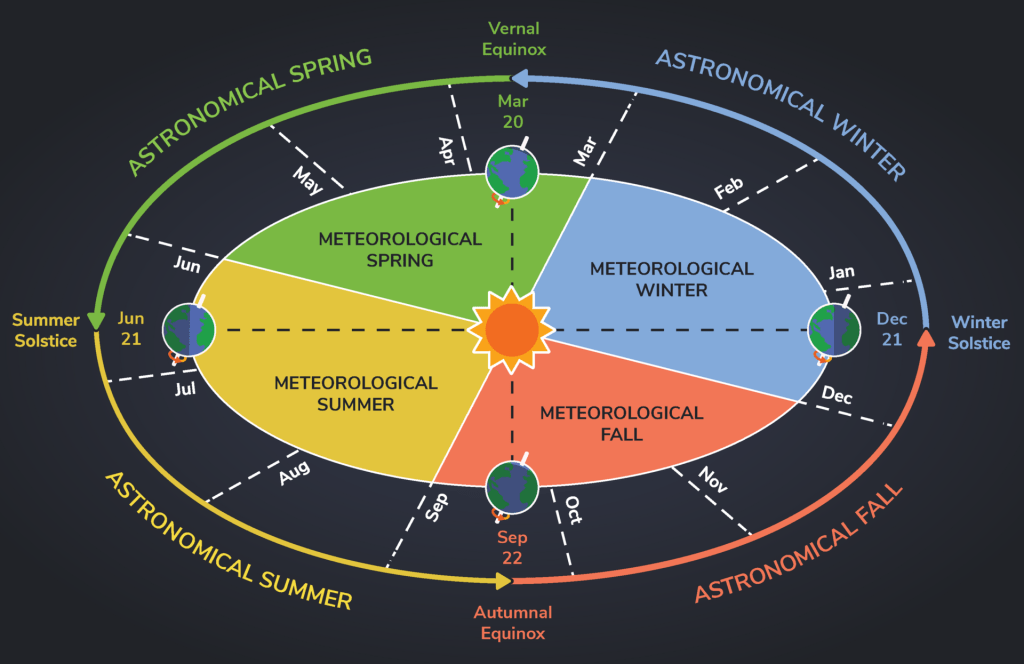
The astronomical seasons are based on the position of the Earth in relation to the sun. The equivalent meteorological seasons are also shown. This image is for the northern hemisphere. Image Wikimedia Commons
Four
In the northern hemisphere, what astronomical season ends at the vernal equinox and what three months form the equivalent meteorological season?
Answers: Astronomical winter; December, January and February.
Astronomical winter starts with the Winter Solstice about December 21st in the northern hemisphere and ends with the Vernal Equinox about March 20th. Meteorological winter covers the months of December, January and February.
Five
Ours is essentially a tragic age, so we refuse to take it tragically.
The opening words of which English novel, first published in Florence Italy in 1928, are quoted above. What is the novel’s title and who is the author?
Answer: Lady Chatterley’s Lover; D.H. Lawrence.
Lady Chatterley’s Lover, D. H. Lawrence’s final novel, explores the relationship between a working-class man and an upper-class woman. The novel, influenced by Lawrence’s life and the story of Lady Ottoline Morrell, faced obscenity trials in the UK and US before becoming a bestseller. It was not published fully and openly in the UK until 1960.
Sailing to Philadelphia – The Post Title
The title refers to Mark Knopfler’s album from 2000, and its title track which was inspired by Mason & Dixon by Thomas Pynchon, a novel about Mason and Dixon. The track features American singer-songwriter James Taylor.
Sailing to Philadelphia
Mark Knopfler
I am Jeremiah Dixon I am a Geordie Boy A glass of wine with you, sir And the ladies I’ll enjoy
All Durham and Northumberland Is measured up by my own hand It was my fate from birth To make my mark upon the earth…
He calls me Charlie Mason A stargazer am I It seems that I was born To chart the evening sky
They’d cut me out for baking bread But I had other dreams instead This baker’s boy from the west country Would join the Royal Society…
We are sailing to Philadelphia A world away from the coaly Tyne Sailing to Philadelphia To draw the line The Mason-Dixon line
Now you’re a good surveyor, Dixon But I swear you’ll make me mad The West will kill us both You gullible Geordie lad
You talk of liberty How can America be free A Geordie and a baker’s boy In the forest of the Iroquois…
Now hold your head up, Mason See America lies there The morning tide has raised The capes of Delaware
Come up and feel the sun A new morning is begun Another day will make it clear Why your stars should guide us here…
We are sailing to Philadelphia A world away from the coaly Tyne Sailing to Philadelphia To draw the line The Mason-Dixon Line
What were the first names of Mason and Dixon, after whom the Mason-Dixon Line is named?
Three
What eight letter word means ‘the study of Chinese language, history, customs, and politics’, and from what does the first three letters of the word ultimately derive?
Four
In the northern hemisphere, what astronomical season ends at the vernal equinox and what three months form the equivalent meteorological season?
Five
Ours is essentially a tragic age, so we refuse to take it tragically.
The opening words of which English novel, first published in Florence Italy in 1928, are quoted above. What is the novel’s title and who is the author?
Today, production of the iconic Type 2 Volkswagen began. In which even-numbered year did this occur?
Answer: 1950.
The first generation Volkswagen Type 2, known as the Microbus or Splitscreen, was produced from 8 March 1950 to the end of 1967. Initially assembled in Wolfsburg from 1950 to 1956, production shifted to Hanover’s Transporter factory in 1956. Like the Beetle, it featured an 1100 cc air-cooled flat-four engine. Initially, only two models were available: the Kombi and the Commercial. The Microbus debuted in May 1950, followed by the Deluxe Microbus in June 1951. In its first year, 9,541 Type 2s were manufactured, marking the beginning of a popular and versatile vehicle line.
Two
In 2014, Malaysia Airlines Flight 370 vanished from radar an hour and 40 minutes after takeoff and has never been seen again. Its fate remains a mystery. What was the departure city and destination of the flight?
Answer: Kuala Lumpur to Beijing.
Malaysia Airlines Flight 370 disappeared on 8 March 2014 while flying from Kuala Lumpur to Beijing. Despite extensive searches and investigations, the cause of the disappearance remains unknown, with theories ranging from hypoxia to hijacking. The disappearance led to safety recommendations and regulations to prevent similar incidents in the future. The official search concluded in January 2017 but was succeeded by a private search the following year that lasted six months.
Three
In 1979, the NASA spacecraft Voyager 1 witnessed volcanic eruption on the moon Io. Of what planet is Io a moon of?
Answer: Jupiter.
Io, Jupiter’s third largest moon, is the most volcanically active world in the solar system, featuring hundreds of volcanoes that can erupt lava fountains dozens of miles high. These powerful eruptions are sometimes visible with large telescopes on Earth, and leave Io’s surface with lakes of molten silicate lava. Slightly larger than Earth’s Moon, Io is about one-quarter the diameter of Earth.
Four
The compact disc was first demonstrated in 1979. Its subsequent development was the result of a collaboration between what two companies?
Answer: Philips and Sony.
The 1979 demonstration was made by Philips in Eindhoven, Netherlands. The compact disc, an evolution of LaserDisc technology, was developed through a collaboration between Philips and Sony in the late 1970s. The Red Book CD-DA standard, published in 1980, utilised Sony’s error correction system and Philips’ eight-to-fourteen modulation, leading to the CD’s commercial success and dominance in the home music market.
Five
The Battle of Guadalajara commenced in 1937. Which war was it a part of?
Answer: Spanish Civil War.
The Battle of Guadalajara (March 8–23, 1937) saw the Spanish Republican Army and International Brigades defeat the Italian and Nationalist forces attempting to encircle Madrid during the Spanish Civil War. The Italian Corps of Volunteer Troops led the Nationalist offensive, which began on March 8 but was halted by March 11. Renewed attacks were repelled between March 12 and 14. A Republican counter-offensive from March 18 to 23 was successful, largely due to superior Soviet armoured vehicles. Italian and Nationalist losses were 17,400, while Republicans suffered 6,258.
Today, production of the iconic Type 2 Volkswagen began. In which even-numbered year did this occur?
Two
In 2014, Malaysia Airlines Flight 370 vanished from radar an hour and 40 minutes after takeoff and has never been seen again. Its fate remains a mystery. What was the departure city and destination of the flight?
Three
In 1979, the NASA spacecraft Voyager 1 witnessed volcanic eruption on the moon Io. Of what planet is Io a moon of?
Four
The compact disc was first demonstrated in 1979. Its subsequent development was the result of a collaboration between what two companies?
Five
The Battle of Guadalajara commenced in 1937. Which war was it a part of?
Here are the answers to the questions I posted earlier.
These are five questions which are related to today, February 5th.
Section of the border between East and West Germany. Image Wikimedia Commons
One
The term ‘Iron Curtain’ described the political and physical boundary dividing Europe from the end of World War II until the end of the Cold War. Who popularised its use in a speech at Westminster College, Fulton, Missouri, on 5 March 1946?
Answer: Winston Churchill.
…an iron curtain has descended across the Continent. Behind that line lie all the capitals of the ancient states of Central and Eastern Europe. — Winston Churchill, Former British prime minister, 5 March 1946, Westminster College, Fulton, Missouri
The Iron Curtain was a political and physical boundary dividing Europe from 1945 to 1990/1991, symbolising the ideological divide between the Soviet-controlled Eastern Bloc and the Western nations. Popularised by Winston Churchill in 1946, the term originally described physical barriers but later encompassed broader cultural and ideological differences. The Iron Curtain largely dissolved in 1989-90 with the fall of communism.
Two
A 31-year-old American country singer, who was born Virginia Patterson Hensley in Virginia, died in a 1963 plane crash in Tennessee. She had enjoyed an eight-year recording career, which included two number ones as well as other major chart hits. By what name was she known professionally?
Answer: Patsy Cline.
Patsy Cline, born Virginia Patterson Hensley, was an American singer known for her crossover success from country to pop music. She achieved major hits like Walkin’ After Midnight and I Fall to Pieces, becoming a trailblazer for women in country music. Although, she died in a plane crash in 1963, her legacy endures through her influential music and posthumous recognition.
Three Cigarettes in an Ashtray
The post title, Three Cigarettes in an Ashtray, was the title of a Patsy Cline single from 1957.
Three
In 1616, 73 years after publication, On the Revolutions of the Heavenly Spheres (De revolutionibus orbium coelestium) was added to the Index of Forbidden Books (Index Librorum Prohibitorum) by the Sacred Congregation of the Index. Which astronomer had written On the Revolutions of the Heavenly Spheres?
Answer: Nicolaus Copernicus
Copernicus’s book placed the Sun rather than the Earth at the centre, meaning the Earth and other planets orbited the Sun. The Index Librorum Prohibitorum, active from 1560 to 1966, was a list of publications deemed heretical or immoral by the Catholic Church. It banned thousands of books, including works by theologians, astronomers, philosophers, and unapproved Bible editions, to protect church members from potentially disruptive ideas.
Four
In 1942 Japanese forces captured what is now Jakarta, Indonesia. At that time, what was the city called and of where was it the capital?
Answers: Batavia; Dutch East Indies.
Batavia, now known as Jakarta, was founded in 1619 by the Dutch East India Company (VOC) as a strategic trading post in the Dutch colonial empire. It became the capital of the Dutch East Indies and was pivotal for their trade routes, especially in spices and other commodities. Following Indonesia’s declaration of independence in 1945, Batavia was renamed Jakarta. The city evolved from a colonial outpost to a major urban centre reflecting Indonesia’s diversity and is a bustling metropolis and the capital of Indonesia. It is a hub for culture, economy, and politics in Southeast Asia.
Five
In 1496, England’s Henry VII issued letters patent authorising a navigator and his sons to explore unknown lands. This led to what is the earliest known exploration of the North American Atlantic coast since the Norse visits to Vinland in the eleventh century. Who was Henry VII’s explorer?
Answer: John Cabot.
John Cabot was an Italian navigator and explorer. His 1497 voyage to North America, commissioned by Henry VII, King of England, is the earliest known European exploration of the region’s coast since the Norse visits to Vinland in the eleventh century. To commemorate the 500th anniversary of Cabot’s expedition, both Canadian and British governments declared Cape Bonavista, Newfoundland, as his first landing site. However, alternative locations have also been suggested.
These are five questions which are related to today, February 5th.
Section of the border between East and West Germany. Image Wikimedia Commons
One
The term ‘Iron Curtain’ described the political and physical boundary dividing Europe from the end of World War II until the end of the Cold War. Who popularised its use in a speech at Westminster College, Fulton, Missouri, on 5 March 1946?
Two
A 31-year-old American country singer, who was born Virginia Patterson Hensley in Virginia, died in a 1963 plane crash in Tennessee. She had enjoyed an eight-year recording career, which included two number ones as well as other major chart hits. By what name was she known professionally?
Three
In 1616, 73 years after publication, On the Revolutions of the Heavenly Spheres (De revolutionibus orbium coelestium) was added to the Index of Forbidden Books (Index Librorum Prohibitorum) by the Sacred Congregation of the Index. Which astronomer had written On the Revolutions of the Heavenly Spheres?
Four
In 1942 Japanese forces captured what is now Jakarta, Indonesia. At that time, what was the city called and of where was it the capital?
Five
In 1496, England’s Henry VII issued letters patent authorising a navigator and his sons to explore unknown lands. This led to what is the earliest known exploration of the North American Atlantic coast since the Norse visits to Vinland in the eleventh century. Who was Henry VII’s explorer?
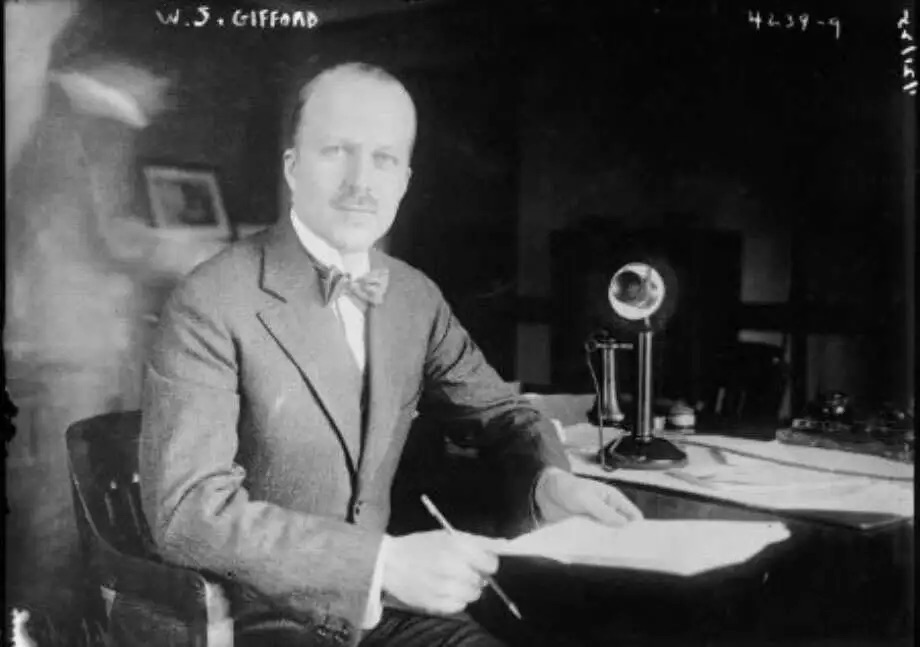
The first ‘official’ commercial transatlantic telephone service was established on this date. In what decade, and between what two cities, was the connection made?
Answer: 1920s; New York City, United States and London, United Kingdom
On January 6 and 7, 1927, the first transatlantic telephone conversations took place between the United States and London. The initial test call, a casual conversation about the weather and travel distances, was followed by a formal ‘official’ inauguration call between AT&T President W.S. Gifford and Sir Evelyn P. Murray, head of the British General Post Office. This historic achievement marked the beginning of a new era of global communication. The previous day, the across-the-ocean ‘test’ conversation was also recorded for the purposes of history — ‘How’s the weather over in London?’. These calls travelled over 3,000 miles, via wire from New York City to a radio transmitter at Rocky Point, Long Island, New York, and then via radio waves—to a radio receiving station at Rugby, England, and finally via wire from there to London. The return conversation went from London via wire to Cupar, Scotland, from there via radio waves to a receiving station at Houlton, Maine, and finally via wire back to New York City. — Sourced from Library of Congress
Two
The first observation of the Galilean moons was made with two being visible. Who made this first observation and in what century was it made?
Answer: Galileo Galilei; 17th century
The Galilean moons, discovered by Galileo in 1610, are the four largest moons of Jupiter: Ganymede, Callisto, Io and Europa. They are planetary-mass moons, larger than any dwarf planet, and Ganymede is the largest moon in the Solar System. Their discovery challenged the geocentric Ptolemaic world system and demonstrated the importance of the telescope.
Three
In 1985, which country’s space agency launched the Sakigake spacecraft, the first deep space probe launched by a nation other than the United States or the Soviet Union?
Answer: Japan
Sakigake, a practice mission for Japan’s Suisei, flew by Comet Halley, providing data on the comet and Earth’s magnetic tail.
Four
What first three-letter distress signal was established in 1904, only to be replaced two years later by SOS?
Answer: CQD
CQD, one of the first radio distress signals, was adopted by the Marconi International Marine Communication Company on 7 January 1904. SOS, agreed upon by the International Radio Telegraphic Convention in 1906, was merely a distinctive Morse code sequence of three dots, three dashes and three dots with no spaces between the letters. Although not an abbreviation, SOS is often associated with phrases like ‘save our souls’ or ‘save our ship’.
Five
In 1954, the Georgetown-IBM experiment at the head office of IBM in New York City was the first public demonstration of a computer doing which of these?
Performing arithmetic and complex mathematical calculations
Scanning text and graphics
Translating from one input language to another output language
Answer: 3. Translating from one input language to another output language
The Georgetown–IBM experiment, a 1954 demonstration of machine translation, showcased the automatic translation of over sixty Russian sentences into English. Developed by Georgetown University and IBM, the experiment utilised a limited vocabulary and grammar rules, focusing on specific domains like politics and science. While the demonstration received widespread attention and encouraged government investment, progress in machine translation was slower than anticipated.
The first ‘official’ commercial transatlantic telephone service was established on this date. In what decade, and between what two cities, was the connection made?
Two
The first observation of the Galilean moons was made with two being visible. Who made this first observation and in what century was it made?
Three
In 1985, which country’s space agency launched the Sakigake spacecraft, the first deep space probe launched by a nation other than the United States or the Soviet Union?
Four
What first three-letter distress signal was established in 1904, only to be replaced two years later by SOS?
Five
In 1954, the Georgetown-IBM experiment at the head office of IBM in New York City was the first public demonstration of a computer doing which of these?
Performing arithmetic and complex mathematical calculations
Scanning text and graphics
Translating from one input language to another output language