Tag: physics

  • Now I am Become Death, the Destroyer of Worlds — Answers

    Here are today’s answers.

    Trinity Test, Jack W. Aeby, July 16, 1945.
    Image Wikimedia Commons

    The first question relates to today’s date, 16 July. The subsequent questions follow a theme established by the first.

    One

    The world’s first atomic bomb exploded in a test on 16 July. 

    • What code name was given to the test?
    • In what year was the test?, and
    • In what U.S. state was the test site located?

    Answers

    • Trinity
    • 1945
    • New Mexico

    The Trinity test, the first nuclear detonation, occurred on July 16, 1945, in New Mexico as part of the Manhattan Project. Directed by Kenneth Bainbridge, it tested an implosion-design plutonium bomb, releasing 25 kilotons of energy and creating trinitite. Observed by 425 people, the site became a National Historic Landmark in 1965. The Manhattan Project established Los Alamos for nuclear weapon development, leading to the first atomic bomb, Gadget, tested at the Trinity Site. The Trinity Site is now a national historic landmark with limited public access.


    Two

    When asked why he chose the nuclear test code name referred to in question one above, Robert Oppenheimer alluded to the work of which English poet?

    Answer: John Donne.

    In 1962 Oppenheimer said:

    Why I chose the name is not clear, but I know what thoughts were in my mind. There is a poem of John Donne, written just before his death, which I know and love.” Oppenheimer then quoted the sonnet “Hymn to God, My God, in My Sickness” about a man unafraid to die because he believed in resurrection.

    Oppenheimer continued: 

    That still does not make a Trinity, but in another, better-known devotional poem Donne opens, ‘Batter my heart, three person’d God.’ Beyond this, I have no clues whatever.
    — Los Alamos National Laboratory


    Three

    Who is traditionally said to have used a clover-like plant, which is now a national symbol, as a metaphor for a Christian doctrine, and what was the plant?

    Answer: St. Patrick; shamrock.

    In 5th-century Ireland, Saint Patrick reportedly used the shamrock to explain the Holy Trinity to pagans. Today, the shamrock is Ireland’s national symbol and a key emblem of Saint Patrick’s Day, celebrated worldwide with parades and festivities.


    Four

    Which charity is the official authority for lighthouses in England and Wales?

    Answer: Trinity House.

    Trinity House, established in 1514, is the UK’s largest maritime charity and General Lighthouse Authority for England, Wales, the Channel Islands, and Gibraltar. It ensures maritime safety through navigation aids, pilot licensing, and audits. Annually, it donates £4m to support cadet training, retired mariners’ welfare, and sea safety education.


    Five

    Of the seven surviving British and Irish medieval and early modern universities founded before 1600 AD, one with a name appropriate for this theme was founded in 1592. Under what name was this 1592 establishment founded?

    Answer: Trinity College Dublin (Coláiste na Tríonóide, Baile Átha Cliath).

    (or in full The Provost, Fellows and Scholars of the College of the Holy and Undivided Trinity of Queen Elizabeth near Dublin (Coláiste Thríonóid Naofa Neamhroinnte na Banríona Eilís gar do Bhaile Átha Cliath)).

    Trinity College Dublin, founded in 1592 by Queen Elizabeth I, is Ireland’s oldest university and a member of LERU and the Coimbra Group. It houses the Book of Kells and has notable alumni like Oscar Wilde and Jonathan Swift. The college, a major tourist destination, has an academic partnership with Oxford and Cambridge.


    Now I am Become Death, the Destroyer of Worlds

    Robert Oppenheimer later recalled a moment, after the Trinity Test, when the line ‘Now I am Become Death, the Destroyer of Worlds’ from the Hindu scripture the Bhagavad Gita came to mind.

  • Now I am Become Death, the Destroyer of Worlds

    Trinity Test, Jack W. Aeby, July 16, ?
    Image Wikimedia Commons

    The first question relates to today’s date, 16 July. The subsequent questions follow a theme established by the first.

    One

    The world’s first atomic bomb exploded in a test on 16 July. 

    • What code name was given to the test?
    • In what year was the test?, and
    • In what U.S. state was the test site located?

    Two

    When asked why he chose the nuclear test code name referred to in question one above, Robert Oppenheimer alluded to the work of which English poet?


    Three

    Who is traditionally said to have used a clover-like plant, which is now a national symbol, as a metaphor for a Christian doctrine, and what was the plant?


    Four

    Which charity is the official authority for lighthouses in England and Wales?


    Five

    Of the seven surviving British and Irish medieval and early modern universities founded before 1600 AD, one with a name appropriate for this theme was founded in 1592. Under what name was this 1592 establishment founded?


    Good luck! I’ll post the answers later.


  • Where – Who – Where – Who (& When) – Where—Answers

    Here are the answers to my earlier questions.

    All of today’s questions are connected to the date, March 20th. There are three places and two people to find in these multiple-choice questions.

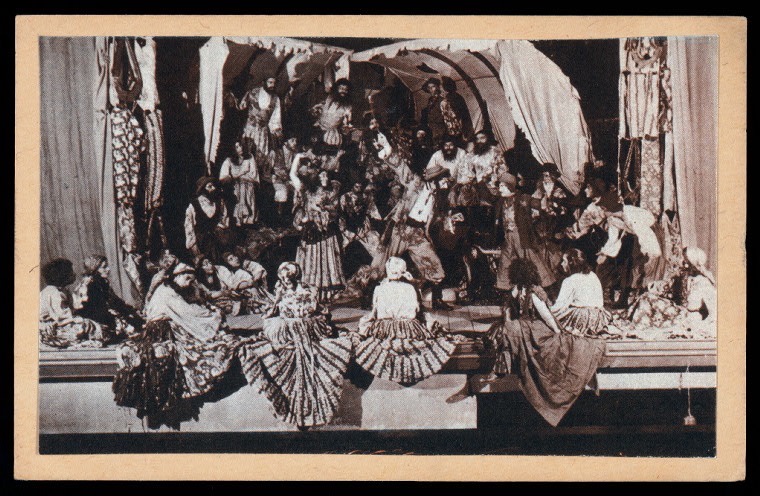
    The Gypsy Theatre, Moscow, c.1931. Image New York Public Library via Wikimedia Commons

    One

    The first Romani language operetta, Children of the Forests, premiered on 20 March 1888. Where was it staged?

    1. Bucharest, Romania
    2. Kyiv, Ukraine
    3. Moscow, Russia

    Answer: 3. Moscow, Russia.

    The premiere of the very first Romani language operetta Children of the Forests was staged in the Maly Theatre, Moscow, Russia on 20 March 1888. It was performed solely by the Romani troupe. The production ran for 18 years and was a great success. The first Romani theatre troupe, founded by Nikolai Shishkin, performed in Moscow and Saint Petersburg in the late 19th century. The troupe’s success led to the establishment of the Romen Theatre in Moscow in 1931.


    Two

    In 1923, the Arts Club of Chicago hosted the United States’ first showing of Original Drawings by… This event signalled the club’s early embrace of modern art in America. There is an artist’s name missing from the show’s title: who is the artist?

    1. Salvador Dali
    2. Pablo Picasso
    3. Jackson Pollock

    Answer: 2. Pablo Picasso

    The Arts Club of Chicago, founded in 1916, is a private club and public exhibition space dedicated to showcasing international contemporary art. The club, known for its pro-Modernist stance, has presented groundbreaking exhibitions by artists like Pablo Picasso and Jean Dubuffet. It curates its own exhibits, emphasising cutting-edge and avant-garde art.


    Three

    Harriet Beecher Stowe’s Uncle Tom’s Cabin was first published on this date in 1852. Between 1832 and 1850 she lived in a city where her personal observations and research informed the basis of her story. Where was this city?

    1. Alexandria, Virginia
    2. Baltimore, Maryland
    3. Cincinnati, Ohio

    Answers: 3. Cincinatti, Ohio.

    On this day in 1852, Harriet Beecher Stowe published Uncle Tom’s Cabin as a novel. The book, which had previously been serialised, played a crucial role in shifting public opinion towards abolitionism and contributed to the outbreak of the Civil War.


    Four

    Who became the first woman to win the Iditarod Trail Sled Dog Race, and when did she achieve this?

    1. Kelly Quinault in 1973
    2. Libby Riddles in 1985
    3. Molly Semyonova in 1997

    Answers: 2. Libby Riddles in 1985

    The Iditarod Trail Sled Dog Race is an annual long-distance sled dog race in Alaska, covering the distance from Anchorage to Nome in eight to fifteen days. The race, which began in 1973, is a symbolic link to Alaska’s history and a popular sporting event, attracting competitors from around the world. The race is known for its challenging conditions, including blizzards, gale-force winds, and sub-zero temperatures, which with wind chill can reach −100 °F (−73 °C).


    Five

    Albert Einstein submitted his paper The Foundation of the General Theory of Relativity in 1916. Where was he working at that time?

    1. Federal Institute of Technology, Zurich
    2. Prussian Academy of Sciences, Berlin
    3. Charles University, Prague

    Answer: Prussian Academy of Sciences, Berlin.

    Albert Einstein was working at the Prussian Academy of Sciences in Berlin when he published The Foundation of the General Theory of Relativity in 1916. He had accepted a position at the Prussian Academy in 1914, specifically to work on his new theory of gravity. The paper was submitted on March 20, 1916, and published later that year in the journal Annalen der Physik. This period marked a significant time in Einstein’s career, as he was developing groundbreaking theories that would change our understanding of gravity and the universe.