Tag: poetry

  • One Thing Leads to Another — Answer

    Today’s Answers

    Question One.
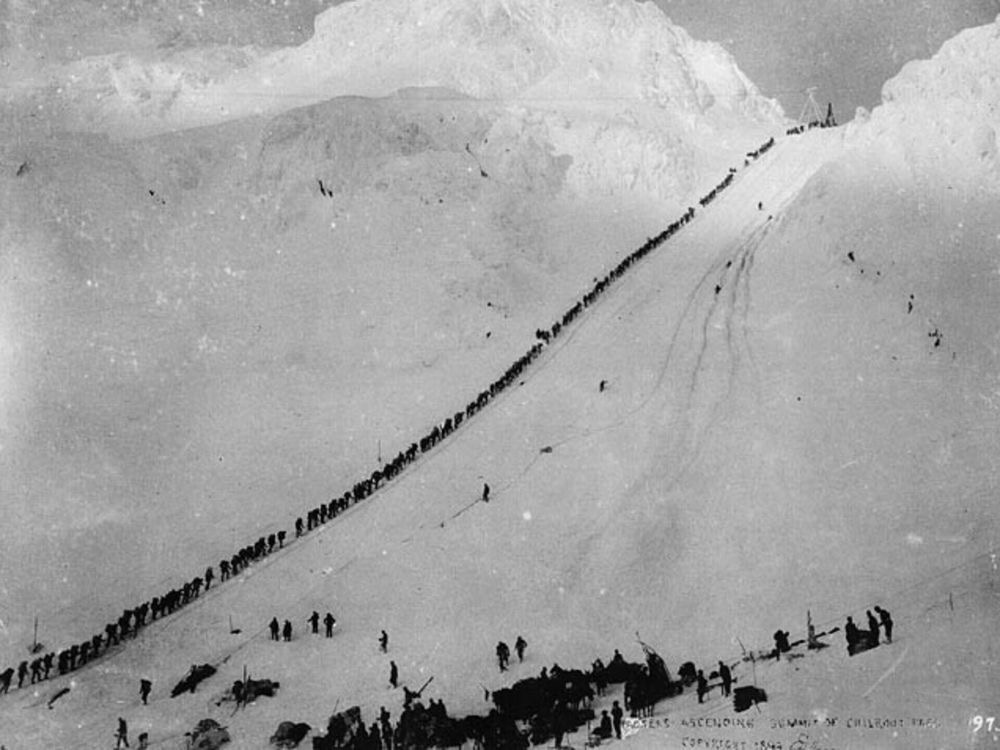
    Klondikers carrying supplies ascending the Chilkoot Pass, 1898.
    Source

    Today’s first question relates to 17 August and the subsequent ones follow on from the first.

    One

    Set during the Klondike Gold Rush, complete the title of British-Canadian poet Robert Service’s The Shooting of …?

    Answer: Dan McGrew.

    Gold found in 1896 launched the Klondike Gold Rush. Robert William Service, an English-born Canadian writer, became well known for his Klondike poems, including The Shooting of Dan McGrew and The Cremation of Sam McGee. Commercial success from collections such as Songs of a Sourdough allowed for travel and a leisurely life.


    Two

    Which nesosilicate mineral derives its name from the Persian word for ‘gold-hued’?

    Answer: Zircon.

    Zircon is a tetragonal nesosilicate (ZrSiO₄) yielding zirconium and containing hafnium at 1–4%. It precipitates from silicate melts and occurs in varied colours. The name comes from Persian zargun (“gold-hued”), becoming jargoon for light zircons; English zircon derives from German Zirkon.


    Three

    Which Persian king, ruler of the Achaemenid Empire, was assassinated in 465BC by Artabanus, the commander of the royal guard?

    Answer: Xerxes I or Xerxes the Great.

    Founded by Cyrus the Great in 550 BC, the Achaemenid Empire became the largest of its time, spanning from the Balkans to the Indus Valley. Alexander the Great conquered it in 330 BC; later, the Parthian Empire emerged. Its bureaucracy, tolerance and infrastructure influenced later empires.


    Four

    Alexander the Great extended the Macedonian kingdom as far east as what modern country?

    Answer: India.

    The Beas River, in Himachal Pradesh and Punjab in northwestern India, marked Alexander the Great’s eastern limit in 326 BC after his troops mutinied at Mukerian. Alexander yielded after three days and raised twelve altars; their fate is unknown.


    Five

    What novel by Herman Wouk, which is about a mutiny, was turned into a 1954 film starring Humphrey Bogart?

    Answer: The Caine Mutiny.

    Herman Wouk’s 1951 novel The Caine Mutiny draws on Pacific Theater service to explore officers’ moral choices. A legalistic mutiny during Typhoon Cobra leads to a court-martial climax.


    One Thing Leads to Another

    The post title points to a trail through the questions. One is set during the Klondike Gold Rush; Two derives from Persian for ‘gold-hued’; Three is about a Persian king of the Achaemenid Empire; Four is about the conqueror of the Achaemenid Empire facing a mutiny; and Five is about a fictional mutiny.


  • One Thing Leads to Another

    Question One.
    Klondikers carrying supplies ascending the Chilkoot Pass, 1898.
    Source

    Today’s first question relates to 17 August and the subsequent ones follow on from the first.

    One

    Set during the Klondike Gold Rush, complete the title of British-Canadian poet Robert Service’s The Shooting of …?


    Two

    Which nesosilicate mineral derives its name from the Persian word for ‘gold-hued’?


    Three

    Which Persian king, ruler of the Achaemenid Empire, was assassinated in 465BC by Artabanus, the commander of the royal guard?


    Four

    Alexander the Great extended the Macedonian kingdom as far east as what modern country?


    Five

    What novel by Herman Wouk, which is about a mutiny, was turned into a 1954 film starring Humphrey Bogart?


    Good luck! I’ll post the answers later.


  • Poetic Justice — Answers

    Here are today’s answers.

    Of Mice and Men.
    Image Wikimedia Commons

    Today’s questions all have a poetry connection.

    One

    What four word phrase links Scottish poet Robert Burns and the American writer John Steinbeck?

    Answer: Of Mice and Men.

    Steinbeck’s 1937 novella Of Mice and Men took its title from the second last verse of Burns’ 1785 To a Mouse.

    To a Mouse

    On turning her up in her nest with the plough, November 1785

    But, Mousie, thou art no thy lane,
    In proving foresight may be vain:
    The best laid schemes o’ mice an’ men,
    Gang aft a-gley,
    An’ lea’e us nought but grief and pain,
    For promis’d joy.
    — Robert Burns.

    The full poem can be found at Project Gutenberg


    Two

    In 1939, Ernest Hemingway drew inspiration for the title of his novel For Whom the Bell Tolls from a poem by what 17th-century English poet.

    Answer: John Donne.

    Donne’s Meditation XVII of Devotions upon Emergent Occasions was the source. In his epigraph to the novel Hemingway quotes part of this meditation

    No man is an Island, intire of it selfe; every man is a piece of the Continent, a part of the maine; if a Clod bee washed away by the SeaEurope is the lesse, as well as if a Promontorie were, as well as if a Mannor of thy friends or of thine owne were; any mans death diminishes me, because I am involved in Mankinde; And therefore never send to know for whom the bell tolls; It tolls for thee.


    Three

    I Know Why the Caged Bird Sings is the first volume of a seven-volume autobiography by an American writer and poet. The title is taken from the work of African-American poet Laurence Dunbar. Who is this writer and poet?

    Answer: Maya Angelou.

    Sympathy

    I know why the caged bird sings, ah me,
    When his wing is bruised and his bosom sore,
    When he beats his bars and would be free;
    It is not a carol of joy or glee,
    But a prayer that he sends from his heart’s deep core,
    But a plea, that upward to Heaven he flings—
    I know why the caged bird sings.
    — Laurence Dunbar


    Four

    The 2005 book No Country for Old Men and its Coen Brothers film are titled after the first line of the poem Sailing to Byzantium by an Irish poet (1865-1939). Who was this poet?

    Answer: William Butler Yeats.

    The title is taken from the opening line of William Butler Yeats’ poem Sailing to Byzantium.

    Sailing to Byzantium
    That is no country for old men. The young
    In one another’s arms, birds in the trees
    – Those dying generations – at their song,
    The salmon-falls, the mackerel-crowded seas,
    Fish, flesh, or fowl, commend all summer long
    Whatever is begotten, born, and dies.
    Caught in that sensual music all neglect
    Monuments of unageing intellect.
    — W.B. Yeats


    Five

    Aldous Huxley took the title for his 1932 novel Brave New World from the works of William Shakespeare. What work provided the title?

    Answer: The Tempest.

    The title Brave New World derives from William Shakespeare’s The Tempest, Act V, Scene I, Miranda’s speech.

    O wonder!
    How many goodly creatures are there here!
    How beauteous mankind is! O brave new world,
    That has such people in ‘t.
    — William Shakespeare, The Tempest, Act V, Scene I, ll. 203–206


  • Poetic Justice

    Of Mice and Men.
    Image Wikimedia Commons

    Today’s questions all have a poetry connection.

    One

    What four word phrase links Scottish poet Robert Burns and the American writer John Steinbeck?


    Two

    In 1939, Ernest Hemingway drew inspiration for the title of his novel For Whom the Bell Tolls from a poem by what 17th-century English poet.


    Three

    I Know Why the Caged Bird Sings is the first volume of a seven-volume autobiography by an American writer and poet. The title is taken from the work of African-American poet Laurence Dunbar. Who is this writer and poet?


    Four

    The 2005 book No Country for Old Men and its Coen Brothers film are titled after the first line of the poem Sailing to Byzantium by an Irish poet (1865-1939). Who was this poet?


    Five

    Aldous Huxley took the title for his 1932 novel Brave New World from the works of William Shakespeare. What work provided the title?


    Good luck! I’ll post the answers later.


  • Now I am Become Death, the Destroyer of Worlds — Answers

    Here are today’s answers.

    Trinity Test, Jack W. Aeby, July 16, 1945.
    Image Wikimedia Commons

    The first question relates to today’s date, 16 July. The subsequent questions follow a theme established by the first.

    One

    The world’s first atomic bomb exploded in a test on 16 July. 

    • What code name was given to the test?
    • In what year was the test?, and
    • In what U.S. state was the test site located?

    Answers

    • Trinity
    • 1945
    • New Mexico

    The Trinity test, the first nuclear detonation, occurred on July 16, 1945, in New Mexico as part of the Manhattan Project. Directed by Kenneth Bainbridge, it tested an implosion-design plutonium bomb, releasing 25 kilotons of energy and creating trinitite. Observed by 425 people, the site became a National Historic Landmark in 1965. The Manhattan Project established Los Alamos for nuclear weapon development, leading to the first atomic bomb, Gadget, tested at the Trinity Site. The Trinity Site is now a national historic landmark with limited public access.


    Two

    When asked why he chose the nuclear test code name referred to in question one above, Robert Oppenheimer alluded to the work of which English poet?

    Answer: John Donne.

    In 1962 Oppenheimer said:

    Why I chose the name is not clear, but I know what thoughts were in my mind. There is a poem of John Donne, written just before his death, which I know and love.” Oppenheimer then quoted the sonnet “Hymn to God, My God, in My Sickness” about a man unafraid to die because he believed in resurrection.

    Oppenheimer continued: 

    That still does not make a Trinity, but in another, better-known devotional poem Donne opens, ‘Batter my heart, three person’d God.’ Beyond this, I have no clues whatever.
    — Los Alamos National Laboratory


    Three

    Who is traditionally said to have used a clover-like plant, which is now a national symbol, as a metaphor for a Christian doctrine, and what was the plant?

    Answer: St. Patrick; shamrock.

    In 5th-century Ireland, Saint Patrick reportedly used the shamrock to explain the Holy Trinity to pagans. Today, the shamrock is Ireland’s national symbol and a key emblem of Saint Patrick’s Day, celebrated worldwide with parades and festivities.


    Four

    Which charity is the official authority for lighthouses in England and Wales?

    Answer: Trinity House.

    Trinity House, established in 1514, is the UK’s largest maritime charity and General Lighthouse Authority for England, Wales, the Channel Islands, and Gibraltar. It ensures maritime safety through navigation aids, pilot licensing, and audits. Annually, it donates £4m to support cadet training, retired mariners’ welfare, and sea safety education.


    Five

    Of the seven surviving British and Irish medieval and early modern universities founded before 1600 AD, one with a name appropriate for this theme was founded in 1592. Under what name was this 1592 establishment founded?

    Answer: Trinity College Dublin (Coláiste na Tríonóide, Baile Átha Cliath).

    (or in full The Provost, Fellows and Scholars of the College of the Holy and Undivided Trinity of Queen Elizabeth near Dublin (Coláiste Thríonóid Naofa Neamhroinnte na Banríona Eilís gar do Bhaile Átha Cliath)).

    Trinity College Dublin, founded in 1592 by Queen Elizabeth I, is Ireland’s oldest university and a member of LERU and the Coimbra Group. It houses the Book of Kells and has notable alumni like Oscar Wilde and Jonathan Swift. The college, a major tourist destination, has an academic partnership with Oxford and Cambridge.


    Now I am Become Death, the Destroyer of Worlds

    Robert Oppenheimer later recalled a moment, after the Trinity Test, when the line ‘Now I am Become Death, the Destroyer of Worlds’ from the Hindu scripture the Bhagavad Gita came to mind.


  • Now I am Become Death, the Destroyer of Worlds

    Trinity Test, Jack W. Aeby, July 16, ?
    Image Wikimedia Commons

    The first question relates to today’s date, 16 July. The subsequent questions follow a theme established by the first.

    One

    The world’s first atomic bomb exploded in a test on 16 July. 

    • What code name was given to the test?
    • In what year was the test?, and
    • In what U.S. state was the test site located?

    Two

    When asked why he chose the nuclear test code name referred to in question one above, Robert Oppenheimer alluded to the work of which English poet?


    Three

    Who is traditionally said to have used a clover-like plant, which is now a national symbol, as a metaphor for a Christian doctrine, and what was the plant?


    Four

    Which charity is the official authority for lighthouses in England and Wales?


    Five

    Of the seven surviving British and Irish medieval and early modern universities founded before 1600 AD, one with a name appropriate for this theme was founded in 1592. Under what name was this 1592 establishment founded?


    Good luck! I’ll post the answers later.


  • Let Me Count the Days — Answers

    Here are the answers to the earlier questions.

    Bear Garden (left) and Globe Theatre (right), Southwark, London. Engraving, 1597.
    Image Encyclopædia Britannica

    Today’s selection of trivia is all related to the date, 29 June.

    One

    London’s Globe Theatre was destroyed by fire in 1613, which took hold during a performance of William Shakespeare’s Henry VIII. What caused the fire?

    Answer: Cannon fire.

    A theatrical cannon misfired during a performance, causing a fire in the wooden beams and thatching. Only one person was injured, with his burning breeches extinguished by ale. The building was rebuilt the next year with a tile roof, costing £1,400.


    Two

    Brazil won their first FIFA World Cup on this day. In what year was this victory, and who were their defeated opponents in the final?

    Answer: 1958; Sweden.

    The 1958 FIFA World Cup final in Sweden saw Brazil win their first title by defeating the hosts. The match, which was the first final between European and American teams, set records for goals, winning margin, and age of the youngest and oldest goal scorers. Pelé was only 17 years and 249 days old, while Nils Liedholm was 18 years and 15 days older than Pelé at 35 years and 263 days.


    Three

    In 1534, Canada’s Prince Edward Island was ‘discovered’ by Europeans. In 1908, a Canadian author wrote a children’s novel about an orphan sent to live at Avonlea, PEI. Who made the 1534 discovery; who was the author, and what was the title of the 1908 novel?

    Answer: Jacques Cartier; Lucy Maud Montgomery and Anne of Green Gables.

    Lucy Maud Montgomery, known as L. M. Montgomery, was a Canadian author famous for Anne of Green Gables (1908). She published 20 novels and over a thousand short stories and poems. Her work, set on Prince Edward Island, inspired adaptations and tourism.


    Four

    Born in 1978, Nicole Scherzinger played what role in the film Men in Black 3?

    Answer: Lilly Poison.

    Nicole Scherzinger is an American singer, actress, and television personality. She gained fame as the lead singer of the Pussycat Dolls and later pursued a successful solo career. Scherzinger has also served as a judge on various talent shows and has received numerous accolades for her work in music and theatre.


    Five

    On this day in 1861, in Florence, Italy, an English poet died at the age of 55. She was living in Florence with her English husband, also a poet. She is known for the line, ’How do I love thee? Let me count the ways’, which, in part, has been used in the title of several works of music and literature? Who is this poet?

    Answer: Elizabeth Barrett Browning.

    Elizabeth Barrett Browning, an English poet, is celebrated for Sonnets from the Portuguese and Aurora Leigh, an early feminist text. Despite a spinal injury at 15, she married Robert Browning in 1846, moved to Florence, and engaged in Italian politics. Her influential work advocated social reforms, impacting slavery and child labour laws.


  • Let Me Count the Days

    Bear Garden (left) and Globe Theatre (right), Southwark, London. Engraving, 1597.
    Image Encyclopædia Britannica

    Today’s selection of trivia is all related to the date, 29 June.

    One

    London’s Globe Theatre was destroyed by fire in 1613, which took hold during a performance of William Shakespeare’s Henry VIII. What caused the fire?


    Two

    Brazil won their first FIFA World Cup on this day. In what year was this victory, and who were their defeated opponents in the final?


    Three

    In 1534, Canada’s Prince Edward Island was ‘discovered’ by Europeans. In 1908, a Canadian author wrote a children’s novel about an orphan sent to live at Avonlea, PEI. Who made the 1534 discovery; who was the author, and what was the title of the 1908 novel?


    Four

    Born in 1978, Nicole Scherzinger played what role in the film Men in Black 3?


    Five

    On this day in 1861, in Florence, Italy, an English poet died at the age of 55. She was living in Florence with her English husband, also a poet. She is known for the line, ’How do I love thee? Let me count the ways’, which, in part, has been used in the title of several works of music and literature? Who is this poet?


    Good luck! I’ll post the answers later.


  • Poetic Licence — Answers

    Here are the answers to today’s questions.

    H.M.S. Pinafore; or, The Lass That Loved a Sailor, theatrical poster.
    Image Wikimedia Commons

    All of these questions are related to today’s date, May 25th.


    One

    What was the first X-rated film to win the Academy Award for best picture?

    Midnight Cowboy.

    Released on this day in 1969, Midnight Cowboy, directed by John Schlesinger, stars Dustin Hoffman and Jon Voight as New York hustlers. It won three Academy Awards, including Best Picture, and is the only X-rated film to do so. Ranked 36th and 43rd on AFI’s lists, it was preserved in the U.S. National Film Registry in 1994.
    X-certification has been renamed in some domains; for example, in the U.K., it is now an 18 certificate, which is suitable only for persons aged 18 years and over, and in the U.S., NC-17, No one 17 and under admitted.


    Two

    He did not wear his scarlet coat,
    For blood and wine are red,
    And blood and wine were on his hands
    When they found him with the dead,
    The poor dead woman whom he loved,
    And murdered in her bed.

    The above lines are the opening verse of an 1897 poem which was published under the pseudonym C.3.3. What is the poem, and who wrote it?

    Answer: The Ballad of Reading Gaol by Oscar Wilde.

    On 25 May 1895, Wilde had been convicted of ‘committing acts of gross indecency with certain male persons’, sentenced to two years’ hard labour; he served the majority of his sentence in Reading Gaol. His poem, The Ballad of Reading Gaol, which was written after his release from prison, narrates the execution of Charles Thomas Wooldridge. It highlights the brutalisation of punishment and Wilde’s identification with prisoners. Published in 1898, under the pseudonym C.3.3. — his prison identification by which he was addressed — it remained anonymous until Wilde’s identity as author was revealed in 1899. The poem, which sold well, provided Wilde with an income for life.


    Three

    The author who created the character Jason Bourne in a 1980 novel was born in 1927. Who was this author?

    Answer: Robert Ludlum.

    Robert Ludlum, an American author known for his spy thrillers, wrote best-sellers like The Bourne Identity and The Scarlatti Inheritance. Despite criticism of his plots and prose, his fast-paced espionage novels were immensely popular. He authored 27 thriller novels, including the Jason Bourne series, which have been published in 33 languages and sold an estimated 300-500 million copies.


    Four

    An actor, born in 1939, links the roles of John Profumo in 1989, Mithrandir (2001), and Leigh Teabing (2006). What actor?

    Answer: Ian McKellen.

    Ian McKellen, who was born in England on this day in 1939, played John Profumo in Scandal (1989). In 2001, he took on the role of Gandalf the Grey in The Lord of the Rings: The Fellowship of the Ring — Mithrandir is how Gandalf is known by the Elves in their Sindarin language. He portrayed Sir Leigh Teabing in The Da Vinci Code (2006).


    Five

    …; or, The Lass That Loved a Sailor, a comic opera, debuted in London in 1878. What has been omitted from the beginning of the opera’s title?

    Answer: H.M.S. Pinafore.

    H.M.S. Pinafore; or, The Lass That Loved a Sailor, a comic opera by Gilbert and Sullivan, premiered in 1878, running for 571 performances. Set on a Royal Navy ship, it humorously critiques the British class system and authority. Its success led to other popular works, influencing modern musical theatre.


  • Poetic Licence

    …; or, The Lass That Loved a Sailor, theatrical poster (cropped). See question five.
    Image Wikimedia Commons

    All of these questions are related to today’s date, May 25th.


    One

    What was the first X-rated film to win the Academy Award for best picture?


    Two

    He did not wear his scarlet coat,
    For blood and wine are red,
    And blood and wine were on his hands
    When they found him with the dead,
    The poor dead woman whom he loved,
    And murdered in her bed.

    The above lines are the opening verse of an 1897 poem which was published under the pseudonym C.3.3. What is the poem, and who wrote it?


    Three

    The author who created the character Jason Bourne in a 1980 novel was born in 1927. Who was this author?


    Four

    An actor, born in 1939, links the roles of John Profumo in 1989, Mithrandir (2001), and Leigh Teabing (2006). What actor?


    Five

    …; or, The Lass That Loved a Sailor, a comic opera, debuted in London in 1878. What has been omitted from the beginning of the opera’s title?


    Good luck! I’ll post the answers later.