See question five. The world’s seventh-highest mountain 8167 m above sea level. Image Wikimedia Commons
Today’s date-related questions are all connected to May 13th.
One
In 1637, according to tradition France’s Cardinal Richelieu invented the table knife by having the tips of knives rounded. He did this to prevent what?
Two
On this day in 1940, some eight months into World War II, Winston Churchill faced the United Kingdom’s House of Commons for the first time as prime minister and informed them that “I have nothing to offer but …, …, … and ….” What four words have been removed from this quotation?
Three
97-year-old Doris von Kappelhoff died on this day in 2019. Who was she better known as?
Four
In 1981, the pope survived an assassination attempt. What pope and where did this happen?
Five
The world’s seventh-highest mountain above sea level has several peaks exceeding 25,000 feet (7,620 m) and one at 26,795 feet (8,167 m). It has a name meaning ‘white mountain’; what is that name?
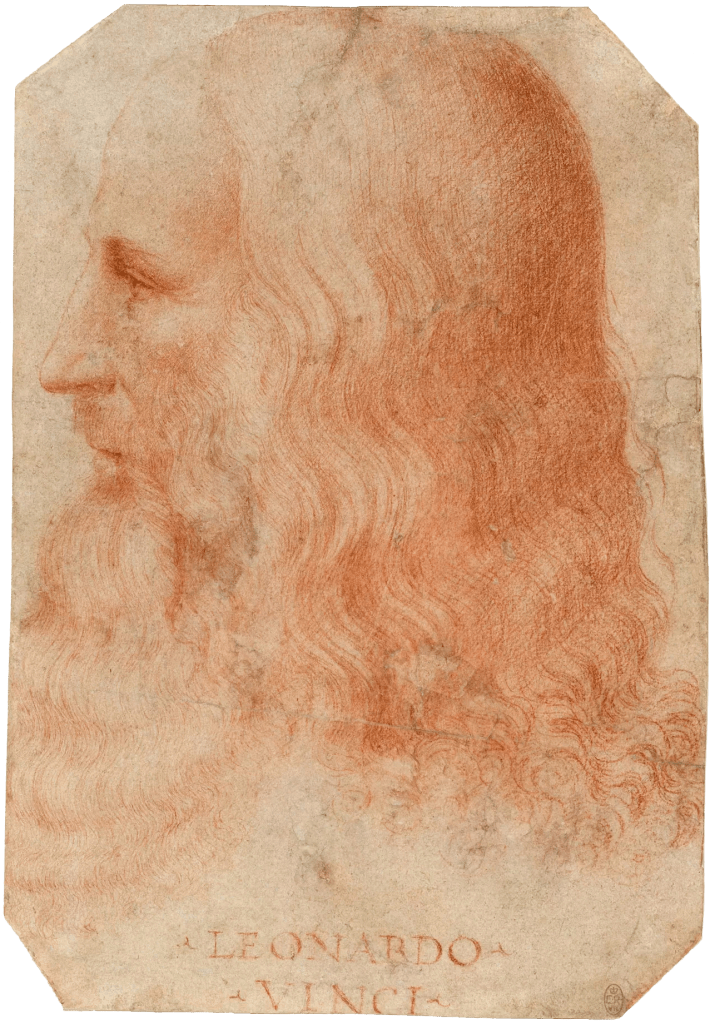
Portrait of Leonardo da Vinci (c. 1515–1518), attributed to Francesco Melzi. Royal Collection, United Kingdom. Image Wikimedia Commons
Here are five questions all connected to today, May 2nd.
One
Leonardo da Vinci, artist, architect and engineer, died on this day. In what century, and in what country, did he die?
Answer: 16th century; France.
He died on 2 May 1519 aged 67, Clos-Lucé, France. Leonardo da Vinci, an Italian Renaissance artist and inventor, epitomised the humanist ideal with his diverse talents in painting, sculpture, architecture, and engineering. His insatiable curiosity and mastery of observation fuelled his artistic and scientific pursuits, making him a true Renaissance man. Invited by King Francis I, Leonardo spent the last three years of his life in France, where he continued to work on unfinished paintings and scientific studies, and created his last series of artworks, Visions of the End of the World, showcasing his mastery of expression and imagination. Leonardo died at Cloux and was buried in the palace church of Saint-Florentin, though his grave is now lost.
Two
The King James Version of the Bible was published. In what decade was this, or as second prize, what century?
Answer: 1610s; 17th century.
The King James Version (KJV) of the Bible, published in 1611 under King James I, was a revision of the Protestant Bible in English, addressing perceived corruption in existing translations. Approved in 1604, 47 scholars, divided into six companies, worked on the translation at Westminster, Oxford, and Cambridge. The KJV sought to be scholarly, nonpartisan, and faithful to the original languages, aiming to popularise the Scriptures. It became the standard English Bible from the mid-17th to early 20th century, influencing English literary style. Authorised for the Church of England, it remains favoured by many Christian fundamentalists.
Three
Anne Boleyn was imprisoned in the Tower of London. Who was her predecessor as Queen and who succeeded her?
Answer: Catherine of Aragon; Jane Seymour.
Anne Boleyn (c. 1501 or 1507 – 19 May 1536) was Henry VIII’s second wife and mother of Elizabeth I. Her marriage and execution were pivotal in the English Reformation. Educated in Europe, Anne resisted Henry’s advances until he sought an annulment from Catherine of Aragon to marry her. This led to the Church of England’s break from Rome. Anne married Henry secretly in 1532, officially in 1533, and was crowned queen. Despite giving birth to Elizabeth, she failed to produce a male heir. Accused of adultery and treason, she was executed in 1536. Posthumously, she became a Reformation martyr, inspiring cultural works. Henry married Jane Seymour eleven days after Anne’s execution.
Four
On this day, a De Havilland Comet became the first jetliner to carry fare-paying passengers. The flight took place in what year and departed from where, with its destination being where?
Answer: 1952; London to Johannesburg.
The de Havilland DH.106 Comet, the first commercial jet airliner, debuted in 1952. After fatal accidents due to metal fatigue, it was redesigned. The Comet 4 series, launched in 1958, served until 1981. Adapted for military roles, the Nimrod variant operated until 2011, highlighting its lasting impact.
Five
Born in 2015, who on their eleventh birthday is third in line of succession to the British throne? Secondly, who is the highest ranked non-titled person to currently appear on the line of succession?
Answer: Princess Charlotte of Wales; Andrew Mountbatten-Windsor.
Portrait of Leonardo da Vinci (c. 1515–1518), attributed to Francesco Melzi. Royal Collection, United Kingdom. Image Wikimedia Commons
Here are five questions all connected to today, May 2nd.
One
Leonardo da Vinci, artist, architect and engineer, died on this day. In what century, and in what country, did he die?
Two
The King James Version of the Bible was published. In what decade was this, or as second prize, what century?
Three
Anne Boleyn was imprisoned in the Tower of London. Who was her predecessor as Queen and who succeeded her?
Four
On this day, a De Havilland Comet became the first jetliner to carry fare-paying passengers. The flight took place in what year and departed from where, with its destination being where?
Five
Born in 2015, who on their eleventh birthday is third in line of succession to the British throne? Secondly, who is the highest ranked non-titled person to currently appear on the line of succession?
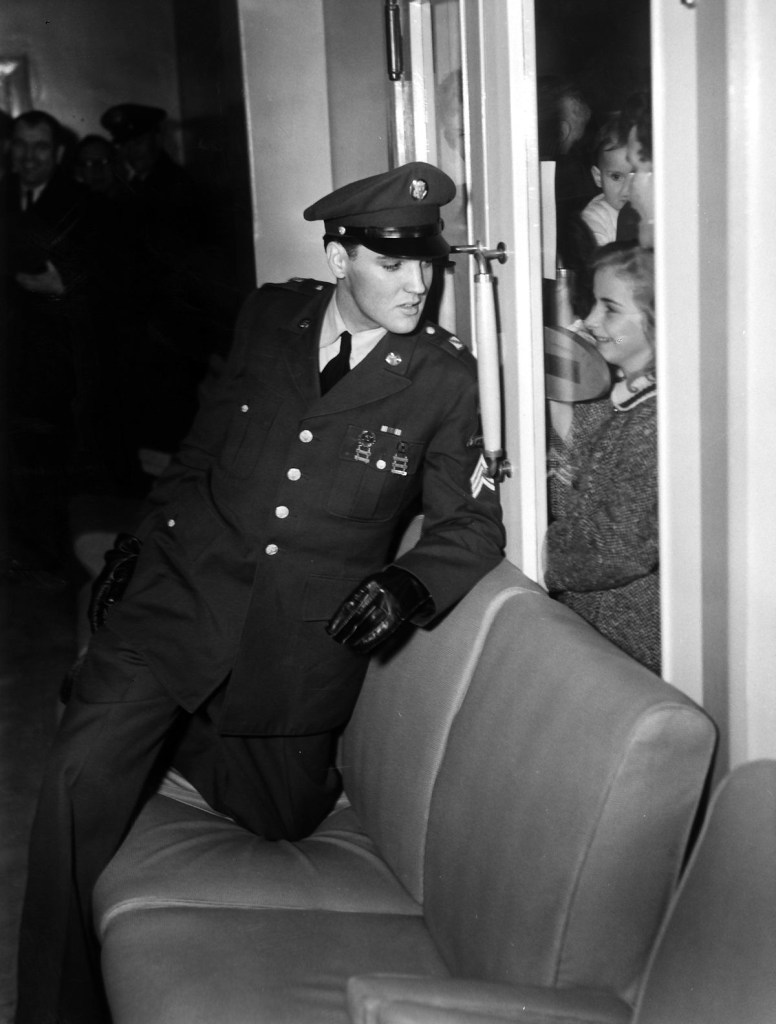
Elvis at Prestwick Airport, 3 March 1960. See question four. Image Daily Record.
No date-related theme today, just five very random questions for you to ponder.
One
Johann Ludwig Burckhardt is best known for rediscovering two of the world’s best-known examples of rock-cut architecture in Jordan in 1812 and Egypt the following year. What are these examples of rock-cut architecture?
Answers: Petra and Abu Simbel.
Johann Ludwig Burckhardt (1784 – 1817) was a Swiss traveller, geographer and Orientalist. During his travels in Arabia, he adopted the alias Sheikh Ibrahim Ibn Abdallah and wrote his letters in French, signing them Louis. He is best known for rediscovering two of the world’s most famous examples of rock-cut architecture: the ruins of Petra, an ancient Nabataean city in Jordan, and the temples of Abu Simbel in Egypt. Petra remained unknown to the Western world until 1812, when Burckhardt rediscovered it. The Great Temple at Abu Simbel remained unknown to Europeans until March 1813, when Burckhardt found the small temple and top frieze of the main temple.
Two
‘I can resist everything except temptation’ is a line from what play and who wrote it?
Answer: Lady Windermere’s Fan, A Play About a Good Woman by Oscar Wilde.
Lady Windermere’s Fan, A Play About a Good Woman is a four-act comedy by Oscar Wilde, debuting on 20 February 1892 at London’s St James’s Theatre. Lady Windermere suspects her husband of infidelity and plans to leave him for Lord Darlington. Mrs. Erlynne, the other woman, intervenes, revealing herself as Lady Windermere’s mother. She sacrifices her reputation to save the marriage, allowing Lady Windermere to return to her husband unnoticed.
Three
What religious organisation was founded by Josemaría Escrivá de Balaguer y Alba?
Answer: Opus Dei.
Opus Dei, founded in 1928 by Josemaría Escrivá, is a Catholic Church personal prelature promoting holiness through daily life. Approved by the Holy See in 1950 and affirmed in 1982, it faces controversy over abuse allegations. Members, mostly laypeople, engage in secular careers and spiritual training globally.
Four
Elvis Presley and the beginnings of Open Golf are both linked to what town?
Answer: Prestwick.
Prestwick, a town in South Ayrshire on Scotland’s west coast, is approximately 30 miles (50 kilometres) southwest of Glasgow. The Prestwick Old Course hosted the inaugural Open Golf Championship in 1860 and was the venue for the first twelve Open Championships from 1860 to 1872, although the event did not take place in 1871. During World War II, the US Army Air Corps set up and maintained a base at the airport. Elvis Presley made his only visit to the UK on 3 March 1960 when his US Army transport aircraft stopped at the airport for refuelling en route from Germany.
Five
Who in 1762 succeeded Peter III, Emperor of Russia, and what relationship was the successor to Peter?
Answers: Catherine II (the Great); his wife.
Peter III, Emperor of Russia for six months in 1762, was overthrown by his wife, Catherine the Great. Despite implementing notable reforms, he is criticised for his alliance with Prussia. On 28 June 1762, Catherine was proclaimed heir to the Russian throne. Peter attempted to flee to Kronstadt but was repelled by the fleet’s cannons. The people of St. Petersburg armed themselves against him. After losing support from the Senate, army, and fleet, Peter was arrested and abdicated on 9 July. He was transported to Ropsha, where he died under mysterious circumstances. Officially, he died from haemorrhoidal colic and a stroke, but assassination is suspected. Some accounts suggest suffocation attempts followed by strangulation. He was buried on 3 August 1762 in the Alexander Nevsky Monastery, Saint Petersburg.
No date-related theme today, just five very random questions for you to ponder.
One
Johann Ludwig Burckhardt is best known for rediscovering two of the world’s best-known examples of rock-cut architecture in Jordan in 1812 and Egypt the following year. What are these examples of rock-cut architecture?
Two
‘I can resist everything except temptation’ is a line from what play and who wrote it?
Three
What religious organisation was founded by Josemaría Escrivá de Balaguer y Alba?
Four
Elvis Presley and the beginnings of Open Golf are both linked to what town?
Five
Who in 1762 succeeded Peter III, Emperor of Russia, and what relationship was the successor to Peter?
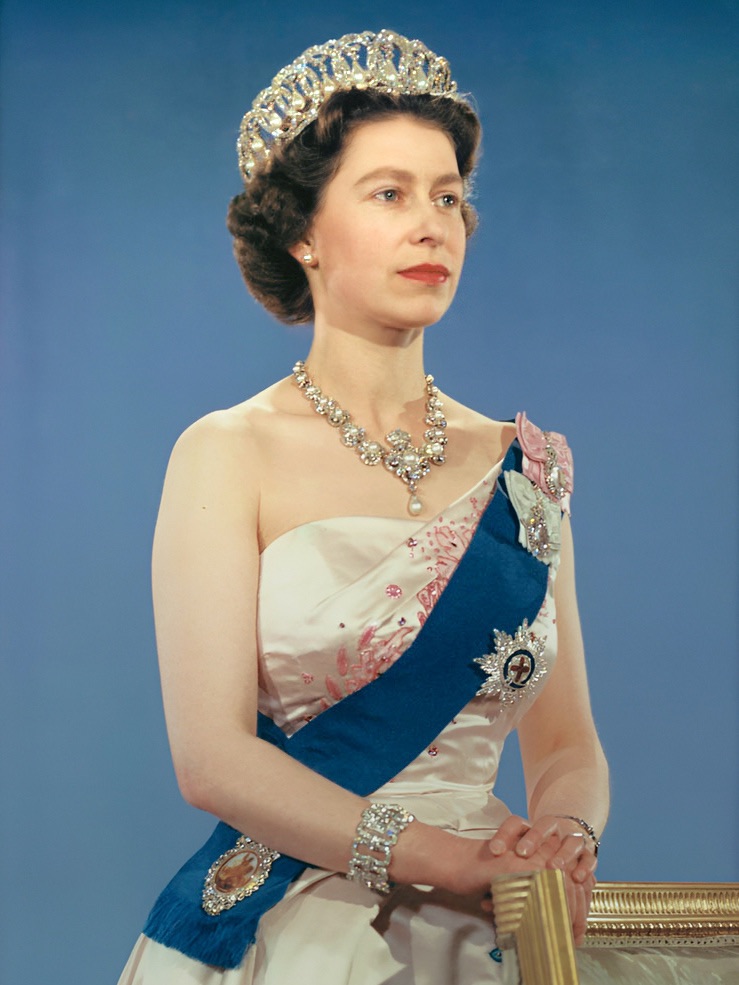
Queen Elizabeth II of the United Kingdom was born on 21 April 1926. To the nearest year how long did she reign?
Answer: 71 years.
Elizabeth II, born on 21 April 1926, was Queen of the United Kingdom and other Commonwealth realms from 1952 until her death in 2022 — 70 years and 214 days — the longest reign of any British monarch. She was queen regnant of 32 states and monarch of 15 at her death. Educated privately, she served in World War II and married Philip Mountbatten in 1947. Her reign saw significant political changes and historic visits. Despite challenges, her popularity remained high. She died at 96, succeeded by Charles III.
Two
On this day In 1918, the Red Baron, Manfred von Richthofen, Germany’s top World War I flying ace, was shot down and killed near Amiens, France. What act had a novelty song Snoopy vs. The Red Baron in the 1966 charts?
Answer: The Royal Guardsmen.
Snoopy vs. the Red Baron is a 1966 novelty song by The Royal Guardsmen, peaking at No.2 on the Hot 100 and No.1 in Australia and Canada. It sold nearly three million copies. The band released other Snoopy-themed songs, including The Return of the Red Baron and Snoopy’s Christmas.
Three
What was the musical Annie based on, and what type of work was it?
Answer: Little Orphan Annie; Newspaper comic strip.
Annie is a musical with music by Charles Strouse, lyrics by Martin Charnin, and a book by Thomas Meehan, based on the 1924 comic strip Little Orphan Annie. It premiered in 1977, ran for nearly six years, won seven Tony Awards, and features popular songs like ‘Tomorrow‘ and ‘It’s the Hard Knock Life‘.
Four
Whose visit to a Caribbean Island nation in 1966 led to the annual celebration of April 21st as Grounation Day?
Answer: Haile Selassie.
In 1966, the Ethiopian emperor Haile Selassie I, believed by many Rastas to be the Second Coming of Christ, arrived in Jamaica for a visit. This event is now celebrated annually in the Rastafari movement as Grounation Day, specifically on April 21.
Five
According to legend Rome was founded in what century?
Answer: 8th Century BCE
Ancient Rome, spanning from 753 BCE to 476 CE, evolved from a small Italic settlement into a dominant Mediterranean power. It encompassed the Roman Kingdom, Republic, and Empire, controlling vast territories including North Africa, Egypt, and much of Europe. At its peak in CE 117, it covered 5 million square kilometres with 50-90 million people. Rome’s influence on language, law, architecture, and governance persists, inspiring modern republics and achieving remarkable technological feats like aqueducts and roads. In Ancient Rome, its founding by Romulus was celebrated annually on April 21st.
The Royal Guardsmen
The post title had nothing to do with question one, but everything to do with question two.
Queen Elizabeth II of the United Kingdom was born on 21 April 1926. To the nearest year how long did she reign?
Two
On this day In 1918, the Red Baron, Manfred von Richthofen, Germany’s top World War I flying ace, was shot down and killed near Amiens, France. What act had a novelty song Snoopy vs. The Red Baron in the 1966 charts?
Three
What was the musical Annie based on, and what type of work was it?
Four
Whose visit to a Caribbean Island nation in 1966 led to the annual celebration of April 21st as Grounation Day?
Five
According to legend Rome was founded in what century?
On 19 April 1999, in politics, what returned to Berlin for the first time in almost fifty years, and where had it returned from?
Answers: Bundestag; Bonn.
The first German Bundestag, the West German parliament, convened in Bonn on 7 September 1949. The Bundestag remained in Bonn until after reunification of Germany, when it returned to Berlin on 19 April 1999.
Two
In 1775, during the opening stages of a revolutionary war, a city was besieged for eleven months from April 19th. What city?
Answer: Boston.
The Siege of Boston (1775-1776) marked the start of the American Revolutionary War. American forces, led by George Washington, besieged the British Army in Boston, ultimately forcing their retreat to Nova Scotia after eleven months.
Three
Observed on April 19th, a celebratory day remembering an experiment where a chemist intentionally ingested LSD, documented it and then went home. What is the day called?
Answer: Bicycle Day.
On 19 April 1943, a few days after accidentally discovering LSD’s effects, which he believed had potential in psychiatry and neurology, Swiss chemist Albert Hofmann intentionally ingested it and documented the first acid trip. After this experiment, he cycled home, leading to the observance of Bicycle Day, as Encyclopædia Britannica comments, ‘And now April 19 is observed as Bicycle Day—mostly by LSD enthusiasts, not cyclists’.
Four
A poet and playwright who died this day in 1824, first became a celebrity with the publication of the first two cantos of Childe Harold’s Pilgrimage in 1812. Who is this poet?
Answer: Byron.
George Gordon Byron, a prominent British Romantic poet, is renowned for works like Don Juan and Childe Harold’s Pilgrimage. He lived in Italy for seven years, befriending Percy Bysshe Shelley, and later joined the Greek War of Independence, becoming a folk hero before his death at 36. Byron, along with Shelley and Keats, was a major figure in the second generation of English Romantic writers and was a literary celebrity known for both his poetry and personality.
Five
IIn 2011, Fidel Castro resigned from Cuba’s Communist Party central committee. The following March, in his role as an elder statesman, Castro briefly met a visiting dignitary, the sixteenth of the name. Who was this dignitary?
Answer: (Pope) Benedict XVI.
On 19 April 2011, Castro resigned from the Communist Party central committee, thus stepping down as First Secretary. Raúl was selected as his successor. Now without any official role in the country’s government, he took on the role of an elder statesman. In late March 2012, Pope Benedict XVI visited Cuba for three days, during which time he briefly met with Castro despite the Pope’s vocal opposition to Cuba’s government.
Bits and Bobs
The title is simply another way of saying bits and pieces, an assortment. It was chosen as the title as all the answers begin with the letter B.
On 19 April 1999, in politics, what returned to Berlin for the first time in almost fifty years, and where had it returned from?
Two
In 1775, during the opening stages of a revolutionary war, a city was besieged for eleven months from April 19th. What city?
Three
Observed on April 19th, a celebratory day remembering an experiment where a chemist intentionally ingested LSD, documented it and then went home. What is the day called?
Four
A poet and playwright who died this day in 1824, first became a celebrity with the publication of the first two cantos of Childe Harold’s Pilgrimage in 1812. Who is this poet?
Five
IIn 2011, Fidel Castro resigned from Cuba’s Communist Party central committee. The following March, in his role as an elder statesman, Castro briefly met a visiting dignitary, the sixteenth of the name. Who was this dignitary?
The first question today relates to the date, April 17th. The rest follows a theme but I’m not going to say what that theme is.
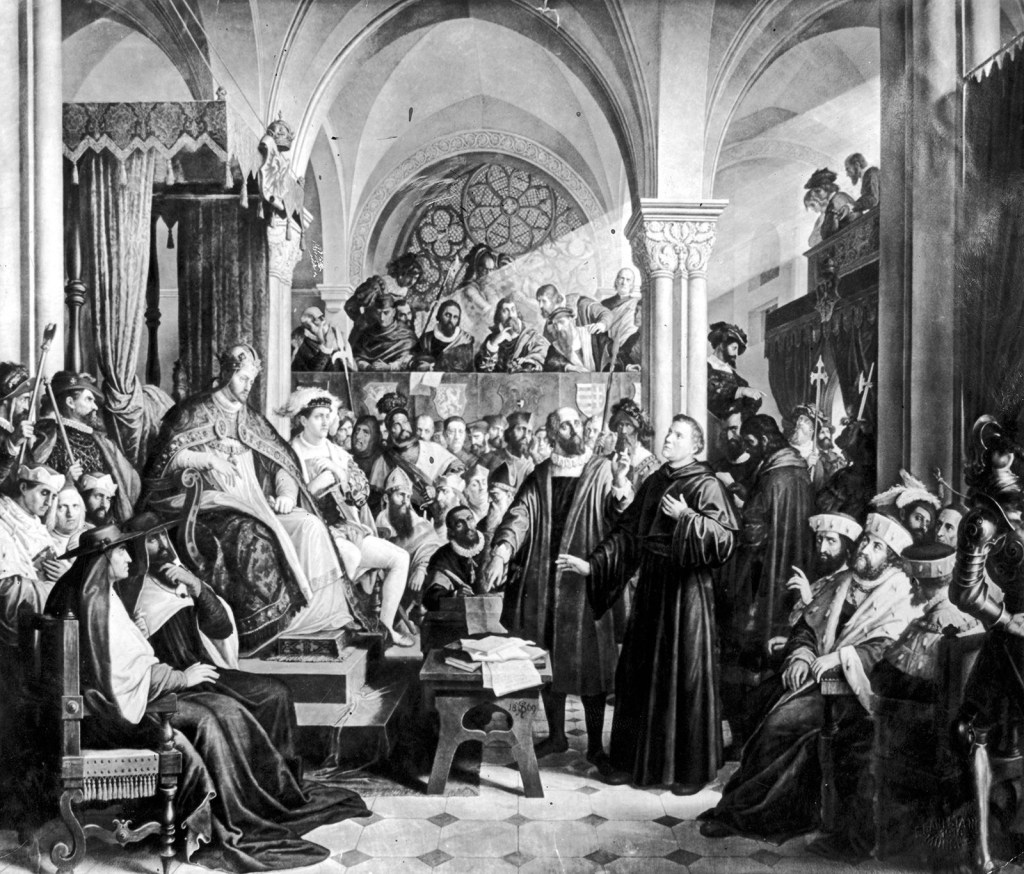
Martin Luther appearing before Charles V, Holy Roman Emperor, at the Diet of Worms. Image Encyclopædia Britannica
One
On 17 April 1521, Martin Luther made his initial appearance at the Diet of Worms which eventually found him to be a heretic and enemy of the state. In what modern country is Worms?
Answer: Germany.
Martin Luther, a German priest and theologian, was a key figure in the Protestant Reformation. He challenged the Catholic Church’s teachings, particularly on indulgences and papal authority, and translated the Bible into German, making it more accessible to ordinary people. Luther’s beliefs, emphasising justification by faith alone and the authority of the Bible, laid the foundation for Lutheranism.
Following on in the theme …
Two
Ben Ainslie is the most successful sailor in Olympic history. In what two classes did he win his four gold and one silver medal?
Answer: Laser and Finn.
Sir Charles Benedict Ainslie is a British competitive sailor and the most successful Olympian in sailing history. He is CEO of Athena Sports Group and a Patron of the 1851 Trust which supports young people in sailing and STEM education.
Three
List the stages of a butterfly’s life cycle?
Answer: Eggs, caterpillar larva, pupa and adult (or butterfly).
Butterflies undergo complete metamorphosis through a four-stage life cycle like other holometabolous insects. Winged adults lay eggs on plant leaves where their caterpillars, or larvae, will feed. These caterpillars grow rapidly and eventually pupate in a chrysalis. Once metamorphosis is complete the pupal skin splits revealing the adult butterfly which then climbs out, dries its wings and flies away.
Four
Name the planets in the solar system?
Answer: Mercury, Venus, Earth, Mars, Jupiter, Saturn, Uranus and Neptune.
The Solar System, formed 4.6 billion years ago, consists of the Sun and orbiting bodies, including eight planets. The Sun, comprising 99.86% of the system’s mass, fuses hydrogen into helium, creating the heliosphere. The system also includes dwarf planets, small bodies like asteroids and comets, and natural satellites, or moons.
Five
Can you name the states between Louisiana and Ohio in an alphabetical list of US states?
Answer: Maine, Maryland, Massachusetts, Michigan, Minnesota, Mississippi, Missouri, Montana, Nebraska, Nevada, New Hampshire, New Jersey, New Mexico, New York, North Carolina and North Dakota.
Sixteen states, eight with names starting with M and, eight with N.
Double Trouble
Today’s title refers to each question doubling the number of answers. Question one has only one answer which was obvious in the question and then number two asks for two answers. You had to work out that the remaining double each time so four, eight and finally sixteen for question five.