Here are the answers to the questions I posted earlier.
Today’s questions all relate to the date, November 22nd.

Image Wikipedia
One
The clipper Cutty Sark was launched in Dumbarton, Scotland, on 22 November 1869. Named after a garment in Robert Burns’ poem, what is the item of clothing and the poem?
Answer: A short shift(or shirt); Tam o’Shanter
Tam tint his reason a’ thegither,
And roars out, ‘Weel done, Cutty-sark!’
And in an instant all was dark:
And scarcely had he Maggie rallied.
When out the hellish legion sallied.
— a few lines from the 200+ that make up Tam 0’Shanter by Robert Burns. The full poem is at the bottom of this page.
Cutty Sark, a British clipper ship built in 1869, was one of the last and fastest tea clippers. After a brief career in the tea trade, she transported wool from Australia and later served as a training ship. Now a museum ship in Greenwich, London, she is one of only three remaining intact composite construction ships from the 19th century.
Two
Mount Merapi erupted on this date in 1994, resulting in the deaths of 64 people. On what island—the world’s most populous—is Mount Merapi located?
Answer: Java
Mount Merapi, an active stratovolcano on the island of Java in Indonesia, is the most active volcano in the country and has erupted regularly since 1548. Located near Yogyakarta, it poses significant hazards to the densely populated area, with eruptions causing fatalities and displacement. The volcano’s activity continues to be closely monitored by volcanologists.
Three
Which infamous pirate, also known as ‘Blackbeard’, was killed in a 1718 battle against Royal Navy Lieutenant Robert Maynard off the coast of North Carolina?
Answer: Edward Teach
Edward Teach, better known as Blackbeard, was an English pirate who operated around the West Indies and the eastern coast of Britain’s North American colonies. He captured a French slave ship, renamed it Queen Anne’s Revenge, and equipped it with 40 guns. Blackbeard was killed in action on 22 November 1718 following a battle with the Royal Navy’s Lieutenant Robert Maynard.
Four
By what pen name is the English novelist born in 1819—known for Middlemarch and pioneering psychological realism—better known?
Answer: George Eliot
Mary Ann Evans, better known by her pen name George Eliot, was a prominent Victorian novelist, poet, journalist and translator. She wrote seven novels, including the acclaimed Middlemarch, and was known for her realism and psychological insight. Eliot lived with George Henry Lewes as his conjugal partner for 24 years before marrying John Cross in 1880.
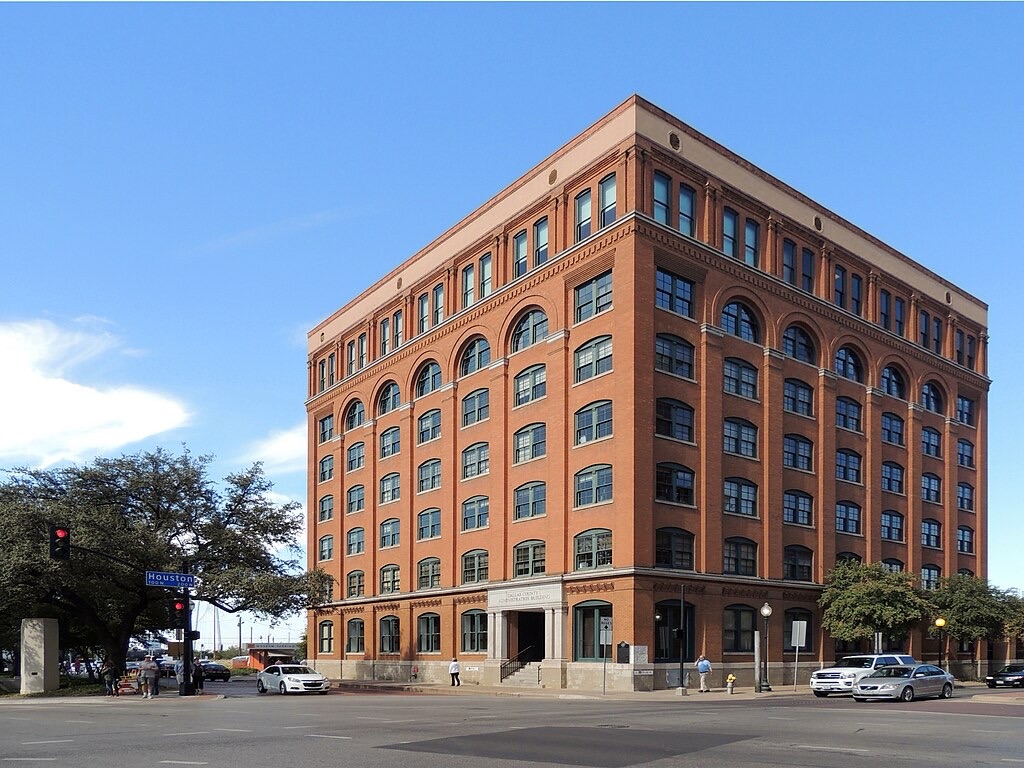
Now Dallas County Administration Building,2015.
Image Wikipedia
Five
On 22 November 1963, from which Texas building (pictured) did Lee Harvey Oswald fire?
Secondly, after fatally shooting Police Officer JD Tippit, what building did Oswald enter?
Answer: Texas School Book Depository; Texas Theatre (Movie Theatre (Cinema))
Oswald was working at the Texas School Book Depository when he allegedly fatally shot President John F Kennedy from a sixth floor window.
Less than an hour after the president’s assassination, Oswald was approached by Patrolman JD Tippit in Dallas’s Oak Cliff neighbourhood. Tippit then exited his vehicle and Oswald shot him three times in the chest. As Tippit lay on the ground, Oswald fired another shot to his head, instantly killing him.
The Texas Theatre, a Dallas landmark, is famous for Lee Harvey Oswald’s arrest. Today it shows repertory films and hosts events.
Tam o’ Shanter
By Robert Burns
(An alongside translation from Scots to English can be found here.)
Of Brownyis and of Bogillis full is this buke.
— Gawin Douglas

When chapman billies leave the street,
And drouthy neebors, neebors meet,
As market-days are wearing late,
An’ folk begin to tak the gate;
While we sit bousing at the nappy,
And getting fou and unco’ happy,
We think na on the lang Scots miles,
The mosses, waters, slaps and styles,
That lie between us and our hame,
Whare sits our sulky sullen dame,
Gathering her brows like gathering storm,
Nursing her wrath to keep it warm.

This truth fand honest Tam o’ Shanter,
As he frae Ayr ae night did canter,
(Auld Ayr, wham ne’er a town surpasses,
For honest men and bonny lasses.)

O Tam! hadst thou but been sae wise,
As ta’en thy ain wife Kate’s advice!
She taul thee weel thou was a skellum,
A blethering, blustering, drunken blellum;
That frae November till October,
Ae market-day thou was nae sober;

That ilka melder, wi’ the miller,
Thou sat as lang as thou had siller;
That every naig was ca’d a shoe on,
The smith and thee gat roaring fou on;
That at the L—d’s house, even on Sunday,
Thou drank wi’ Kirkton Jean till Monday.
She prophesied that late or soon,
Thou would be found deep drown’d in Doon;
Or catch’d wi’ warlocks in the mirk,
By Alloway’s auld haunted kirk.

Ah, gentle dames! it gars me greet,
To think how mony counsels sweet,
How mony lengthen’d sage advices,
The husband frae the wife despises!

But to our tale: Ae market-night,
Tam had got planted unco right;
Fast by an ingle, bleezing finely,
Wi’ reaming swats, that drank divinely;
And at his elbow, Souter Johnny,
His ancient, trusty, drouthy crony;
Tam lo’ed him like a vera brither;
They had been fou for weeks thegither.
The night drave on wi’ sangs and clatter;
And ay the ale was growing better:
The landlady and Tam grew gracious,
Wi’ favours, secret, sweet, and precious:
The Souter tauld his queerest stories;
The landlord’s laugh was ready chorus:
The storm without might rair and rustle,
Tam did na mind the storm a whistle.

Care, mad to see a man sae happy,
E’en drown’d himsel amang the nappy:
As bees flee hame wi’ lades o’ treasure,
The minutes wing’d their way wi’ pleasure;
Kings may be blest, but Tam was glorious,
O’er a’ the ills o’ life victorious!

But pleasures are like poppies spread,
You seize the flower, its bloom is shed;
Or like the snow falls in the river,
A moment white—then melts for ever;
Or like the borealis race,
That flit ere you can point their place;
Or like the rainbow’s lovely form
Evanishing amid the storm.—
Nae man can tether time or tide;
The hour approaches Tam maun ride;
That hour, o’ night’s black arch the key-stane,
That dreary hour he mounts his beast in;
And sic a night he taks the road in,
As ne’er poor sinner was abroad in.

The wind blew as ’twad blawn its last;
The rattling showers rose on the blast;
The speedy gleams the darkness swallow’d;
Loud, deep, and lang, the thunder bellow’d:
That night, a child might understand,
The Deil had business on his hand.

Weel mounted on his gray mare, Meg,
A better never lifted leg,
Tam skelpit on thro’ dub and mire,
Despising wind, and rain, and fire;
Whiles holding fast his gude blue bonnet;
Whiles crooning o’er some auld Scots sonnet;
Whiles glowring round wi’ prudent cares,
Lest bogles catch him unawares:
Kirk-Alloway was drawing nigh,
Whare ghaists and houlets nightly cry.—

By this time he was cross the ford,
Whare, in the snaw, the chapman smoor’d;
And past the birks and meikle stane,
Whare drunken Charlie brak’s neck-bane;
And thro’ the whins, and by the cairn,
Whare hunters fand the murder’d bairn;
And near the thorn, aboon the well,
Whare Mungo’s mither hang’d hersel.—
Before him Doon pours all his floods;
The doubling storm roars thro’ the woods;
The lightnings flash from pole to pole;
Near and more near the thunders roll:
When, glimmering thro’ the groaning trees,
Kirk-Alloway seem’d in a bleeze;
Thro’ ilka bore the beams were glancing;
And loud resounded mirth and dancing.—

Inspiring bold John Barleycorn!
What dangers thou canst make us scorn!
Wi’ tippeny, we fear nae evil;
Wi’ usquabae, we’ll face the devil!—
The swats sae ream’d in Tammie’s noddle,
Fair play, he car’d na deils a boddle.
But Maggie stood right sair astonish’d,
Till, by the heel and hand admonish’d,
She ventured forward on the light;
And, vow! Tam saw an unco sight!
Warlocks and witches in a dance;
Nae cotillion brent new frae France,
But hornpipes, jigs, strathspeys, and reels,
Put life and mettle in their heels.
A winnock-bunker in the east,
There sat auld Nick, in shape o’ beast;
A towzie tyke, black, grim, and large,
To gie them music was his charge:
He screw’d the pipes and gart them skirl,
Till roof and rafters a’ did dirl.—
Coffins stood round, like open presses,
That shaw’d the dead in their last dresses;
And by some devilish cantraip slight
Each in its cauld hand held a light.—
By which heroic Tam was able
To note upon the haly table,
A murderer’s banes in gibbet airns;
Twa span-lang, wee, unchristen’d bairns;
A thief, new-cutted frae a rape,
Wi’ his last gasp his gab did gape;
Five tomahawks, wi’ blude red-rusted;
Five scymitars, wi’ murder crusted;
A garter, which a babe had strangled;
A knife, a father’s throat had mangled,
Whom his ain son o’ life bereft,
The grey hairs yet stack to the heft;
Wi’ mair o’ horrible and awefu’,
Which even to name wad be unlawfu’.

As Tammie glowr’d, amaz’d, and curious,
The mirth and fun grew fast and furious:
The piper loud and louder blew;
The dancers quick and quicker flew;
They reel’d, they set, they cross’d, they cleekit,
Till ilka carlin swat and reekit,
And coost her duddies to the wark,
And linket at it in her sark!

Now, Tam, O Tam! had thae been queans,
A’ plump and strapping in their teens,
Their sarks, instead o’ creeshie flannen,
Been snaw-white seventeen hunder linnen!
Thir breeks o’ mine, my only pair,
That ance were plush, o’ gude blue hair,
I wad hae gi’en them off my hurdies,
For ae blink o’ the bonie burdies!

But wither’d beldams, auld and droll,
Rigwoodie hags wad spean a foal,
Lowping and flinging on a crummock,
I wonder didna turn thy stomach.

But Tam kend what was what fu’ brawlie,
There was ae winsome wench and wawlie,
That night enlisted in the core,
(Lang after kend on Carrick shore;
For mony a beast to dead she shot,
And perish’d mony a bony boat,
And shook baith meikle corn and bear,
And kept the country-side in fear:)
Her cutty sark, o’ Paisley harn,
That while a lassie she had worn,
In longitude tho’ sorely scanty,
It was her best, and she was vauntie.—
Ah! little kend thy reverend grannie,
That sark she coft for her wee Nannie,
Wi’ twa pund Scots, (’twas a’ her riches),
Wad ever grac’d a dance of witches!

But here my Muse her wing maun cour;
Sic flights are far beyond her pow’r;
To sing how Nannie lap and flang,
(A souple jade she was, and strang),
And how Tam stood, like ane bewitch’d,
And thought his very een enrich’d;
Even Satan glowr’d, and fidg’d fu’ fain,
And hotch’d an blew wi’ might and main:
Till first ae caper, syne anither,
Tam tint his reason a’ thegither,
And roars out, ‘Weel done, Cutty-sark!’
And in an instant all was dark:
And scarcely had he Maggie rallied.
When out the hellish legion sallied.

As bees bizz out wi’ angry fyke,
When plundering herds assail their byke;
As open pussie’s mortal foes,
When, pop! she starts before their nose;
As eager runs the market-crowd,
When ‘Catch the thief!’ resounds aloud;
So Maggie runs, the witches follow,
Wi’ mony an eldritch skreech and hollow.

Ah, Tam! Ah, Tam! thou’ll get thy fairin!
In hell they’ll roast thee like a herrin!
In vain thy Kate awaits thy comin!
Kate soon will be a woefu’ woman!
Now, do thy speedy utmost, Meg,
And win the key-stane of the brig;
There at them thou thy tail may toss,
A running stream they dare na cross.
But ere the key-stane she could make,
The fient a tail she had to shake!
For Nannie, far before the rest,
Hard upon noble Maggie prest,
And flew at Tam wi’ furious ettle;
But little wist she Maggie’s mettle—
Ae spring brought off her master hale,
But left behind her ain gray tail:
The carlin claught her by the rump,
And left poor Maggie scarce a stump.

Now, wha this tale o’ truth shall read,
Ilk man and mother’s son, take heed:
Whene’er to drink you are inclin’d,
Or cutty-sarks run in your mind,
Think, ye may buy the joys o’er dear,
Remember Tam o’ Shanter’s mare.
 Quizology.Online
Leave a comment