Quizology.Online

“There is much pleasure to be gained from useless knowledge.”

— Bertrand Russell

Tag: archaeology

  • Five a Day — Answers

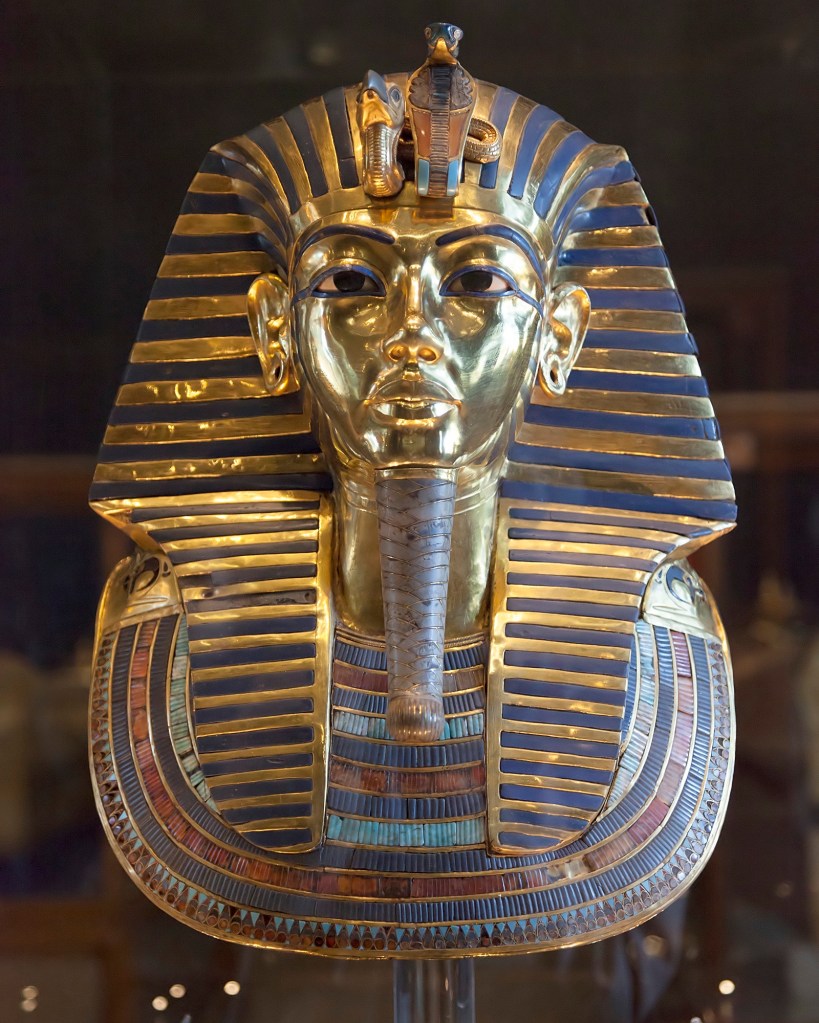
    Tutankhamun’s golden funerary mask at the Grand Egyptian Museum in Giza, Egypt.
    Image Wikimedia Commons

    Today’s Answers

    These questions all related to the date, 4 November.

    One

    On this day, an archaeologist and his team discovered the entrance of the Egyptian pharaoh Tutankhamen’s tomb. Who was the archaeologist, and in what year was this discovery made?

    Answers: Howard Carter; 1922.

    British archaeologist and Egyptologist Howard Carter (1874–1939) is famous for his November 1922 discovery of Tutankhamun’s intact tomb in the Valley of the Kings, which remains the best-preserved pharaonic tomb ever found.


    Two

    On this day in 1501, Catherine of Aragon meets the man destined to become her first husband. Who was he, and whom did she later wed after being widowed?

    Answers: Arthur, Prince of Wales; Henry VIII.

    Catherine of Aragon was Queen of England as the first wife of Henry VIII from their marriage on 11 June 1509 until its annulment on 23 May 1533. She had previously been Princess of Wales as the wife of Henry’s elder brother Arthur, Prince of Wales for a short time before his death.


    Three

    A specialised agency of the UN which was to promote science and other fields of endeavour was established on this day. What was the organisation’s original full name, and in what year was it established?

    Answers: United Nations Educational, Scientific and Cultural Organisation; 1946.

    The United Nations Educational, Scientific and Cultural Organization (UNESCO) is a specialized UN agency dedicated to fostering world peace and security through international collaboration in education, the arts, sciences, and culture. Headquartered in Paris, France, the organization comprises 194 member states and 12 associate members. It also collaborates with various non-governmental, intergovernmental, and private sector partners, operating through 53 regional field offices and 199 national commissions.


    Sir James Young Simpson discovered the anaesthetic properties of what volatile liquid, and in what year did he make this discovery?

    Answers: Chloroform; 1847.

    Sir James Young Simpson (1811–1870) was a pioneering Scottish obstetrician who played a major role in the history of medicine. He is best known for being the first physician to prove that chloroform could be used as an effective anaesthetic in humans, a discovery that helped popularise its use in medical practice.


    Five

    On this day in 1952, the US government established an agency which specialises in a discipline known by a six-letter abbreviation. What is the name of the agency; what is the six-letter abbreviation referred to; and what is the abbreviation’s meaning?

    Answers: National Security Agency; SIGINT; Signals Intelligence.

    The National Security Agency (NSA) is a US Department of Defense intelligence agency under the Director of National Intelligence. The NSA is responsible for global monitoring, data collection, and counterintelligence, with a focus on signals intelligence (SIGINT), and is also tasked with protecting U.S. communications networks. The agency employs roughly 32,000 people and relies largely on clandestine measures to accomplish its mission.
  • Five a Day

    Tutankhamun’s golden funerary mask at the Grand Egyptian Museum in Giza, Egypt.
    Image Wikimedia Commons

    These questions all related to the date, 4 November.

    One

    On this day, an archaeologist and his team discovered the entrance of the Egyptian pharaoh Tutankhamen’s tomb. Who was the archaeologist, and in what year was this discovery made?


    Two

    On this day in 1501, Catherine of Aragon meets the man destined to become her first husband. Who was he, and whom did she later wed after being widowed?


    Three

    A specialised agency of the UN which was to promote science and other fields of endeavour was established on this day. What was the organisation’s original full name, and in what year was it established?


    Sir James Young Simpson discovered the anaesthetic properties of what volatile liquid, and in what year did he make this discovery?


    Five

    On this day in 1952, the US government established an agency which specialises in a discipline known by a six-letter abbreviation. What is the name of the agency; what is the six-letter abbreviation referred to; and what is the abbreviation’s meaning?


    Good luck! I’ll post the answers later.


  • Gallimaufry XV — Answers

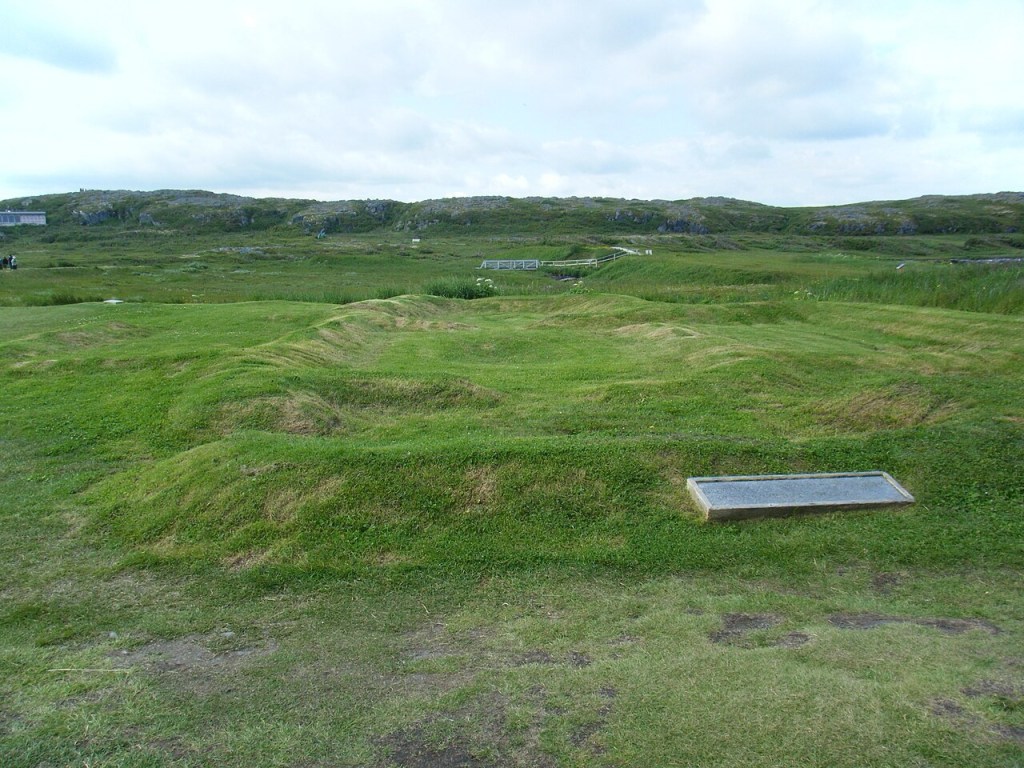
    L’Anse aux Meadows. The remains of seven Norse buildings were uncovered during the excavation of the site.
    Image Wikimedia Commons

    Today’s Answers

    No theme, simply five diverse questions.

    One

    The World Heritage Site L’Anse aux Meadows is an archaeological site of a … settlement dating to roughly 1,000 years ago. Which noun describing the inhabitants has been omitted from the preceding sentence, and where is this World Heritage Site located?

    Answers: Norse; Newfoundland, Canada.

    L’Anse aux Meadows is an archaeological site in North America linked to Leif Erikson and Norse sagas. It served as a base camp for exploration and includes the remains of eight sod-and-wood buildings. Over 800 Norse artifacts have been unearthed there, along with evidence of iron production. The site was designated a National Historic Site of Canada in 1968 and a UNESCO World Heritage Site in 1978.


    Two

    What surname is shared by two Bond villains: one portrayed by Adolfo Celi in a 1965 film and the other, played by Klaus Maria Brandauer, in an ‘unofficial’ 1983 production; and what were the two films?

    Answers: Largo; Thunderball; and Never Say Never Again.

    Emilio Largo is a fictional character and the main antagonist in the 1961 James Bond novel Thunderball and its 1965 film adaptation, where he is portrayed by Italian actor Adolfo Celi. He also appears as the main antagonist in the 1983 unofficial James Bond film Never Say Never Again, a remake of Thunderball, where his name was changed to Maximillian Largo and he was played by Austrian actor Klaus Maria Brandauer.

    Three

    What ancient city which is still occupied is home to the Sycamore Tree of Zacchaeus? To the nearest 1,000 years how old is the city?

    Answers: Jericho; (either) 10,000 or 11,000 years old.

    Jericho is roughly 10,000 to 11,000 years old, with human settlement and activity at the site dating back to around 9000 BCE.

    Four

    This fish, when improperly prepared as a Japanese dish, can be fatal. What is the English name of the fish, and the Japanese name of the fish and the dish?

    Answers: Pufferfish; fugu.

    Fugu (pufferfish) is a highly celebrated delicacy in Japanese, Korean, and Chinese cuisine, often served as sashimi or in hot pots. However, it is strictly regulated due to its extreme toxicity. Only chefs with three or more years of rigorous training are legally allowed to prepare it. While the liver was traditionally considered the most flavourful part, serving it was banned in Japan in 1984 because it is highly poisonous, and domestic preparation of the fish still occasionally leads to accidental death.

    Five

    Which poet composed The Rime of the Ancient Mariner? At the opening, a man is halted by the title figure, who then recounts a story. Where was the man heading when interrupted?

    Answers: Samuel Taylor Coleridge; a wedding.

    Samuel Taylor Coleridge’s poem, The Rime of the Ancient Mariner describes how the mariner stops a wedding guest to share his story, shifting the guest’s mood from amusement to fascination. The poem is noted for its use of personification and repetition to create varying atmospheres, and it is considered a key work in the start of British Romantic literature.


  • Gallimaufry XV

    L’Anse aux Meadows. The remains of seven Norse buildings were uncovered during the excavation of the site.
    Image Wikimedia Commons

    No theme, simply five diverse questions.

    One

    The World Heritage Site L’Anse aux Meadows is an archaeological site of a … settlement dating to roughly 1,000 years ago. Which noun describing the inhabitants has been omitted from the preceding sentence, and where is this World Heritage Site located?


    Two

    What surname is shared by two Bond villains: one portrayed by Adolfo Celi in a 1965 film and the other, played by Klaus Maria Brandauer, in an ‘unofficial’ 1983 production; and what were the two films?

    Three

    What ancient city which is still occupied is home to the Sycamore Tree of Zacchaeus? To the nearest 1,000 years how old is the city?

    Four

    This fish, when improperly prepared as a Japanese dish, can be fatal. What is the English name of the fish, and the Japanese name of the fish and the dish?

    Five

    Which poet composed The Rime of the Ancient Mariner? At the opening, a man is halted by the title figure, who then recounts a story. Where was the man heading when interrupted?


    Good luck! I’ll post the answers later.


  • Come to Light — Answers

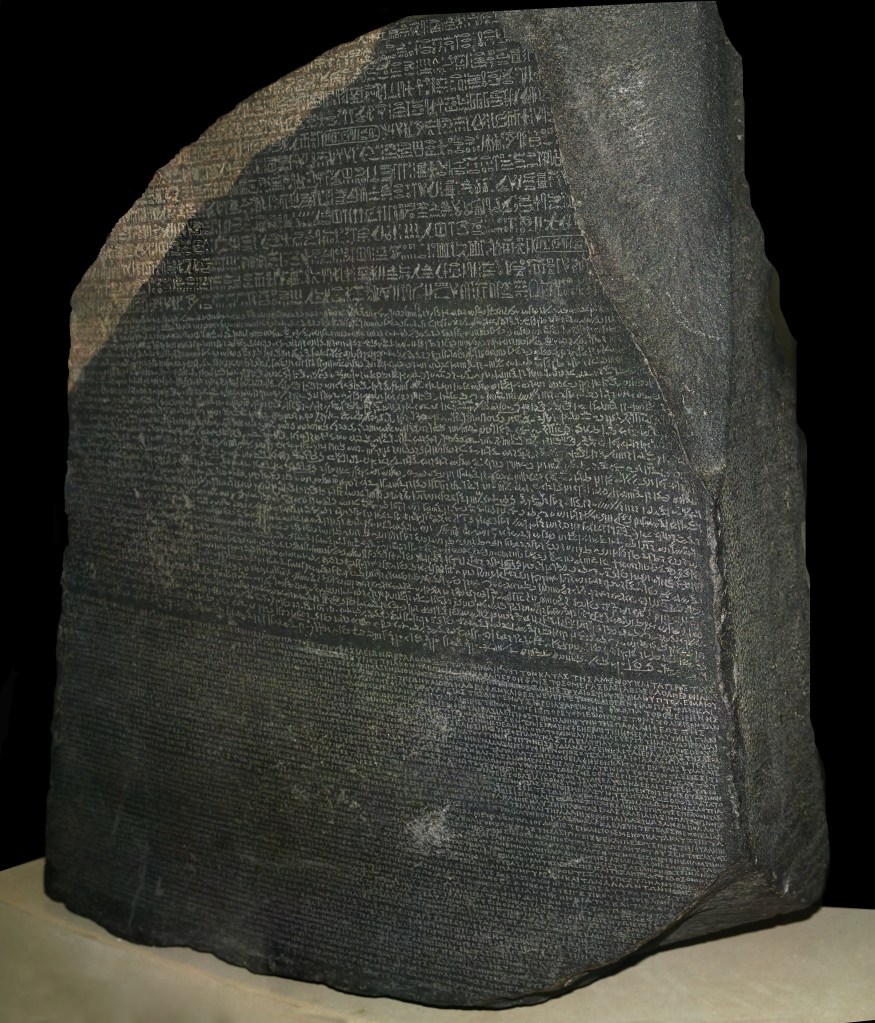
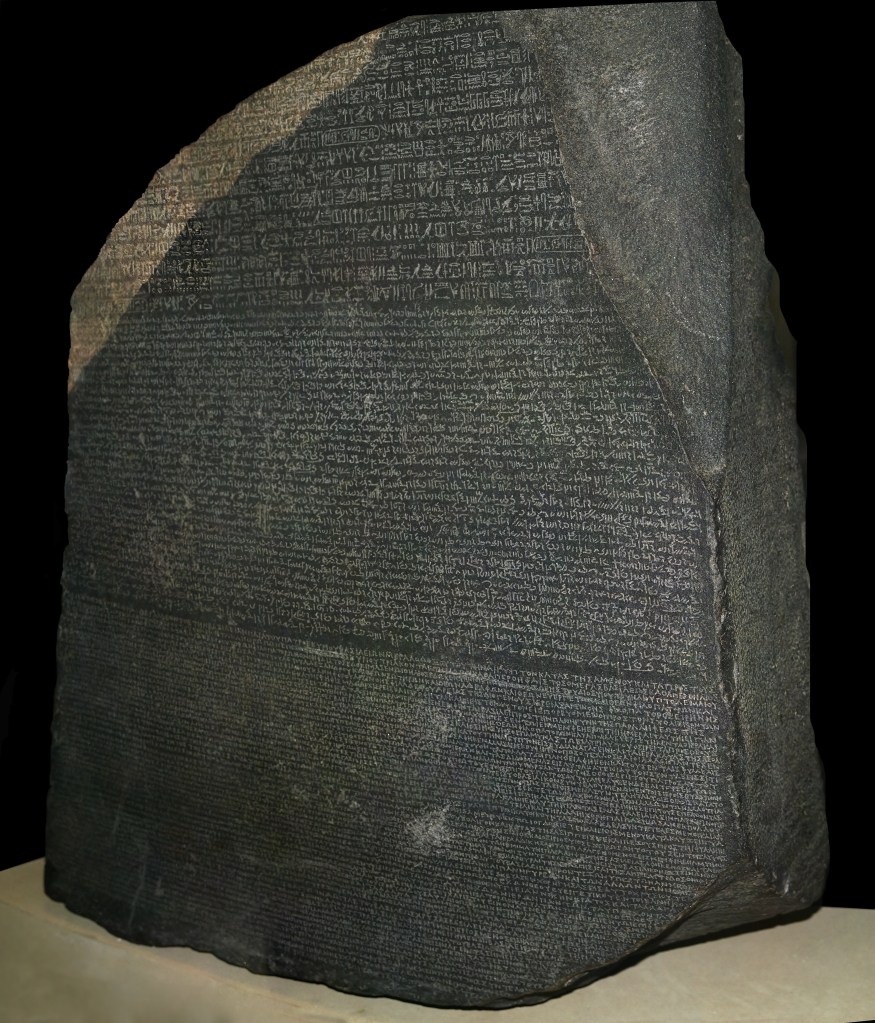
    The Rosetta Stone.
    Image Hans Hillewaert via Wikimedia Commons

    Today’s Answers

    The first question relates to today, 27 September, while the remainder are not date-related but follow on from the first.

    One

    On 27 September 1822, the Rosetta Stone was decoded 23 years after its discovery in a river delta by an army officer. In what river delta was it found; and in what country’s army was the finder an officer?

    Answers: Nile Delta; France.

    The Rosetta Stone, likely originally displayed in a temple during the Hellenistic period, was later used as building material for a fort near Rosetta. It was rediscovered there in July 1799 by French army officer Pierre-François Bouchard.In 1822, Jean-François Champollion successfully decoded the Rosetta Stone by realising its hieroglyphs served different functions, revealing the ancient inscription to be political propaganda praising Ptolemy V.


    Two

    In 2026, in a new major archaeological project woolly rhinoceros bones were found in a cave under a castle. Is that castle in …

    • Coastal South Wales, United Kingdom
    • Inland river valley, central Italy
    • Alpine foothills, eastern Austria

    Answer: Coastal South Wales, United Kingdom.

    Excavations at Wogan Cavern under Pembroke Castle revealed intact sediments and evidence of human and animal visits over 100,000 years, including bones and stone tools. The site has already yielded the remains of mammoths, woolly rhinoceroses, reindeer, wild horses, and a hippopotamus which roamed Wales 120,000 years ago; alongside are stone tools and signs of human habitation spanning several eras.


    Three

    In 2023, archaeologists uncovered the submerged remnants of a Nabataean temple during an underwater survey of the ancient port of Puteoli. In what modern country is the ancient port of Puteoli, and what four-letter word describes the ethnic group of the Nabataean people?

    Answers: Italy; Arab.

    Puteoli (modern Pozzuoli), a Roman trading hub, hosts a submerged Nabataean temple mapped via photogrammetry. The rectangular structure in a Lartidianus contains altars and a Latin inscription to Dushara, confirming Nabataean trade integration.


    Four

    A Maya tomb discovered in 2025 may be 1,700 years old. It was found at the ancient city of Carocal. In what modern country is the site of this tomb?

    Answer: Belize.

    Archaeologists in Belize have unearthed a 1,700-year-old tomb at the ancient Maya city of Caracol, which may be the earliest known royal burial at the site and the resting place of its founding king, Te K’ab Chaak. The discovery could also indicate that ties between the Maya and the metropolis of Teotihuacan began earlier than previously thought, though experts note that further evidence is needed to confirm the identity of the tomb’s occupant.


    Five

    In 2026, archaeologists found a papyrus fragment from Homer’s Iliad inside …

    • A harp’s frame
    • A model wooden horse
    • A mummy’s wrapping

    Answer: A mummy’s wrapping.

    Archaeologists have unearthed a 1,600-year-old Egyptian mummy with a papyrus fragment from Homer’s Iliad tucked inside its wrappings. The ancient Greek text, found on the mummy’s abdomen, contains a passage from the “catalog of ships” in Book II, which lists the Greek leaders who sailed to Troy. Researchers from the Oxyrhynchus Archaeological Mission describe the discovery of a literary text in this context as “truly novel” and are currently studying it further.


  • Come to Light

    The Rosetta Stone.
    Image Hans Hillewaert via Wikimedia Commons

    The first question relates to today, 27 September, while the remainder are not date-related but follow on from the first.

    One

    On 27 September 1822, the Rosetta Stone was decoded 23 years after its discovery in a river delta by an army officer. In what river delta was it found; and in what country’s army was the finder an officer?


    Two

    In 2026, in a new major archaeological project woolly rhinoceros bones were found in a cave under a castle. Is that castle in …

    • Coastal South Wales, United Kingdom
    • Inland river valley, central Italy
    • Alpine foothills, eastern Austria

    Three

    In 2023, archaeologists uncovered the submerged remnants of a Nabataean temple during an underwater survey of the ancient port of Puteoli. In what modern country is the ancient port of Puteoli, and what four-letter word describes the ethnic group of the Nabataean people?


    Four

    A Maya tomb discovered in 2025 may be 1,700 years old. It was found at the ancient city of Carocal. In what modern country is the site of this tomb?


    Five

    In 2026, archaeologists found a papyrus fragment from Homer’s Iliad inside …

    • A harp’s frame
    • A model wooden horse
    • A mummy’s wrapping

    Good luck! I’ll post the answers later.