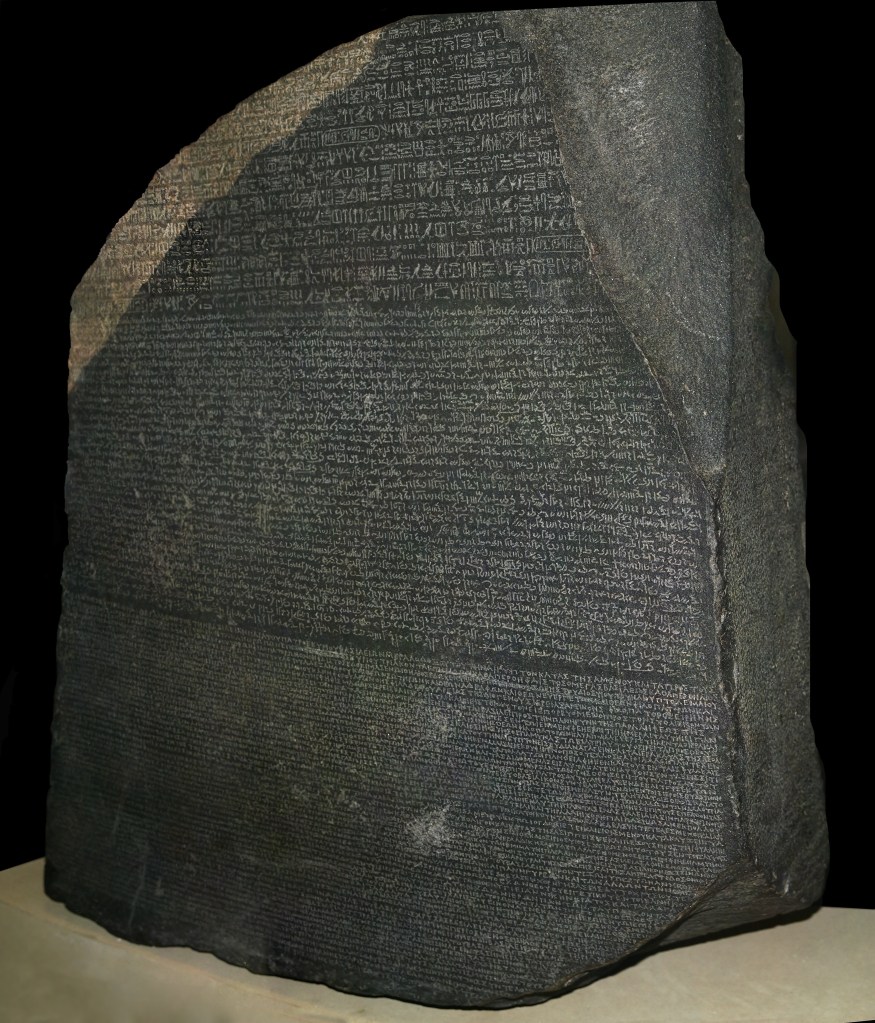
Image Hans Hillewaert via Wikimedia Commons
Today’s Answers
The first question relates to today, 27 September, while the remainder are not date-related but follow on from the first.
One
On 27 September 1822, the Rosetta Stone was decoded 23 years after its discovery in a river delta by an army officer. In what river delta was it found; and in what country’s army was the finder an officer?
Answers: Nile Delta; France.
The Rosetta Stone, likely originally displayed in a temple during the Hellenistic period, was later used as building material for a fort near Rosetta. It was rediscovered there in July 1799 by French army officer Pierre-François Bouchard.In 1822, Jean-François Champollion successfully decoded the Rosetta Stone by realising its hieroglyphs served different functions, revealing the ancient inscription to be political propaganda praising Ptolemy V.
Two
In 2026, in a new major archaeological project woolly rhinoceros bones were found in a cave under a castle. Is that castle in …
- Coastal South Wales, United Kingdom
- Inland river valley, central Italy
- Alpine foothills, eastern Austria
Answer: Coastal South Wales, United Kingdom.
Excavations at Wogan Cavern under Pembroke Castle revealed intact sediments and evidence of human and animal visits over 100,000 years, including bones and stone tools. The site has already yielded the remains of mammoths, woolly rhinoceroses, reindeer, wild horses, and a hippopotamus which roamed Wales 120,000 years ago; alongside are stone tools and signs of human habitation spanning several eras.
Three
In 2023, archaeologists uncovered the submerged remnants of a Nabataean temple during an underwater survey of the ancient port of Puteoli. In what modern country is the ancient port of Puteoli, and what four-letter word describes the ethnic group of the Nabataean people?
Answers: Italy; Arab.
Puteoli (modern Pozzuoli), a Roman trading hub, hosts a submerged Nabataean temple mapped via photogrammetry. The rectangular structure in a Lartidianus contains altars and a Latin inscription to Dushara, confirming Nabataean trade integration.
Four
A Maya tomb discovered in 2025 may be 1,700 years old. It was found at the ancient city of Carocal. In what modern country is the site of this tomb?
Answer: Belize.
Archaeologists in Belize have unearthed a 1,700-year-old tomb at the ancient Maya city of Caracol, which may be the earliest known royal burial at the site and the resting place of its founding king, Te K’ab Chaak. The discovery could also indicate that ties between the Maya and the metropolis of Teotihuacan began earlier than previously thought, though experts note that further evidence is needed to confirm the identity of the tomb’s occupant.
Five
In 2026, archaeologists found a papyrus fragment from Homer’s Iliad inside …
- A harp’s frame
- A model wooden horse
- A mummy’s wrapping
Answer: A mummy’s wrapping.
Archaeologists have unearthed a 1,600-year-old Egyptian mummy with a papyrus fragment from Homer’s Iliad tucked inside its wrappings. The ancient Greek text, found on the mummy’s abdomen, contains a passage from the “catalog of ships” in Book II, which lists the Greek leaders who sailed to Troy. Researchers from the Oxyrhynchus Archaeological Mission describe the discovery of a literary text in this context as “truly novel” and are currently studying it further.


Leave a comment