Image NASA
Today’s Answers
Today, 18 November 2026, Voyager 1 becomes the first man made object to reach one light-day from the Sun. Our questions are all related to this event and space craft.
One
Voyager 1 is about to reach one light-day from the Sun on Nov. 18, 2026. How far is that distance?
- 10 billion miles (about 16.1 billion km)
- 13 billion miles (about 20.9 billion km)
- 16 billion miles (about 25.9 billion km)
Answer: 16 billion miles (about 25.9 billion km).
Two
When did Voyager 1 lift off from Earth?
- 1967
- 1977
- 1987
Answer: 1977.
Three
When did Voyager 2 lift off from Earth?
- 16 days before Voyager 1
- 16 weeks after Voyager 1
- 16 months after Voyager 1
Answer: 16 days before Voyager 1.
Four
Voyager 1 is travelling at a relative velocity to the Sun of about 38,026 mph or 61,197 kilometres per hour. At that speed how long will it be until it reaches a distance of one light year from the Sun?
- 180 years
- 1,800 years
- 18,000 years
Answer: 18,000 years.
Five
In 1998 Voyager 1 became the farthest man-made object from the sun when it overtook the distance achieved by what other space craft?
- Discovery 9
- Pioneer 10
- Voyager 11
Answer: Pioner 10.
Voyager 1
No spacecraft has gone farther than NASA’s Voyager 1. Launched in 1977 to fly by Jupiter and Saturn, Voyager 1 crossed into interstellar space in August 2012 and continues to collect data. Now, more than 49 years into its mission, Voyager 1 is on the brink of another unprecedented milestone — reaching a distance one light-day away from Earth. — NASA
The Pale Blue Dot
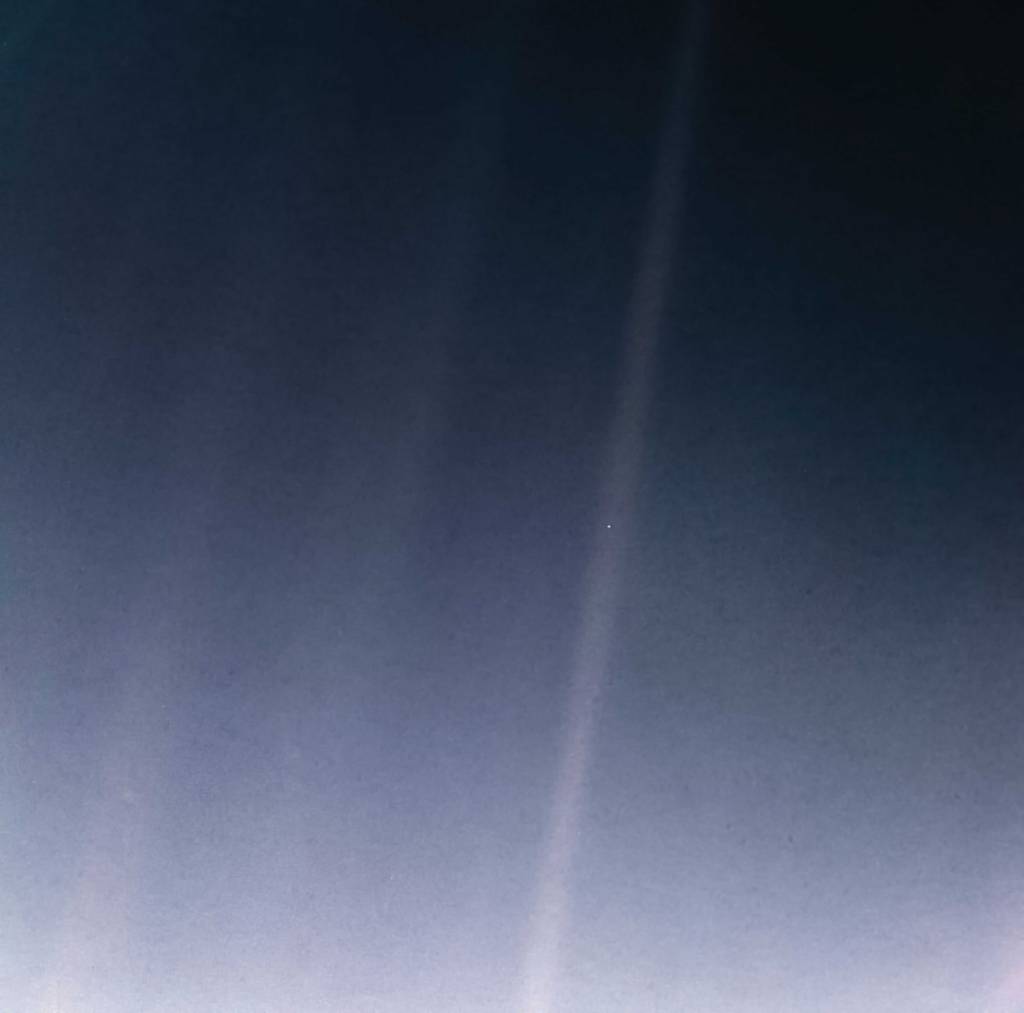
Voyager 1 was speeding out of the solar system — beyond Neptune and about 3.7 billion miles (6 billion kilometers) from the Sun — when mission managers commanded it to look back toward home for a final time. It snapped a series of 60 images that were used to create the first “family portrait” of our solar system.
The picture that would become known as the Pale Blue Dot shows Earth within a scattered ray of sunlight. Voyager 1 was so far away that — from its vantage point — Earth was just a point of light about a pixel in size. — NASA


Leave a Reply