Quizology.Online

“There is much pleasure to be gained from useless knowledge.”

— Bertrand Russell

Tag: culture

  • Who, What, When, Where, Why and How IX — Answers

    Canada–US Border: Boundary markers and a 25 foot (7.6 m) swath cut into the forest marking the Alberta–Montana border.
    Image Wikimedia Commons

    Today’s Answers

    Six questions today, each starting with one of these words: Who, What, When, Where, Why, and How.

    One

    Who led the expedition which became the first undisputed to walk to the North Pole, and in what decade was this achieved?

    Answers: Wally Herbert; 1960s.

    In 1969, Wally Herbert led the British Trans-Arctic Expedition, completing a 3,800-mile (6,115 km) overland crossing of the Arctic Ocean from Alaska to Spitsbergen. Accompanied by Allan Gill, Roy Koerner and Kenneth Hedges, he reached the North Pole on 6 April after spending the winter drifting with the ice. His achievement coincided with the 60th anniversary of Robert Peary’s disputed expedition, and Herbert became the first man widely recognised as having reached the pole on foot. Sir Ranulph Fiennes later described him as “the greatest polar explorer of our time.”


    Two

    What Baltic capital, once labelled the ‘Jerusalem of the North’ by Napoleon, launched a campaign calling itself the ‘G-spot of Europe’, and which country does it serve as the capital of?

    Answers: Vilnius, Lithuania.

    The Vilnius tourist commission has launched a new campaign branding the city as ‘the G-spot of Europe’ to attract young British tourists, using the tagline “Nobody knows where it is, but when you find it – it’s amazing.” The campaign, which has gained international attention, plays on the idea that while few people know where Vilnius is, visitors quickly fall in love with it once they arrive.


    Three

    When did Nils Bohlin’s three-point seat belt first appear (year) as standard equipment in production cars, and which Swedish manufacturer employed him to develop and build them?

    Answers: 1959; Volvo.

    The three-point seat belt was invented by Nils Bohlin a mechanical engineer. Bohlin drew on his experience designing ejection seats for SAAB and spent roughly a year developing the seat belt. The seat belt was first fitted to the Volvo PV544 in 1959. The US National Highway Traffic Safety Administration reports that the seat belt saves approximately 15,000 lives annually in the US. Additionally a study of 28,000 accidents in Sweden, which showed that no belted occupants were fatally injured at speeds below 60 mph or as long as the passenger compartment remained intact.


    Four

    Where does ‘Mr. Smith’ go in the title of an early James Stewart movie?

    Answers: Washington

    Mr. Smith Goes to Washington was initially controversial in the U.S. for its portrayal of Washington politics but became a major box office success and made James Stewart a star. The film received eleven Academy Award nominations, winning Best Original Story, and was among the first 25 films selected for the U.S. National Film Registry in 1989 for its cultural and historical significance.


    Five

    Why was the Australian city of Darwin rebuilt twice in the 20th century (two answers one for each rebuilding)?

    Answers: Air raids; Cyclone

    On February 19, 1942, Japanese warplanes attacked Darwin, Australia, in two waves, using the same fleet that bombed Pearl Harbor. The attack caused extensive damage and killed at least 243 people, making it the most serious wartime attack on Australia. On December 25, 1974, Cyclone Tracy struck Darwin, killing 71 people and destroying over 70% of the city’s buildings. This led to the evacuation of 30,000 residents in Australia’s largest airlift. The city was rebuilt in the late 1970s using newer materials, and the satellite city of Palmerston was established nearby in the early 1980s.


    Six

    How many Canadian Provinces share an international border with the U.S.A., and how many U.S. states have such a border with Canada?

    Answers: Eight; Thirteen.

    The length of the terrestrial boundary is 8,891 km (5,525 mi), of which 6,416 km (3,987 mi) is between Canada and the contiguous 48 US states, and 2,475 km (1,538 mi) is between Canada and Alaska. Eight out of thirteen provinces and territories of Canada and thirteen out of fifty U.S. states share this international boundary.
    — Wikipedia


  • Who, What, When, Where, Why and How IX

    Canada–US Border: Boundary markers and a 25 foot (7.6 m) swath cut into the forest marking the border.
    Image Wikimedia Commons

    Six questions today, each starting with one of these words: Who, What, When, Where, Why, and How.

    One

    Who led the expedition which became the first undisputed to walk to the North Pole, and in what decade was this achieved?


    Two

    What Baltic capital, once labelled the ‘Jerusalem of the North’ by Napoleon, launched a campaign calling itself the ‘G-spot of Europe’, and which country does it serve as the capital of?


    Three

    When did Nils Bohlin’s three-point seat belt first appear (year) as standard equipment in production cars, and which Swedish manufacturer employed him to develop and build them?


    Four

    Where does ‘Mr. Smith’ go in the title of an early James Stewart movie?


    Five

    Why was the Australian city of Darwin rebuilt twice in the 20th century (two answers one for each rebuilding)?


    Six

    How many Canadian Provinces share an international border with the U.S.A., and how many U.S. states have such a border with Canada?


    Good luck! I’ll post the answers later.


  • For the Birds II — Answers

    Today’s Answers

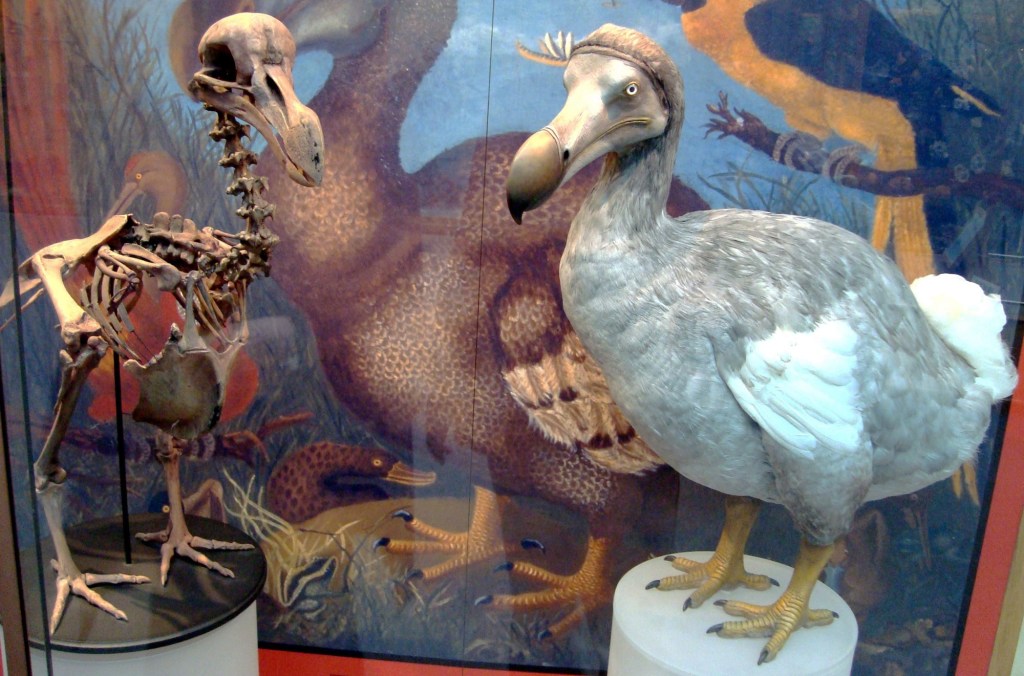
    Cast and model of dodo.
    Oxford University Natural History Museum.
    Image Wikimedia Commons

    Today’s questions have no date connection, but there is a theme.

    One

    This Sebastian Faulks novel published in 1993 is partly set during a major conflict. What is the novel and in what conflict is it partly set?

    Answer: Birdsong; First World War.

    Sebastian Faulks’s Birdsong follows Stephen Wraysford in the First World War and Elizabeth Benson in the 1970s. It explores trauma and historical recovery, earning acclaim and ranking 13th in the Big Read. Adaptations include radio, television and stage versions.


    Two

    Columbine, pertaining to the family Columbidae, refers to what?

    Answer: Doves (and/or) Pigeons.

    Columbine, pertaining to birds of the family Columbidae (doves and pigeons) from French Colombine, from Italian Colombina, feminine of colombino ‘dove-like’, from colombo ‘dove’.


    Three

    The dodo is an extinct flightless bird. To where was it native, and in what century was one last seen alive?

    Answer: Mauritius; 17th century.

    The dodo, native to Mauritius, was a flightless bird linked to the Rodrigues solitaire and the Nicobar pigeon. After 1598, hunting and habitat loss occurred, and the bird was last seen in 1662; the species has become a symbol of extinction. Although people often blame human hunting, the main cause was the introduction of cats, dogs, macaques, pigs, and rats, which raided nests and competed for scarce food.


    Four

    The UK’s Hawker Siddeley Harrier evolved from the Hawker P.1127 prototype and which evaluation aircraft? Which branch of the US military also took delivery of more than 100 of these V/STOL aircraft?

    Answer: Kestrel; US Marine Corps.

    The Hawker Siddeley Harrier GR.1/GR.3 and AV-8A were the first V/STOL close-support and reconnaissance aircraft, derived from the P.1127 and Kestrel. The GR.1 entered RAF service on 18 April 1969 at RAF Wittering; the USMC acquired 102 AV-8A and 8 TAV-8A between 1971 and 1976.


    Five

    Three birds feature on the Australian coat of arms; how many can you name?

    Answer: Emu, shrike & black swan.

    The Australian Commonwealth Coat of Arms features six animal figures representing five different types of animals: a kangaroo, an emu, two lions (representing New South Wales and Tasmania), an Australian piping shrike (South Australia), and a black swan (Western Australia).


  • Ox, Tiger, Dragon, Monkey, Rooster And Pig — Answers

    Today’s Answers

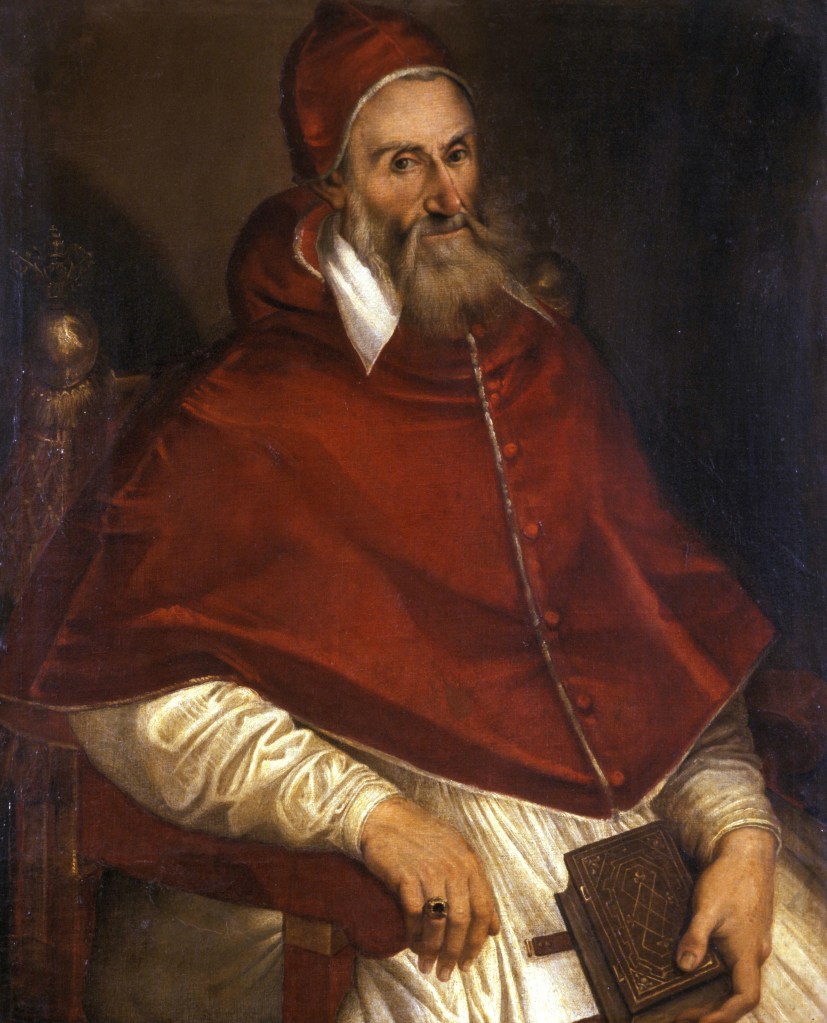
    Pope Gregory XIII, portrait attributed to Bartolomeo Passarotti.
    Image Wikimedia Commons

    Today’s first question is date-related being connected to today, 4 October. Subsequently, the questions are not date-related but maybe they really are!

    One

    This day in 1582 saw the introduction of the Gregorian calendar to replace the … calendar meaning that Thursday 4 October 1582 was followed by Friday … — what calendar’s name, and date complete the previous sentence?

    Answer: Julian (calendar); and (Friday) 15 October 1582.

    The Gregorian calendar was introduced by Pope Gregory XIII in 1582 to correct the Julian calendar’s 11-minute yearly drift. By dropping 10 days and adjusting the leap year rule for century years, it realigned the calendar with the vernal equinox. Although adoption was gradual, most of continental Catholic Europe adopted the new calendar in 1582, while Great Britain and Ireland waited until 1752. More recent shifts occurred with Greece in 1923 and Saudi Arabia in 2016 and it is now the primary international dating system.


    Two

    Which song featuring lyrics by Howard Greenfield contains these lines, and which singer wrote the music?

    (January)

    You start the year all fine

    (February)

    You’re my little Valentine

    (March)

    I’m gonna march you down the aisle

    (April)

    You’re the Easter bunny

    When you smile

    — AZ Lyrics

    Answers: Calendar Girl: Neil Sedaka.

    Released in December 1960, Calendar Girl by Neil Sedaka and Howard Greenfield reached No. 1 for Sedaka in Canada and Japan, and made the top ten in both the UK and US. Inspired by Lloyd Price, Al Jolson, Eddie Cantor and Ricky Nelson, it uses monthly imagery including Betty Grable and Marilyn Monroe. Stan Applebaum and Gary Chester provided instrumentation.


    Three

    What secular device and tradition is associated with the beginning of the Christian liturgical year?

    Answer: Advent Calendar.

    An Advent calendar is a decorative tool used to count down the days leading up to Christmas, typically spanning from December 1 or the First Sunday of Advent through December 24 or 25. While often secular today, the practice originated with German Lutherans as a period of spiritual preparation for the birth of Jesus Christ. Early 19th-century traditions included lighting candles or marking doors to track the days. The modern format—featuring compartments, flaps, or pockets that reveal images, stories, Bible verses, or small gifts like chocolate—emerged in early 20th-century Germany. Following a decline during World War II, the tradition gained global popularity.


    Four

    Clues to this fitting novel are immersed in the following: it marked its author’s debut in 1984; sales rose after US President Ronald Reagan noted his enjoyment; a film with a former James Bond followed in 1990. What were the titles of the book and film; who wrote the book; and what was the former Bond actor’s character name?

    Answers: The Hunt for Red October; Tom Clancy; Marko Ramius.

    Tom Clancy’s debut novel, The Hunt for Red October, published by Naval Institute Press in 1984, features Soviet captain Marko Ramius allegedly defecting with the revolutionary new ballistic submarine Red October; CIA analyst Jack Ryan must try to assist Ramius’s defection and capture the submarine.


    Five

    This list from 1793 arranged names in sequence: vintage, mist, frost, snow, rain, wind, seedtime, blossom, meadow, harvest, heat and fruits. What did these terms denote; what system were they part of; and in what year was it replaced by a more international choice?

    Answers: Months; the French Republican calendar (also called the French Revolutionary calendar); 1806.

    Adopted on 5 October 1793, the French republican calendar replaced the Gregorian system with a secular structure of 12 months and supplementary days. It was abandoned by Emperor Napoleon on 1 January 1806.


    Ox, Tiger, Dragon, Monkey, Rooster And Pig

    The post title is a list of a few of the animals from the Chinese calendar. Although questions two to five are not date-related as in connected to 4 October they are date-related in being connected to calendars in general and calendars are collections of dates.


  • Ox, Tiger, Dragon, Monkey, Rooster And Pig

    Pope Gregory XIII, portrait attributed to Bartolomeo Passarotti.
    Image Wikimedia Commons

    Today’s first question is date-related being connected to today, 4 October. Subsequently, the questions are not date-related but maybe they really are!

    One

    This day in 1582 saw the introduction of the Gregorian calendar to replace the … calendar meaning that Thursday 4 October 1582 was followed by Friday … — what calendar’s name, and date complete the previous sentence?


    Two

    Which song featuring lyrics by Howard Greenfield contains these lines, and which singer wrote the music?

    (January)

    You start the year all fine

    (February)

    You’re my little Valentine

    (March)

    I’m gonna march you down the aisle

    (April)

    You’re the Easter bunny

    When you smile

    — AZ Lyrics


    Three

    What secular device and tradition is associated with the beginning of the Christian liturgical year?


    Four

    Clues to this fitting novel are immersed in the following: it marked its author’s debut in 1984; sales rose after US President Ronald Reagan noted his enjoyment; a film with a former James Bond followed in 1990. What were the titles of the book and film; who wrote the book; and what was the former Bond actor’s character name?


    Five

    This list from 1793 arranged names in sequence: vintage, mist, frost, snow, rain, wind, seedtime, blossom, meadow, harvest, heat and fruits. What did these terms denote; what system were they part of; and in what year was it replaced by a more international choice?


    Good luck! I’ll post the answers later.


  • Come to Light — Answers

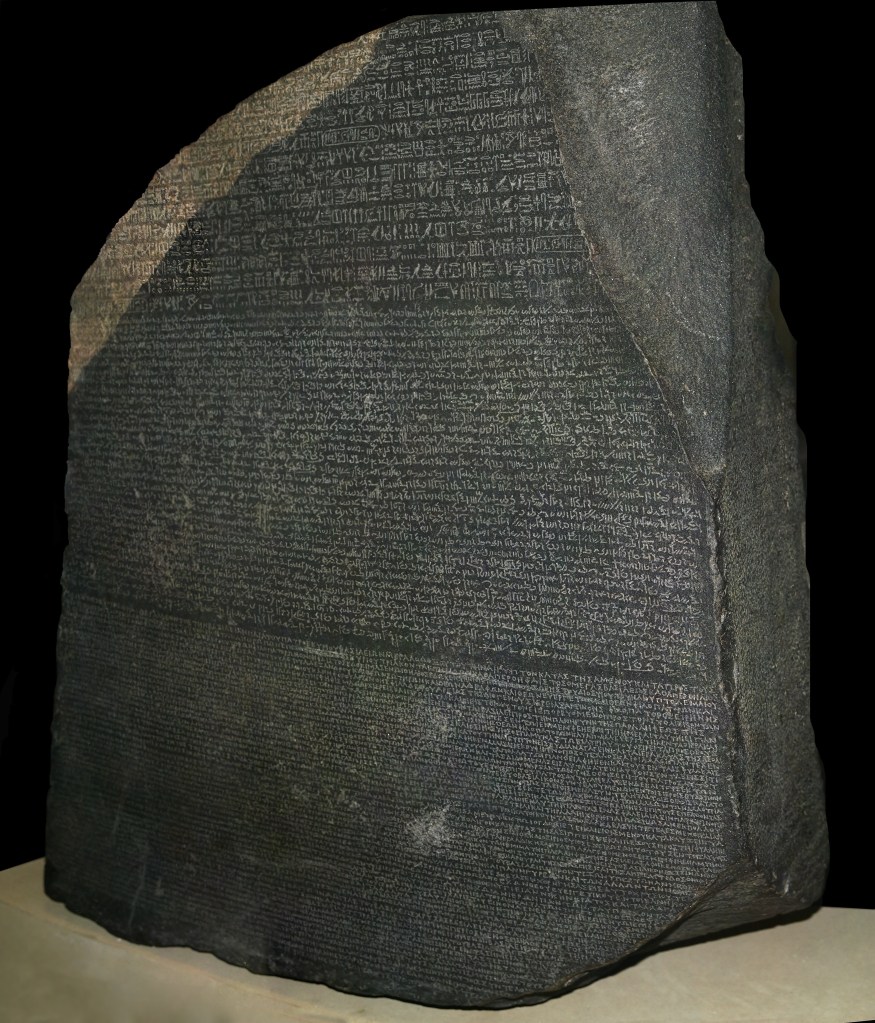
    The Rosetta Stone.
    Image Hans Hillewaert via Wikimedia Commons

    Today’s Answers

    The first question relates to today, 27 September, while the remainder are not date-related but follow on from the first.

    One

    On 27 September 1822, the Rosetta Stone was decoded 23 years after its discovery in a river delta by an army officer. In what river delta was it found; and in what country’s army was the finder an officer?

    Answers: Nile Delta; France.

    The Rosetta Stone, likely originally displayed in a temple during the Hellenistic period, was later used as building material for a fort near Rosetta. It was rediscovered there in July 1799 by French army officer Pierre-François Bouchard.In 1822, Jean-François Champollion successfully decoded the Rosetta Stone by realising its hieroglyphs served different functions, revealing the ancient inscription to be political propaganda praising Ptolemy V.


    Two

    In 2026, in a new major archaeological project woolly rhinoceros bones were found in a cave under a castle. Is that castle in …

    • Coastal South Wales, United Kingdom
    • Inland river valley, central Italy
    • Alpine foothills, eastern Austria

    Answer: Coastal South Wales, United Kingdom.

    Excavations at Wogan Cavern under Pembroke Castle revealed intact sediments and evidence of human and animal visits over 100,000 years, including bones and stone tools. The site has already yielded the remains of mammoths, woolly rhinoceroses, reindeer, wild horses, and a hippopotamus which roamed Wales 120,000 years ago; alongside are stone tools and signs of human habitation spanning several eras.


    Three

    In 2023, archaeologists uncovered the submerged remnants of a Nabataean temple during an underwater survey of the ancient port of Puteoli. In what modern country is the ancient port of Puteoli, and what four-letter word describes the ethnic group of the Nabataean people?

    Answers: Italy; Arab.

    Puteoli (modern Pozzuoli), a Roman trading hub, hosts a submerged Nabataean temple mapped via photogrammetry. The rectangular structure in a Lartidianus contains altars and a Latin inscription to Dushara, confirming Nabataean trade integration.


    Four

    A Maya tomb discovered in 2025 may be 1,700 years old. It was found at the ancient city of Carocal. In what modern country is the site of this tomb?

    Answer: Belize.

    Archaeologists in Belize have unearthed a 1,700-year-old tomb at the ancient Maya city of Caracol, which may be the earliest known royal burial at the site and the resting place of its founding king, Te K’ab Chaak. The discovery could also indicate that ties between the Maya and the metropolis of Teotihuacan began earlier than previously thought, though experts note that further evidence is needed to confirm the identity of the tomb’s occupant.


    Five

    In 2026, archaeologists found a papyrus fragment from Homer’s Iliad inside …

    • A harp’s frame
    • A model wooden horse
    • A mummy’s wrapping

    Answer: A mummy’s wrapping.

    Archaeologists have unearthed a 1,600-year-old Egyptian mummy with a papyrus fragment from Homer’s Iliad tucked inside its wrappings. The ancient Greek text, found on the mummy’s abdomen, contains a passage from the “catalog of ships” in Book II, which lists the Greek leaders who sailed to Troy. Researchers from the Oxyrhynchus Archaeological Mission describe the discovery of a literary text in this context as “truly novel” and are currently studying it further.


  • Come to Light

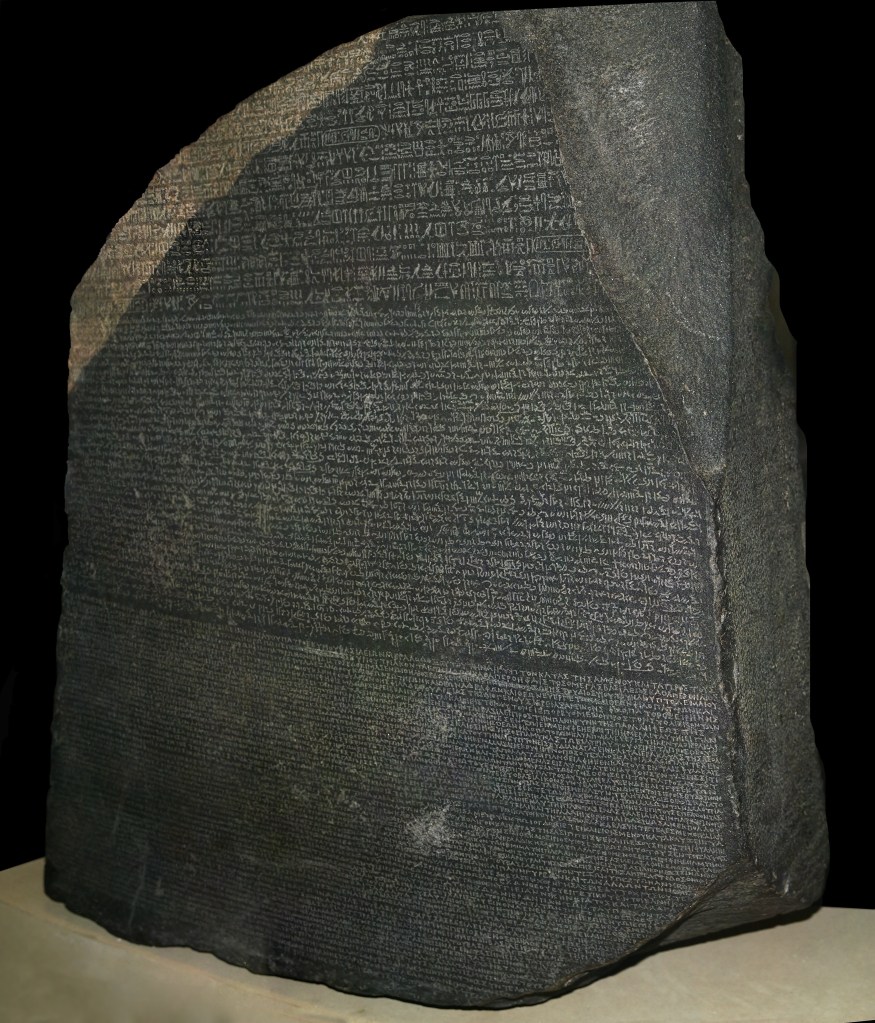
    The Rosetta Stone.
    Image Hans Hillewaert via Wikimedia Commons

    The first question relates to today, 27 September, while the remainder are not date-related but follow on from the first.

    One

    On 27 September 1822, the Rosetta Stone was decoded 23 years after its discovery in a river delta by an army officer. In what river delta was it found; and in what country’s army was the finder an officer?


    Two

    In 2026, in a new major archaeological project woolly rhinoceros bones were found in a cave under a castle. Is that castle in …

    • Coastal South Wales, United Kingdom
    • Inland river valley, central Italy
    • Alpine foothills, eastern Austria

    Three

    In 2023, archaeologists uncovered the submerged remnants of a Nabataean temple during an underwater survey of the ancient port of Puteoli. In what modern country is the ancient port of Puteoli, and what four-letter word describes the ethnic group of the Nabataean people?


    Four

    A Maya tomb discovered in 2025 may be 1,700 years old. It was found at the ancient city of Carocal. In what modern country is the site of this tomb?


    Five

    In 2026, archaeologists found a papyrus fragment from Homer’s Iliad inside …

    • A harp’s frame
    • A model wooden horse
    • A mummy’s wrapping

    Good luck! I’ll post the answers later.


  • Decade Decisions — Answers

    Today’s Answers

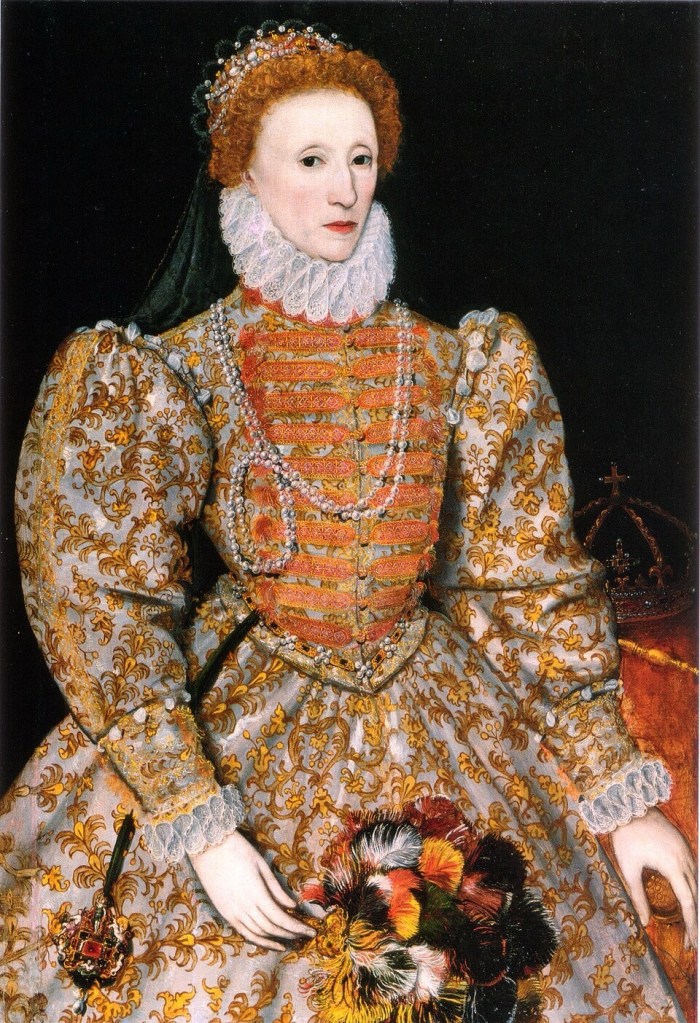
    Elizabeth I of England, c.1575.
    Image Wikimedia Commons

    Today’s questions are all related to today, 7th September.

    One

    The first Miss America pageant took place on this day. In what decade, and at what location did this occur?

    Answer: 1920s; Atlantic City, New Jersey, USA.

    The inaugural Miss America pageant began on 7 September 1921, when the two-day Inter-City Beauty event opened in Atlantic City during the Fall Frolic. Margaret Gorman, representing Washington, D.C., secured victory on the first day and again in the Bathers’ Revue the following day. She was named ‘the most beautiful bathing girl in America’.


    Two

    England’s future Queen Elizabeth I was born on this day. In what decade, and at what palace was she born?

    Answers: 1530s; Greenwich Palace.

    Elizabeth I, born on this day in 1533, ruled England from 1558 to 1603. Her reign, known as the Elizabethan Age, saw the country emerge strongly as a leading European force in politics, trade, and the arts.


    Three

    The earliest recorded submarine attack occurred when an attempt was made by the Turtle to fix an explosive device with a timer to the British ship HMS Eagle in a harbour. In what decade, and in what harbour, did this occur?

    Answers: 1770s; New York Harbor.

    American colonial accounts describe how on 7 September 1776, Ezra Lee launched the first submarine strike in the Turtle, aiming to fix a timed explosive to HMS Eagle in New York Harbor, though British records do not confirm the event.


    Four

    A songwriter achieved a record-setting milestone while working at EMI by having written seven simultaneous hits by different artists on the Billboard Hot 100 charts. In what decade did she achieve this, and who was she?

    Answers: 1980’s; Diane Eve Warren.

    Her success drew praise from EMI’s UK Chairman, Peter Reichardt, who famously described her as ‘the most important songwriter in the world’. Although Warren is recognised for her extensive catalogue of hits with some of the most popular artists, she is strongly committed to safeguarding her creative rights; she founded Realsongs to retain ownership of her masters, a step that grants her full control over how her music is used and how revenue is generated.


    Five

    Georgi Markov, a Bulgarian dissident, was assassinated while walking across Waterloo Bridge in London, U.K. by Bulgarian secret police. In what decade did this happen, and what was the weapon speculated to have been used?

    Answers: 1970s; Umbrella.

    On 7 September 1978, Markov felt a sharp pain on his right thigh at a bus stop on Waterloo Bridge and reported seeing a man pick up an umbrella behind him. A post mortem examination later found a tiny pellet measuring 0.067 in (1.70 mm) in diameter in his leg. The assumption is that Francesco Gullino, a Bulgarian secret police agent, killed him using a ricin pellet launched from a purpose-built umbrella.


  • Decade Decisions

    Elizabeth I of England.
    Image Wikimedia Commons

    Today’s questions are all related to today, 7th September.

    One

    The first Miss America pageant took place on this day. In what decade, and at what location did this occur?


    Two

    England’s future Queen Elizabeth I was born on this day. In what decade, and at what palace was she born?


    Three

    The earliest recorded submarine attack occurred when an attempt was made by the Turtle to fix an explosive device with a timer to the British ship HMS Eagle in a harbour. In what decade, and in what harbour, did this occur?


    Four

    A songwriter achieved a record-setting milestone while working at EMI by having written seven simultaneous hits by different artists on the Billboard Hot 100 charts. In what decade did she achieve this, and who was she?


    Five

    Georgi Markov, a Bulgarian dissident, was assassinated while walking across Waterloo Bridge in London, U.K. by Bulgarian secret police. In what decade did this happen, and what was the weapon speculated to have been used?


    Good luck! I’ll post the answers later.


  • Join the Club — Answers

    Here are the answers to today’s questions.

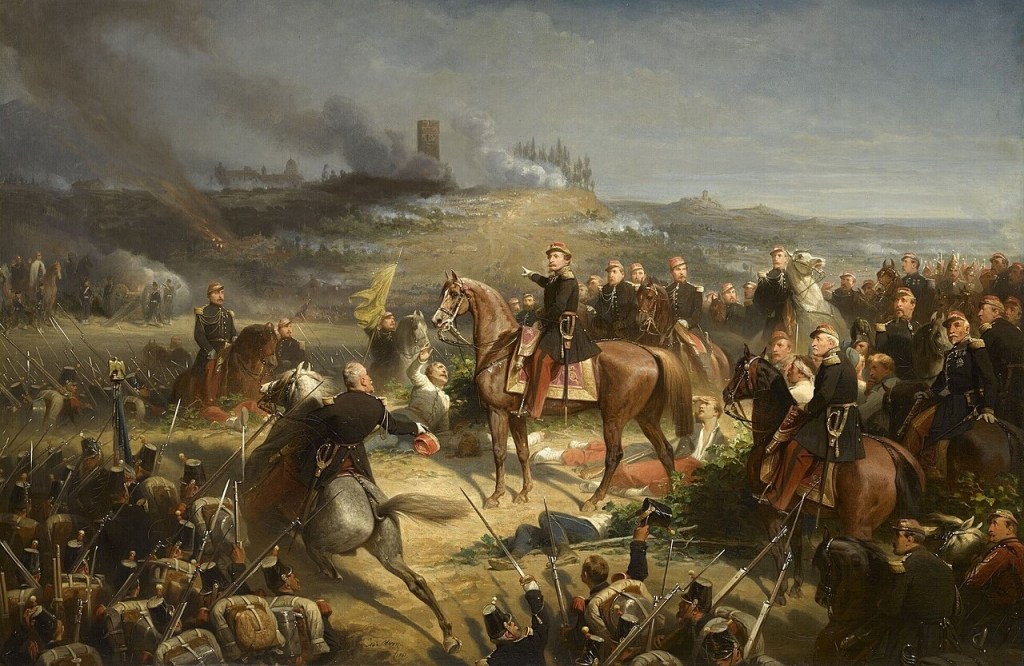
    See question two. Napoleon III at the decisive moment of the Battle of Solferino, 1859.
    Image Wikimedia Commons

    Today’s first question centres around the date 6th June, and the subsequent questions build on a theme established by the first.


    One

    The YMCA was founded on this day. Which decade and major city was it established in?

    Answers: 1840s; London, UK.

    The YMCA, founded in London in 1844 by George Williams, is a nonsectarian Christian movement promoting Christian character through activities. It spread globally, reaching North America in 1851. Programs include sports, education, and public affairs. In 2010, the U.S. branch rebranded as ‘the Y’, while some branches retained YMCA.


    Two

    The aftermath of the Battle of Solferino on 24 June 1859, during the Second War of Italian Independence, resulted in the 1863 formation of what organisation?

    Answer: International Committee of the Red Cross (aka Red Cross).

    Until the mid-19th century, army nursing systems were unorganised. In June 1859, Swiss businessman Jean-Henri Dunant witnessed the aftermath of the Battle of Solferino, where 40,000 soldiers were casualties, and was shocked by the lack of medical care. He organised relief efforts and wrote A Memory of Solferino in 1862, advocating for national and international relief organisations. In 1863, Geneva lawyer Gustave Moynier initiated discussions on Dunant’s ideas, leading to an investigatory commission and plans for an international conference which resulted in the formation of the International Red Cross.


    Three

    By what name were the Poor Fellow-Soldiers of Christ and of the Temple of Solomon commonly known by; in what century were they founded and where were their headquarters?

    Answers: Knights Templar; 12th century; Temple Mount, Jerusalem, Kingdom of Jerusalem.

    The Knights Templar, founded in 1119 to protect pilgrims in the Holy Land, evolved into a wealthy and powerful religious military order. Endorsed by the Church, they grew rapidly, becoming skilled Crusaders and prominent in finance. With innovative banking techniques, they managed a vast economic network of nearly 1,000 commanderies across Europe and the Holy Land. Their influence bred envy, and as they lost support due to their failure to hold the Holy Land, King Philip IV of France arrested and tortured them in 1307. This led Pope Clement V to disband the order in 1312. Some assets merged into the Portuguese Order of Christ and Spanish Order of Montesa. Accused of heresy, they were brutally suppressed by Philip IV.


    Four

    What organisation founded in 1945 has major offices in New York City, Geneva, Nairobi, Vienna and The Hague; and, to the nearest ten, how many of the world’s states are members of it?

    Answers: United Nations; 190.

    The United Nations (UN), established on 26 June 1945, aims to maintain peace, develop friendly relations, and promote cooperation. Headquartered in New York City, it includes six principal organisations, 193 member states, and two observer states. The UN operates 11 peacekeeping missions and has received both praise and criticism for its efforts.


    Five

    The British branch of an international organisation founded in 1961 began running charity fundraising shows in 1976 to support the organisation’s wider mission. These shows gained popularity and became known as The Secret Policeman’s Balls. What is the name of the international organisation founded in 1961?

    Answer: Amnesty International.

    Amnesty International, founded in London in 1961 by Peter Benenson, is a global NGO advocating for human rights, especially freedom of speech and against torture. It campaigns for political prisoners’ release and collaborates internationally. Awarded the 1977 Nobel Peace Prize, it operates in over 150 countries, led by an international executive committee. With over ten million members, it focuses on justice, torture issues, and awareness campaigns.