Here are the answers to today’s questions.
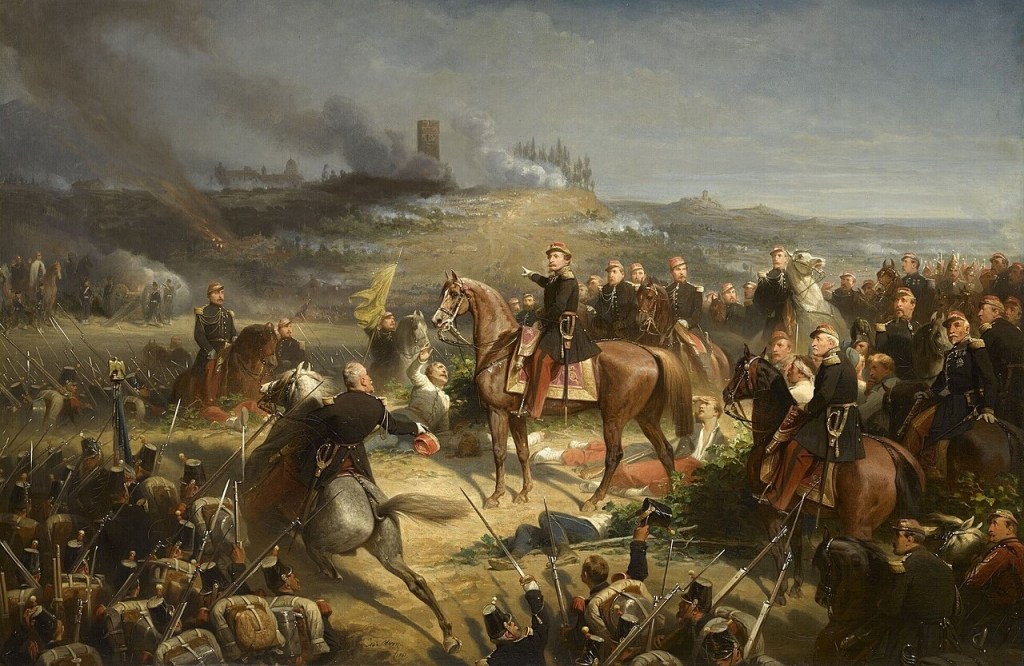
Image Wikimedia Commons
Today’s first question centres around the date 6th June, and the subsequent questions build on a theme established by the first.
One
The YMCA was founded on this day. Which decade and major city was it established in?
Answers: 1840s; London, UK.
The YMCA, founded in London in 1844 by George Williams, is a nonsectarian Christian movement promoting Christian character through activities. It spread globally, reaching North America in 1851. Programs include sports, education, and public affairs. In 2010, the U.S. branch rebranded as ‘the Y’, while some branches retained YMCA.
Two
The aftermath of the Battle of Solferino on 24 June 1859, during the Second War of Italian Independence, resulted in the 1863 formation of what organisation?
Answer: International Committee of the Red Cross (aka Red Cross).
Until the mid-19th century, army nursing systems were unorganised. In June 1859, Swiss businessman Jean-Henri Dunant witnessed the aftermath of the Battle of Solferino, where 40,000 soldiers were casualties, and was shocked by the lack of medical care. He organised relief efforts and wrote A Memory of Solferino in 1862, advocating for national and international relief organisations. In 1863, Geneva lawyer Gustave Moynier initiated discussions on Dunant’s ideas, leading to an investigatory commission and plans for an international conference which resulted in the formation of the International Red Cross.
Three
By what name were the Poor Fellow-Soldiers of Christ and of the Temple of Solomon commonly known by; in what century were they founded and where were their headquarters?
Answers: Knights Templar; 12th century; Temple Mount, Jerusalem, Kingdom of Jerusalem.
The Knights Templar, founded in 1119 to protect pilgrims in the Holy Land, evolved into a wealthy and powerful religious military order. Endorsed by the Church, they grew rapidly, becoming skilled Crusaders and prominent in finance. With innovative banking techniques, they managed a vast economic network of nearly 1,000 commanderies across Europe and the Holy Land. Their influence bred envy, and as they lost support due to their failure to hold the Holy Land, King Philip IV of France arrested and tortured them in 1307. This led Pope Clement V to disband the order in 1312. Some assets merged into the Portuguese Order of Christ and Spanish Order of Montesa. Accused of heresy, they were brutally suppressed by Philip IV.
Four
What organisation founded in 1945 has major offices in New York City, Geneva, Nairobi, Vienna and The Hague; and, to the nearest ten, how many of the world’s states are members of it?
Answers: United Nations; 190.
The United Nations (UN), established on 26 June 1945, aims to maintain peace, develop friendly relations, and promote cooperation. Headquartered in New York City, it includes six principal organisations, 193 member states, and two observer states. The UN operates 11 peacekeeping missions and has received both praise and criticism for its efforts.
Five
The British branch of an international organisation founded in 1961 began running charity fundraising shows in 1976 to support the organisation’s wider mission. These shows gained popularity and became known as The Secret Policeman’s Balls. What is the name of the international organisation founded in 1961?
Answer: Amnesty International.
Amnesty International, founded in London in 1961 by Peter Benenson, is a global NGO advocating for human rights, especially freedom of speech and against torture. It campaigns for political prisoners’ release and collaborates internationally. Awarded the 1977 Nobel Peace Prize, it operates in over 150 countries, led by an international executive committee. With over ten million members, it focuses on justice, torture issues, and awareness campaigns.


Leave a Reply