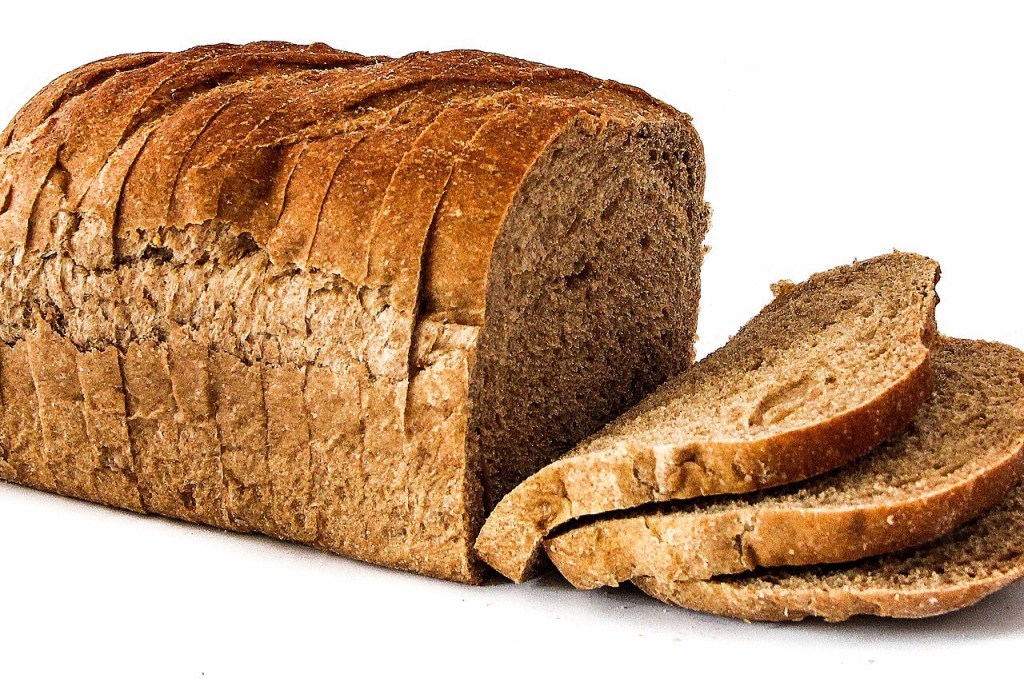
Fresh brown loaf sliced to uniform thickness by a bread slicing machine. Image Wikimedia Commons
All of today’s questions relate to the date, 7 July.
One
On this day, bread loaves that had been pre-sliced by a machine designed by jeweller Otto Rohwedder were sold for the first time. In what decade and on what continent did this occur?
Two
The archipelago in which the six-month-long World War II Battle of Guadalcanal took place gained independence in 1978. By what name is this island country known today, and what country did it gain independence from?
Three
Also in 1978, Martina Navratilova won the first of her Wimbledon singles titles. Who was the defeated semi-finalist in that match, and how many singles titles did Navratilova win at Wimbledon in total?
Four
The final film adaptation of J.K. Rowling’s Harry Potter book series premiered in London. What was the film’s title, and in what year was this?
Five
On this day in 1937, an incident occurred at the Marco Polo Bridge between troops of two armies. This became the first incident in a war that lasted eight years. In what country is the Marco Polo Bridge? The belligerents in this war were a republic and an empire. Who were they?
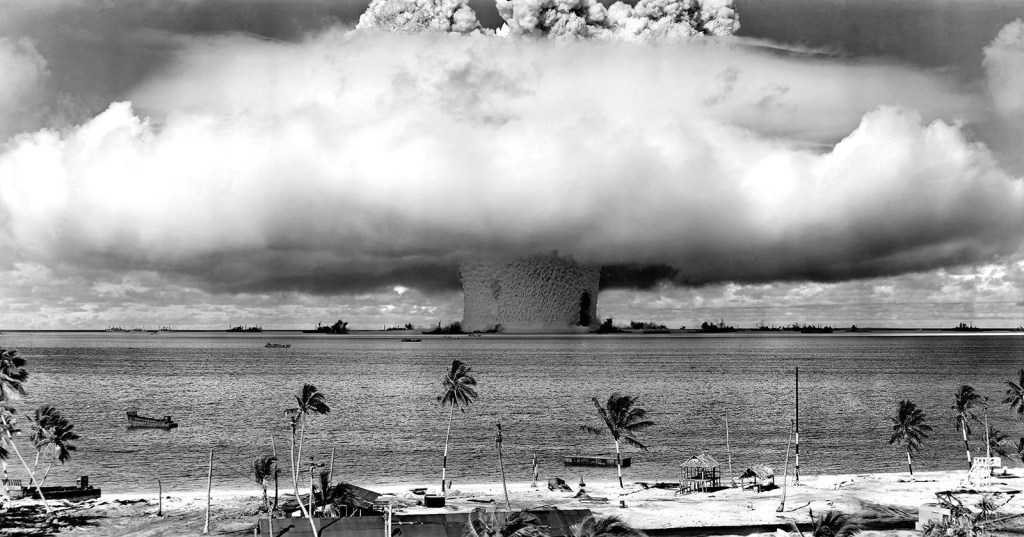
The first underwater test conducted by the U.S. of an atomic bomb at Bikini atoll. Image Encyclopædia Britannica
Today’s first question concerns the date 5 July. The subsequent questions share a theme established by the first.
One
On this day in 1946, French designer Louis Réard introduced a new swimsuit he called the Bikini, inspired by the location of recent US nuclear tests. In what island group is the Bikini Atoll situated?
Answer: Marshall Islands.
On this day in 1946, French designer Louis Réard unveiled the bikini, a two-piece swimsuit named after Bikini Atoll. The bikini became a symbol of changing attitudes towards self-expression and bodily autonomy, despite initial scandal and condemnation. Today, the bikini is celebrated as a powerful expression of agency and body positivity. The Marshall Islands atomic bomb tests by the United States from 1946 to 1958 involved 67 tests on Bikini and Enewetak atolls. The Castle Bravo thermonuclear bomb test in 1954 yielded 15 megatons, far exceeding expectations and causing widespread devastation, including vaporising three of Bikini’s islands. The U.S. has since paid compensation to affected parties but the atolls remain contaminated with radiation and uninhabitable. Bikini’s coral reefs recovered, but land and food are unsafe.
Two
A balaclava, also known as a ski mask, was named after its use by British troops at the Battle of Balaclava. Which war was this and in which decade did it occur?
Answers: Crimean War; 1850s.
A balaclava, or ski mask, is headgear exposing parts of the face, used in skiing, snowboarding, and racing. Originating from the 1854 Battle of Balaclava during the Crimean War, British troops wore knitted headgear for warmth. Similar 19th-century headgear included the Uhlan cap and Templar cap.
Three
The sturdy cotton warp-faced textile used to make jeans has a name which points to the city of origin. What is that name, and what is the city?
Answers: Denim; Nîmes.
Denim is a sturdy cotton warp-faced textile in which the weft passes under two or more warp threads, originating from the French phrase sergé de Nîmes (‘serge from Nîmes’). This durable twill-woven fabric, typically made from cotton, is known for its longevity and is yarn-dyed and mill-finished. Jeans, trousers made from denim, originated in the 19th century as workwear. They gained popularity beyond labourers, becoming associated with various cultural movements and are now valued for their versatility and ability to transcend social boundaries.
Four
What U.S. president has a short battledress-type uniform jacket named after him?
Answer: Dwight. D Eisenhower.
The Eisenhower jacket, or Ike jacket, officially the M-1944 Jacket, was developed for the U.S. Army in WWII, named after Dwight D. Eisenhower. Inspired by the British Battledress, it featured a pleated back, adjustable waist, and multiple pockets. Major General Ira C. Eaker influenced its creation.
Five
Made famous when worn by Audrey Hepburn in Roman Holiday (1953) Capri pants are named after the island of Capri. In what marginal sea is the Capri located?
Answer: Tyrrhenian Sea.
Capri pants, introduced by Sonja de Lennart in 1948, gained popularity on the Italian isle of Capri in the late 1950s and early 1960s. Iconic figures like Audrey Hepburn and Brigitte Bardot popularised them. In the U.S., Mary Tyler Moore’s character in The Dick Van Dyke Show further popularised capris.
As soon as the war ended, we located the one spot on earth that hadn’t been touched by the war and blew it to hell.
The post title is a quote from American comedian Bob Hope.
The first underwater test conducted by the U.S. of an atomic bomb at Bikini atoll. Image Encyclopædia Britannica
Today’s first question concerns the date 5 July. The subsequent questions share a theme established by the first.
One
On this day in 1946, French designer Louis Réard introduced a new swimsuit he called the Bikini, inspired by the location of recent US nuclear tests. In what island group is the Bikini Atoll situated?
Two
A balaclava, also known as a ski mask, was named after its use by British troops at the Battle of Balaclava. Which war was this and in which decade did it occur?
Three
The sturdy cotton warp-faced textile used to make jeans has a name which points to the city of origin. What is that name, and what is the city?
Four
What U.S. president has a short battledress-type uniform jacket named after him?
Five
Made famous when worn by Audrey Hepburn in Roman Holiday (1953) Capri pants are named after the island of Capri. In what marginal sea is the Capri located?
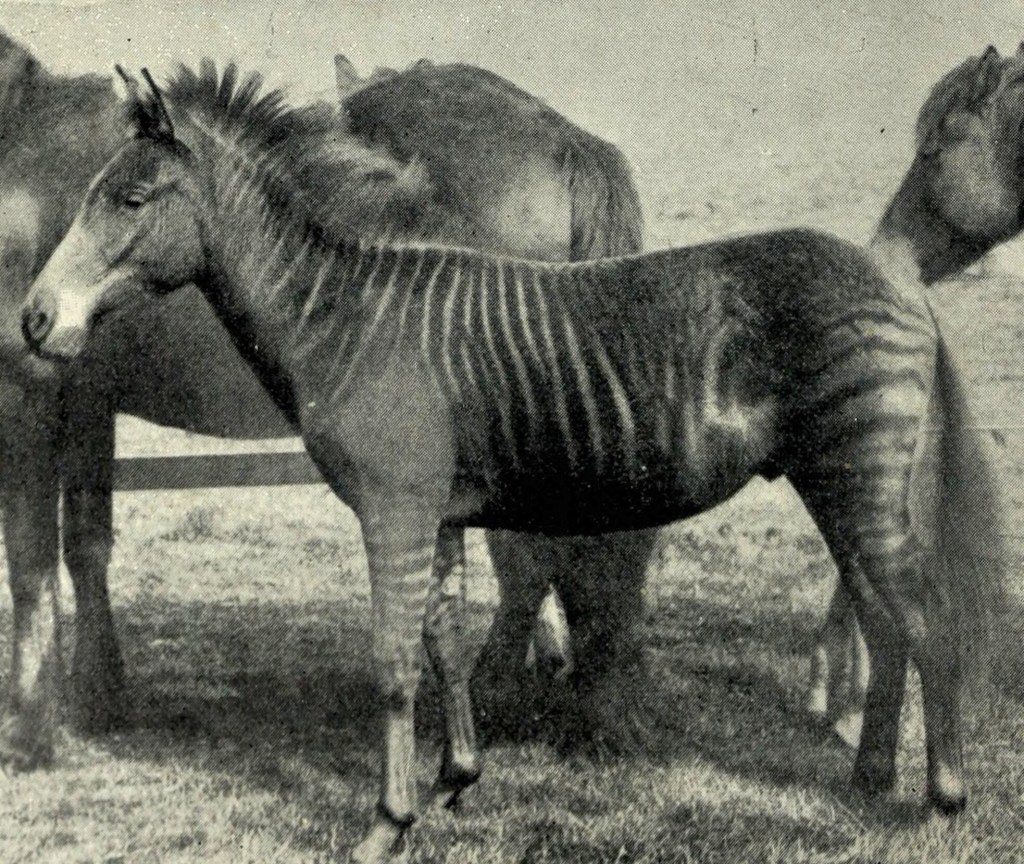
See question two. Zonkey, the hybrid offspring of a donkey and a zebra. Image Wikimedia Commons
Today’s questions are not date-related, nor are the questions related, but there is a theme concerning the answers.
One
What word completes the title of a 1965 war film starring Kirk Douglas and Richard Harris, which was based on a true story and shot in Norway: The Heroes of …?
Answer: Telemark.
The Heroes of Telemark is a 1965 British war film based on a true story. It depicts a sabotage mission against a Norwegian heavy water plant during World War II. At the time, Norway was occupied by German forces and there was a fear that the plant could aid their efforts to build an atomic bomb.
Two
What is defined in the Oxford English Dictionary as ‘the hybrid offspring of a donkey and a zebra’? (NB. The same word is used in Mexico for donkeys painted as zebras for tourist souvenir photos.)
Answer: Zonkey.
Imagine a creature that embodies the rugged resilience of a donkey and the striking elegance of a zebra. This is no mythical beast, but a living, breathing marvel known as the zonkey. A fascinating hybrid, the zonkey captures the imagination with its unique blend of features, often sporting the sturdy body of a donkey adorned with the distinctive stripes of a zebra, typically concentrated on its legs, neck, and sometimes its torso. These captivating animals are a testament to the intricate dance of genetics and the surprising outcomes that can arise when different species meet.
Dating from the first half of the 20th century from what language did the words ‘rooibos’ and ‘apartheid’ originate?
Answer: Afrikaans.
Rooibos is an evergreen South African shrub, and its leaves are used to make a tea. It originated in the early 20th century from Afrikaans, and means literally ‘red bush’. Apartheid, a system of racial segregation and discrimination, was adopted as a slogan in the 1948 election by the Afrikaner National Party in South Africa. The system was maintained until February 1991 despite domestic unrest and international isolation. Originating in the 1940s, from Afrikaans, literally ‘separateness’.
Four
Who won Best Supporting Actress Oscar for her part in The Constant Gardener?
Answer: Rachel Weisz.
The Constant Gardener is a 2005 drama thriller film directed by Fernando Meirelles, based on John le Carré’s novel. It follows a British diplomat in Kenya investigating his wife’s murder. A critical and box office success, it achieved four Oscar nominations, with Weisz winning Best Supporting Actress.
Five
What body of water was home to the British Fleet during both the First and Second World Wars, as well as being the site of the 1919 scuttling of the interred German High Sea Fleet and the 1939 sinking of HMS Royal Oak?
Answer: Scapa Flow.
Scapa Flow, a sheltered body of water in the Orkney Islands, Scotland, has historical significance as a Viking anchorage and UK naval base. HMS Royal Oak is a war grave for over 800 seamen who perished when the ship was torpedoed by a German U-boat. Today, it is known for its diving sites and as a location for oil and LNG transfers.
Russian Caesars
The post title Russian Caesars refers to Tzar (also Tsar or Czar) in plural, TZARS which gives the start letter for each of the above answers.
See question two. ?, the hybrid offspring of a donkey and a zebra. Image Wikimedia Commons
Today’s questions are not date-related, nor are the questions related, but there is a theme concerning the answers.
One
What word completes the title of a 1965 war film starring Kirk Douglas and Richard Harris, which was based on a true story and shot in Norway: The Heroes of …?
Two
What is defined in the Oxford English Dictionary as ‘the hybrid offspring of a donkey and a zebra’? (NB. The same word is used in Mexico for donkeys painted as zebras for tourist souvenir photos.)
Three
Dating from the first half of the 20th century from what language did the words ‘rooibos’ and ‘apartheid’ originate?
Four
Who won Best Supporting Actress Oscar for her part in The Constant Gardener?
Five
What body of water was home to the British Fleet during both the First and Second World Wars, as well as being the site of the 1919 scuttling of the interred German High Sea Fleet and the 1939 sinking of HMS Royal Oak?
Today’s questions are a mixed bag with no connection to the date.
One
What does the Oxford English Dictionary define as ‘a German dish of chopped pickled cabbage’?
Answer: Sauerkraut.
Sauerkraut, made by fermenting finely cut raw white cabbage with lactic acid bacteria, has a sour flavour and a long shelf life. This ancient fermentation process preserves cabbage by converting sugars into lactic acid. Roman writers Cato, Columella, and Plinius the Elder mentioned cabbage preservation, with evidence of sauerkraut in Europe during the early Western Roman Empire. Essential for winter nutrients in Northern, Central, and Eastern Europe, it was also used by Captain James Cook to prevent scurvy.
Two
What is a shark’s skeleton primarily composed of?
Answer: Cartilage.
Shark skeletons are made of cartilage, making them lighter and more flexible than bony fish and terrestrial vertebrate skeletons.
Three
What 2002 film was a remake of a 1960 Rat pack film?
Answer: Ocean’s Eleven.
Ocean’s Eleven was a remake of Ocean’s 11. During the 1960s, the Rat Pack included legends like Frank Sinatra, Dean Martin, Sammy Davis Jr, Joey Bishop and Peter Lawford.
Four
What is the capital city of the State of Florida?
Answer: Tallahassee.
Tallahassee, Florida’s capital since 1824, had 205,089 residents in 2024, ranking eighth in the state. Home to Florida State University and Florida A&M University, it hosts the Florida State Capitol. Indigenous peoples lived there for millennia. During the First Seminole War, future president General Andrew Jackson attacked the Seminoles near Tallahassee.
Five
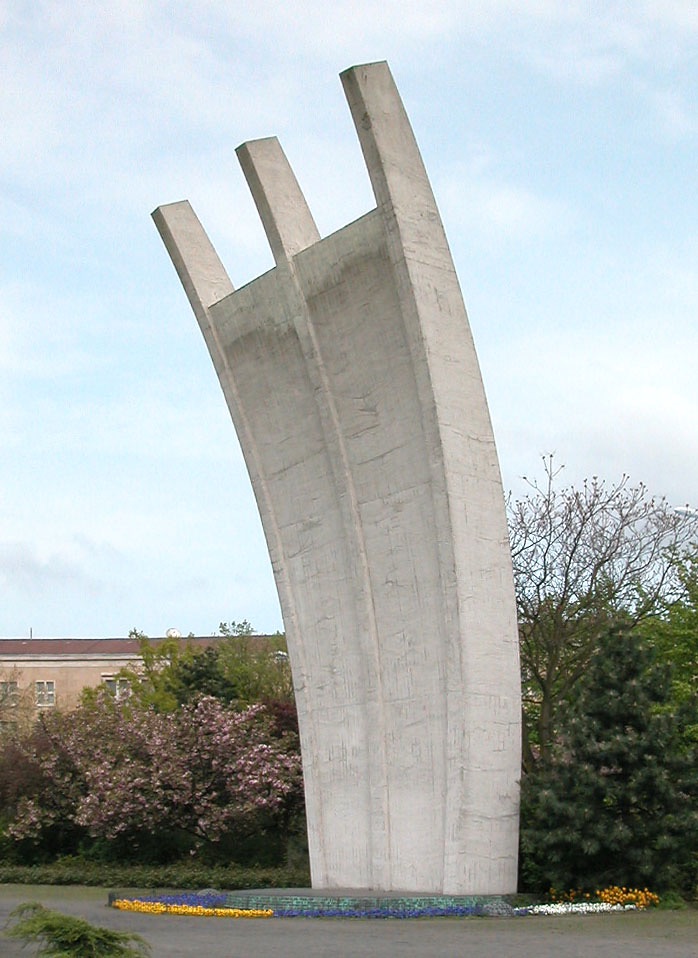
The Berlin Airlift Monument pictured at top is located at which German airport?
Answer: Tempelhof.
The Berlin Blockade (24 June 1948 – 12 May 1949) was a Cold War crisis where the Soviet Union blocked Western access to West Berlin. The Berlin Airlift supplied the city, with over 250,000 flights delivering 2,334,374 tons of supplies. The blockade ended, highlighting ideological tensions and aligning West Berlin with the US and Britain. The Berlin Airlift Monument displays the names of the 39 British and 31 American airmen who lost their lives during the operation.
Operation Little Vittles
The post title Operation Little Vittles refers to an operation which came about when aircrew in the airlift started dropping sweets to German children as they made their landing approach over Berlin.
Today’s questions are a random mix, which are neither date-related nor themed.
One
Whose house is scheduled for demolition at the beginning of The Hitchhiker’s Guide to the Galaxy?
Answer: Arthur Dent.
Arthur wakes to be informed by a council official that his house has to be demolished that morning to make way for a bypass. While he tries to prevent this happening, his friend Ford Prefect arrives and insists on taking him to the pub. As they do this, a Vogon spaceship appears, and an announcement is made that Earth has to be demolished that morning to make way for an interstellar bypass. Ford manages to get both himself and Arthur onto the spaceship before Earth is destroyed.
Two
Established in the year 324, this city was built on the site of an existing one and initially known as New Rome. Three questions:
What was the name of the existing city?
What name very quickly superseded New Rome?
What name is this city known as today?
Answers
Byzantium
Constantinople
Istanbul Istanbul, originally Byzantium, became a pivotal city, serving as the capital of four empires over 16 centuries: Roman, Byzantine, Latin, and Ottoman. It advanced Christianity before becoming an Islamic stronghold in 1453. Istanbul’s historic centre remains a UNESCO World Heritage Site.
Three
Starting in the 1970s, an actor who connected Lawrence of Arabia and Doctor Zhivago dedicated much of his time to bridge. He published books, videos, video games, and a syndicated column all about the card game. Who is this?
Answer: Omar Sharif.
Omar Sharif, born Michel Yusef Dimitri Chalhoub, was an Egyptian actor famed for roles in Lawrence of Arabia and Doctor Zhivago. He starred in over 100 films and won three Golden Globes and a César Award. A multilingual bridge and horse racing enthusiast, he received prestigious honours and passed away in 2015.
Four
Rhea and Tethys are two major moons of a planet in the solar system. Here are three questions:
Which planet are they moons of?
Rhea and Tethys are what in Greek mythology?
Approximately how many moons does this planet have in total, to the nearest ten?
Answers
Saturn
Titans
270 (274)
Saturn has 274 confirmed moons in its orbit, far more than any other planet in our solar system. In March 2025, astronomers confirmed the discovery of 128 small moons around Saturn — adding to the already large moon count.
Saturn’s moons range in size, from one that is larger than the planet Mercury — the giant moon Titan — to others as small as a sports arena. The small moon Enceladus has a global ocean under a thick, icy shell. Scientists have identified both moons as high-priority science destinations for future deep-space missions.
The 2008 film and 2019 musical The Curious Case of Benjamin Button are both adaptations of a short story. Who wrote it?
Answer: F. Scott Fitzgerald.
The Curious Case of Benjamin Button is a satirical short story by F. Scott Fitzgerald, published in Collier’s Magazine on 27 May 1922. It features reverse ageing and was included in Tales of the Jazz Age. The story inspired a 2008 Oscar-nominated film and an Olivier Award-winning musical.
Title
The post title ‘Is there any tea on this spaceship?’ is a quote by Arthur Dent in Douglas Adams’ The Hitchhiker’s Guide to the Galaxy.
Today’s questions are a random mix, which are neither date-related nor themed.
One
Whose house is scheduled for demolition at the beginning of The Hitchhiker’s Guide to the Galaxy?
Two
Established in the year 324, this city was built on the site of an existing one and initially known as New Rome. Three questions:
What was the name of the existing city?
What name very quickly superseded New Rome?
What name is this city known as today?
Three
Starting in the 1970s, an actor who connected Lawrence of Arabia and Doctor Zhivago dedicated much of his time to bridge. He published books, videos, video games, and a syndicated column all about the card game. Who is this?
Four
Rhea and Tethys are two major moons of a planet in the solar system. Here are three questions:
Which planet are they moons of?
Rhea and Tethys are what in Greek mythology?
Approximately how many moons does this planet have in total, to the nearest ten?
Five
The 2008 film and 2019 musical The Curious Case of Benjamin Button are both adaptations of a short story. Who wrote it?
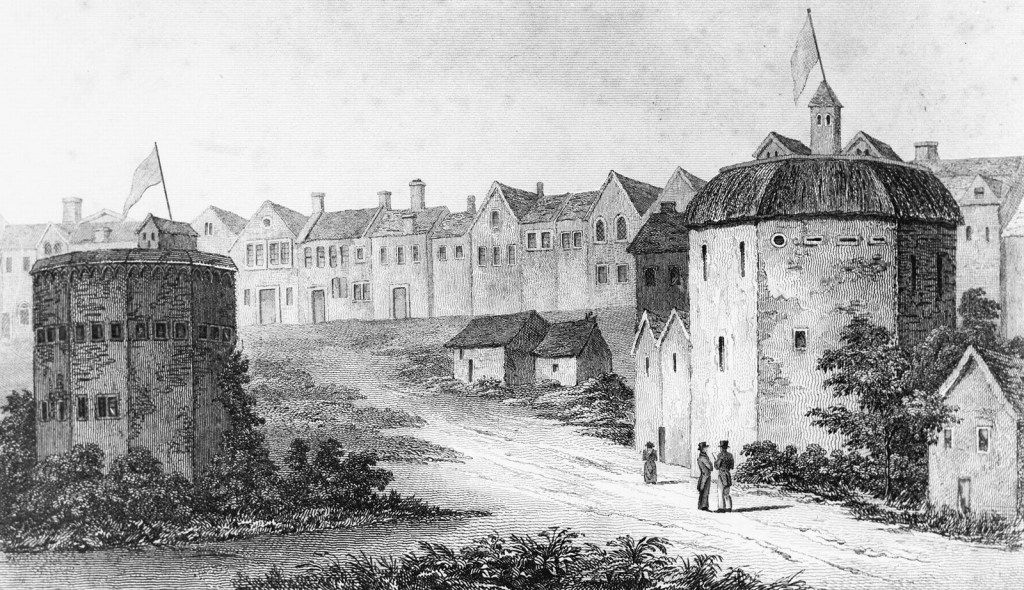
Bear Garden (left) and Globe Theatre (right), Southwark, London. Engraving, 1597. Image Encyclopædia Britannica
Today’s selection of trivia is all related to the date, 29 June.
One
London’s Globe Theatre was destroyed by fire in 1613, which took hold during a performance of William Shakespeare’s Henry VIII. What caused the fire?
Answer: Cannon fire.
A theatrical cannon misfired during a performance, causing a fire in the wooden beams and thatching. Only one person was injured, with his burning breeches extinguished by ale. The building was rebuilt the next year with a tile roof, costing £1,400.
Two
Brazil won their first FIFA World Cup on this day. In what year was this victory, and who were their defeated opponents in the final?
Answer: 1958; Sweden.
The 1958 FIFA World Cup final in Sweden saw Brazil win their first title by defeating the hosts. The match, which was the first final between European and American teams, set records for goals, winning margin, and age of the youngest and oldest goal scorers. Pelé was only 17 years and 249 days old, while Nils Liedholm was 18 years and 15 days older than Pelé at 35 years and 263 days.
Three
In 1534, Canada’s Prince Edward Island was ‘discovered’ by Europeans. In 1908, a Canadian author wrote a children’s novel about an orphan sent to live at Avonlea, PEI. Who made the 1534 discovery; who was the author, and what was the title of the 1908 novel?
Answer: Jacques Cartier; Lucy Maud Montgomery and Anne of Green Gables.
Lucy Maud Montgomery, known as L. M. Montgomery, was a Canadian author famous for Anne of Green Gables (1908). She published 20 novels and over a thousand short stories and poems. Her work, set on Prince Edward Island, inspired adaptations and tourism.
Four
Born in 1978, Nicole Scherzinger played what role in the film Men in Black 3?
Answer: Lilly Poison.
Nicole Scherzinger is an American singer, actress, and television personality. She gained fame as the lead singer of the Pussycat Dolls and later pursued a successful solo career. Scherzinger has also served as a judge on various talent shows and has received numerous accolades for her work in music and theatre.
Five
On this day in 1861, in Florence, Italy, an English poet died at the age of 55. She was living in Florence with her English husband, also a poet. She is known for the line, ’How do I love thee? Let me count the ways’, which, in part, has been used in the title of several works of music and literature? Who is this poet?
Answer: Elizabeth Barrett Browning.
Elizabeth Barrett Browning, an English poet, is celebrated for Sonnets from the Portuguese and Aurora Leigh, an early feminist text. Despite a spinal injury at 15, she married Robert Browning in 1846, moved to Florence, and engaged in Italian politics. Her influential work advocated social reforms, impacting slavery and child labour laws.