Confused to Start With | Answers

J. M. Flagg’s recruiting poster, 1917
Wikipedia
  1. Luc means—is an anagram of Uncle Sam. Uncle Sam, a national personification of the United States, represents the federal government and is a symbol of patriotic emotion. The character, popularised by a 1917 recruiting poster, originated during the War of 1812 and is distinct from Columbia, representing the nation, and Brother Jonathan, representing the populace.
    Lonesome George.
    Wikipedia
  2. Pinta—Pinta Island tortoise, a subspecies of Galápagos tortoise, was hunted to near extinction by the end of the 19th century. A single male, Lonesome George, was discovered in 1971 but died in 2012, leading to the subspecies’ presumed extinction.
  3. YesterdayYesterday was the only “solo” Beatles Track.

    “He [McCartney] played it to John, George and Ringo, who approved but didn’t think it required them to play on it. Yesterday would be a Beatles song with only one Beatle on it.”

    The Sunday Times, 23 March 2025 © Ian Leslie 2025. Extracted from John and Paul: A Love Story in Songs.

  4. AA Milne—Heffalumps and Woozles appear in the Winnie-the-Pooh stories
  5. Galahad—Sir Galahad, a knight of King Arthur’s Round Table, is the illegitimate son of Sir Lancelot and Lady Elaine. He is renowned for his gallantry and purity, replacing Percival as the hero in the quest for the Holy Grail.
  6. Arachnophobia—fear of spiders. Shelob is a spider featured in The Lord of the Rings. Emetophobia is the fear of vomiting and pogonophobia is having an extreme dislike of beards.
Piglet dreams of the Heffalump. E. H. Shepard’s original illustration, from Winnie-the-Pooh.
Wikipedia

Confused to Start With


Nothing to do with today’s date just a selection of questions.

Flag of the US
Wikipedia
  1. Which one of the following can become a personification of the US government?
    • Clean Sue
    • Muscleman
    • Luc means
  2. Lonesome George, the last of his subspecies, died in 2012. His subspecies, now extinct, was named…
    • Niña Island tortoise
    • Pinta Island tortoise
    • Santa Maria Island tortoise
  3. The only Beatles song featuring just one Beatle was…
    • If I Fell
    • This Boy
    • Yesterday
  4. Heffalumps and Woozles appear in books by…
    • AA Milne
    • CS Lewis
    • JRR Tolkien
  5. One of King Arthur’s Knights of the Round Table; the son of Sir Lancelot du Lac and Lady Elaine of Corbenic; renowned for his gallantry and purity as the most perfect of all knights, is…
    • Bedivere
    • Galahad
    • Percival
  6. An irrational fear of the fictional Shelob is…
    • Arachnophobia
    • Emetophobia
    • Pogonophobia
The Arming and Departure of the Knights,
one of the Holy Grail tapestries, 1890s, figures by Edward Burne-Jones
Wikipedia

Good luck! The answers will be posted later.

Measure for Measure—Answers

The answers to the questions asked in my earlier post are shown, in bold, below.

Grains of barley
Wikipedia
  1. Wheat or barleycorn—Grain (abbreviation gr.), the smallest unit of weight in the troy and avoirdupois systems; originally, the weight was equivalent to that of a grain of corn.
    Surveyor’s chain.
    Gunter’s chain photographed at Campus Martius Museum/Wikipedia
  2. Chain—The chain, a unit of length equal to 66 feet, is used in both the US customary and Imperial unit systems. It is subdivided into 100 links and has been used since the early 17th century in England. The UK used 80 chains to the mile, but Scotland and Ireland used longer chains until 1824. India uses metric chains of 20 metres.
  3. Rod—which is a measure of length equal to a quarter of a chain or 5.5 yards (approximately 5.029 m).  Also called perch or pole, it was especially used for measuring land.
    Illustration of Carob (Ceratonia siliqua)
    Wikipedia
  4. Carob seed—The carat (ct) is a unit of mass equal to 200 mg, used to measure gemstones and pearls. The current definition, adopted in 1907, is divisible into 100 points of 2 mg. Carob seeds, historically used to measure jewellery due to their believed consistent mass, actually vary in mass like other seeds.
    A woodcut of Noah’s Ark from Anton Koberger’s German Bible
    University of Edinburgh Image Collections/Wikipedia
  5. 300 cubits long, 50 cubits wide and 30 cubits highGenesis 6:14–16 King James Bible reads, 
    • “14 Make thee an ark of gopher wood; rooms shalt thou make in the ark, and shalt pitch it within and without with pitch. 
    • 15 And this is the fashion which thou shalt make it of: The length of the ark shall be three hundred cubits, the breadth of it fifty cubits, and the height of it thirty cubits
    • 16 A window shalt thou make to the ark, and in a cubit shalt thou finish it above; and the door of the ark shalt thou set in the side thereof; with lower, second, and third stories shalt thou make it.”
    Snow leopard
    Wikipedia
  6. Snow leopard—which is also known as the Ounce. The Old French word “once,” originally intended for the Eurasian lynx, is the source of the Latin name “uncia” and the English word “ounce”. An ounce is also a unit of weight equal to 437.5 grains or 1/16 pound (28.35 grams) avoirdupois. Another unit is 480 grains, which is 1/12 pound (31.1 grams) troy or apothecaries’ weight.
    The Nippur cubit-rod.
    Archeological Museum of Istanbul, Turkey/Wikipedia
  7. Euphrates—The Nippur cubit, one of the oldest known units of length, dates back to 2650 BCE. A copper bar standard for this Sumerian unit was discovered in Nippur, on the banks of the Euphrates, and is housed in the Istanbul Archaeological Museum.
  8. Jules VerneTwenty Thousand Leagues Under the Seas is a science fiction adventure novel by Jules Verne. It was originally serialised in a French periodical and later published in a deluxe edition with illustrations.
  9. Grain—The grain, based on barley weight, is the only unit equal across troy, avoirdupois, and apothecaries’ systems. It was the fundamental unit of the pre-1527 English weight system, Tower weight, based on wheat grain, was defined as exactly 45⁄64 (≈+3⁄4) of the troy “barley” grain.
  10. AU—Astronomical unit, defined as exactly equal to 149,597,870,700 m (92,955,807.3 miles) and effectively equal to the average, or mean, distance between the Earth and the Sun.
1 Astronomical Unit.
NASA/JPL-Caltech

Measure for Measure

Four measuring instruments calibrated in metric units
Wikipedia

Ten questions, all to do with measurements.

  1. The grain was the earliest unit of mass, initially, it referred to a grain of …
    • Rice
    • Salt
    • Wheat or barleycorn
  2. What unit of length is equivalent to 66 feet (20.1168 m)?
    • Cana
    • Chain
    • Cubit
  3. Of these three choices what is NOT a unit for measuring how heavy something is?
    • Rod
    • Shekel
    • Talent
  4. The carat, a unit for measuring gemstones, had its origin in what?
    • Carrot seed
    • Carob seed
    • Caraway seed
    Noah’s Ark by Edward Hicks
    Wikipedia
  5. According to the bible (Genesis 6:14–16) God decreed the dimensions for Noah to build his ark. In modern measurements the ark would be approximately 450 x 75 x 45 feet (137 x 23 x 14 m) but what were the original sizes as given in Genesis?
    • 100 cubits long, 30 cubits wide and 10 cubits high
    • 200 cubits long, 40 cubits wide and 20 cubits high
    • 300 cubits long, 50 cubits wide and 30 cubits high
  6. Which of these cats shares its alternative name with a unit of mass or weight?
    • Margay
    • Ocelot
    • Snow leopard
  7. The Nippur cubit, one of the oldest known units of length, dates from 2650 BCE. It was discovered on the banks of what river?
    • Euphrates
    • Nile
    • Yangtze
  8. What author used the measurement “leagues” in the title of a work written in 1870?
    • Arthur Conan Doyle
    • Jules Verne
    • HG Wells
  9. What is the only unit which is equal across the troy, avoirdupois and apothecaries’ systems?
    • Dram
    • Grain
    • Scruple
  10. What is an abbreviation for a unit of length which is defined to be exactly equal to 149,597,870,700 m?
    • AG
    • AR
    • AU
Balance scale
Wikipedia

Truth or Consequence—Answers

Truth and Consequence City Hall.
Wikipedia

Here, in bold, are the answers to my earlier post.

  1. False—It changed name to Truth or Consequence (not Tacos or Chocolate) in 1950 after the radio show of the same name ran a competition for a town or city to do so; the prize being that the show would be broadcast from the winner—the first settlement to change their town’s name. 
  2. False—Nothing to do with First Lady’s. It was chosen because it sounded like the French for help me, m’aider and was picked in 1920 by the head of radio in air traffic control at Croydon Aerodrome (then the world’s busiest) as most of their flights were from France.
  3. False—No, not Martin Luther King. It was about the assassination of JFK.
  4. False—Not the Inca Empire. Hernán Cortés conquered the Aztec Empire in what is now central Mexico in 1521 not the Inca’s in what is now Peru.
    Lucy in the Sky with Diamonds
    Wikipedia
  5. True—Lucy was named after the Beatles song, Lucy in the Sky with Diamonds.
  6. False—Pete Conrad, Apollo 12 was the third person to walk on the Moon. Michael Collins was the command module pilot of Apollo 11 and did not land on the Moon but remained in orbit while Neil Armstrong and Buzz Aldrin landed on the lunar surface.
    Goldeneye Estate
    Wikipedia
  7. False—Not Skyfall. Fleming’s house and estate were both named GoldenEye and are now a hotel complex.
  8. True—It is a neighbourhood on the West Side of Midtown Manhattan.
  9. False—Not Coprophagia which is dung-eating. Lalochezia is the release of stress etc by swearing.
  10. False—It wasn’t Please Mister Postman. The third number one, I Want to Hold Your Hand, was released in November 1963 with the B-side This Boy.
Pete Conrad
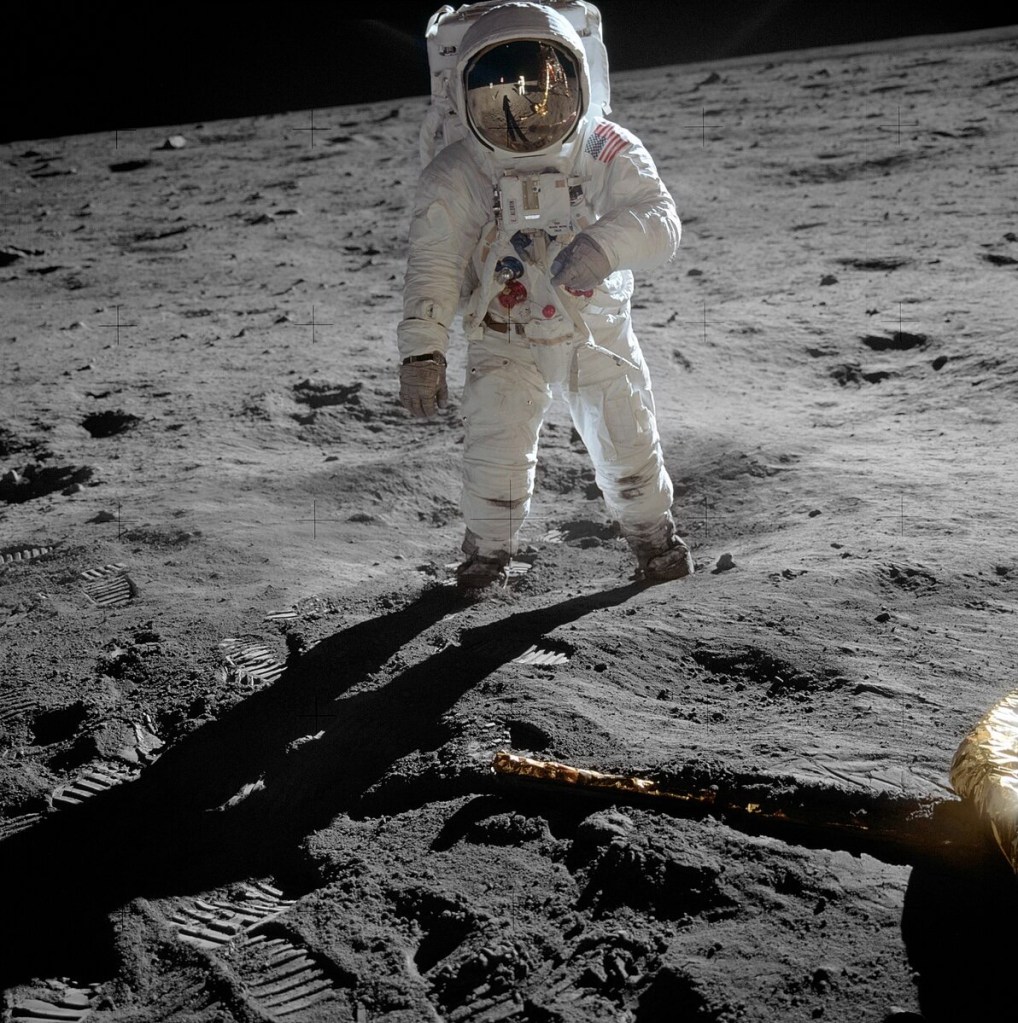
Conrad descends the Lunar Module ladder, moments before becoming the third human to walk on the Moon.
Wikipedia

Truth or Consequence

For some variety a selection of true or false questions unconnected to today.

Hot Springs, New Mexico.
Wikipedia
  1. True or false: the American city of Hot Springs, New Mexico is now known as ‘T or C’ after changing its name to Tacos or Chocolate in 1950.
  2. True or false: Mayday, the international distress signal, was chosen in honour of the then US First Lady.
  3. True or false: in 2020, Murder Most Foul was released as a single by Bob Dylan. The murder referred to in the title was the assassination of Martin Luther King in 1967.
  4. True or false: Hernán Cortés was a Spanish conquistador who conquered the Inca Empire in the Americas in 1521.
  5. True or false: Lucy the 3.2 million-year-old skeleton found in Ethiopia was named after a Beatles song.
  6. True or false: the Apollo astronaut Michael Collins was the third person to walk on the Moon.
  7. True or false: Ian Fleming, the author who created James Bond, had a home on Jamaica’s north coast named Skyfall.
  8. True or false: there is a neighbourhood of New York City called Hell’s Kitchen.
  9. True or false: relief of stress, pain and frustration by swearing is known as coprophagia.
  10. True or false: The Beatles third UK No. 1 hit I Want to Hold Your Hand was released with the B-side Please Mister Postman.

Good luck! The answers will be posted later today.

From House Demolition to Dining Out—Answers

Douglas Hydro.
Wikipedia

Below, in bold, are the answers to my earlier post.

  1. Douglas AdamsThe Hitchhiker’s Guide to the Galaxy is a renowned science fiction comedy series created by British writer Douglas Adams.
  2. Paranoid Android—Marvin the Paranoid Android. A robot endowed with a “brain the size of a planet” but cursed with chronic depression. Often providing dry, sardonic humour, Marvin’s character contrasts sharply with the other characters’ antics.
  3. Agrajag—A tragic figure who is continually reincarnated and inadvertently killed by Arthur Dent in various lifetimes, harbouring a grudge that adds a darkly comedic layer to the narrative.
  4. Eaten—The concept of an Ameglian Major Cow is that it genuinely desires to be consumed and satirises ethical debates around eating meat.
  5. Mattress—An inhabitant of the planet Squornshellous Zeta, Zem is a sentient, albeit somewhat dim-witted, swamp-dwelling mattress, showcasing Adams’ flair for the absurd.
  6. Ford Prefect-—Arthur’s eccentric friend who masquerades as an out-of-work actor but is actually an alien researcher for The Hitchhiker’s Guide to the Galaxy who is here to write an entry for Earth for inclusion in the next edition of the guide. His quick wit and knowledge of the intergalactic landscape often prove invaluable.
  7. Infinite Improbability Drive—A revolutionary propulsion system aboard the Heart of Gold spaceship. It allows the craft to traverse vast interstellar distances instantaneously by passing through every conceivable point in the universe simultaneously. Its unpredictability leads to many of the series’ most absurd and humorous moments.
  8. Slartibartfast—A Magrathean planet designer passionate about crafting coastlines, notably Norway’s fjords. His calm, methodical approach adds depth to the exploration of cosmic mysteries.
  9. Arthur Dent—The quintessential everyman protagonist whose mundane life is upended when Earth is destroyed to make way for a hyperspace bypass. Arthur’s bewildered journey through space forms the heart of the narrative.
  10. Radio series—Initially debuting as a radio series on BBC Radio 4 in 1978, it gained immense popularity, subsequently evolving into a series of novels, a television adaptation, stage shows, a text adventure game, and a feature film released in 2005.

From House Demolition to Dining Out

Zaphod Beeblebrox.
Wikipedia

As the writer and creator of The Hitchhiker’s Guide to the Galaxy was born on 12 March 1952, here are some questions on that subject; so from Agrajag to Zem, if you like.

  1. The creator and writer of The Hitchhiker’s Guide to the Galaxy was…
    • Douglas Adams
    • Terry Pratchett
    • Isaac Asimov
  2. The character Marvin is known as the…
    • Fraught Robot
    • Paranoid Android
    • Clot Bot
  3. Who, described as “a tragic and piteous creature”, is continually reincarnated and subsequently killed?
    • Agrajag
    • Annie
    • Almighty Bob
  4. The Ameglian Major Cow, which the main characters meet, has a desire to be…
    • Loved
    • Read poetry
    • Eaten
  5. Zem is an affable, yet stupid, swamp-dwelling…
    • Magician
    • Mattress
    • Mannequin
  6. Who, with an automobile-like name, is a main character?
    • Ford Prefect
    • Nissan Micra
    • Vauxhall Viva
  7. What is a type of drive powered the spacecraft Heart of Gold?
    • Infantile Tantrum Drive
    • Infinite Improbability Drive
    • Impractical Inability Drive
  8. This person is a Magrathean who is a designer of planets, his name is…
    • Vroomfondel
    • Slartibartfast
    • Majikthise
  9. The story opens on Earth in the home of…
    • Arthur Dent
    • Brian Bash
    • Charlie Scrape
  10. As what did The Hitchhiker’s Guide to the Galaxy start out?
    • Novel
    • Radio series
    • Film

Good luck! The answers will appear later today.
Where have you gone Joe DiMaggio—Answers

Joe DiMaggio.
Wikipedia
  1. Paul Simon and the song was Mrs Robinson—DiMaggio’s elegant style and sophisticated demeanour inspired nostalgic lines in literature and music, including Paul Simon’s tribute to forgotten heroes in Mrs. Robinson from the film The Graduate:”—
    “Where have you gone, Joe DiMaggio? 
    A nation turns its lonely eyes to you, whoa, whoa, whoa 
    What’s that you say, Mrs. Robinson? 
    Joltin Joe has left and gone away, hey, hey, hey 
    Hey, hey, hey”
    Queen Anne
    by Michael Dahl
    Wikipedia
  2. Anne—Anne, born on 6 February 1665, in London, became the last Stuart monarch of Great Britain on 8 March 1702, succeeding under the Act of Settlement of 1701. She reigned until her death on 1714, marking the end of the Stuart monarchy. Despite her desire for independent rule, Anne’s health issues and intellectual limitations led her to rely on ministers, who guided the country through the War of the Spanish Succession. Her reign was marked by Whig-Tory rivalries and succession uncertainty. Anne, raised Protestant, married Prince George of Denmark in 1683 and had a significant political relationship with Sarah Jennings Churchill.
    The cover for The Wind in the Willows
    Wikipedia
  3. Kenneth Grahame—Kenneth Grahame, born on 8 March 1859, in Edinburgh, Scotland, was a British author renowned for The Wind in the Willows (1908), a beloved children’s classic featuring animal characters with human traits. Orphaned young, he lived with his grandmother in England and attended St. Edward’s School, Oxford. Financial constraints prevented university attendance, leading him to a career at the Bank of England until his retirement in 1908 due to ill health. Grahame also contributed to journals like the St. James Gazette and published works such as Pagan Papers (1893), The Golden Age (1895), and Dream Days (1898), showcasing his insight into childhood.
    Althing logo.
    Wikipedia
  4. Althing—The Althing, Iceland’s unicameral legislature, is one of the world’s oldest national parliaments, founded around 930 at Thingvellir. It was the first representative assembly in medieval Scandinavia to hold national legislative power. The Althing met at Thingvellir until 1798 and was abolished by the Danish crown in 1800. It was reconvened in Reykjavík in 1845, with a special session at Thingvellir on June 17, 1944, to proclaim Iceland’s republic. Despite its historical interruptions, the Althing continues to serve as Iceland’s legislative body, reflecting its enduring significance in the nation’s political history.
  5. Clove and coconut plantations—1964 Revolutionary government of Zanzibar nationalized all farms and clove and coconut plantations. 
Flag of independent People Republic of Zanzibar in use between 12 January and 26 April 1964.
Wikipedia

Where have you gone Joe DiMaggio

Joe DiMaggio
Wikipedia
  1. In 1999 Joe DiMaggio died. A few decades before he died  he was mentioned in a lament to lost heroes in the line “Where have you gone Joe DiMaggio”—Who wrote the song that contained that line?
    • David Crosby
    • Bob Dylan
    • Paul Simon, and
    • as a bonus what was the song?
  2. On this day in 1702, who became the last Stuart monarch of Great Britain?
    • Anne
    • James VII
    • Charles II
  3. In 1859 the author of The Wind in the Willows was born, who was he?
    • Kenneth Grahame
    • Jerome K. Jerome
    • AA Milne 
  4. In 1844, the parliament of Iceland was reopened after a closure of 45 years, by what name is it known?
    • Althing
    • Storting
    • Folketing
  5. 1964 Revolutionary government of Zanzibar nationalized all…
    • Antimony and arsenic production
    • Banking and betting professions
    • Clove and coconut plantations

Good luck! The answers will be posted later