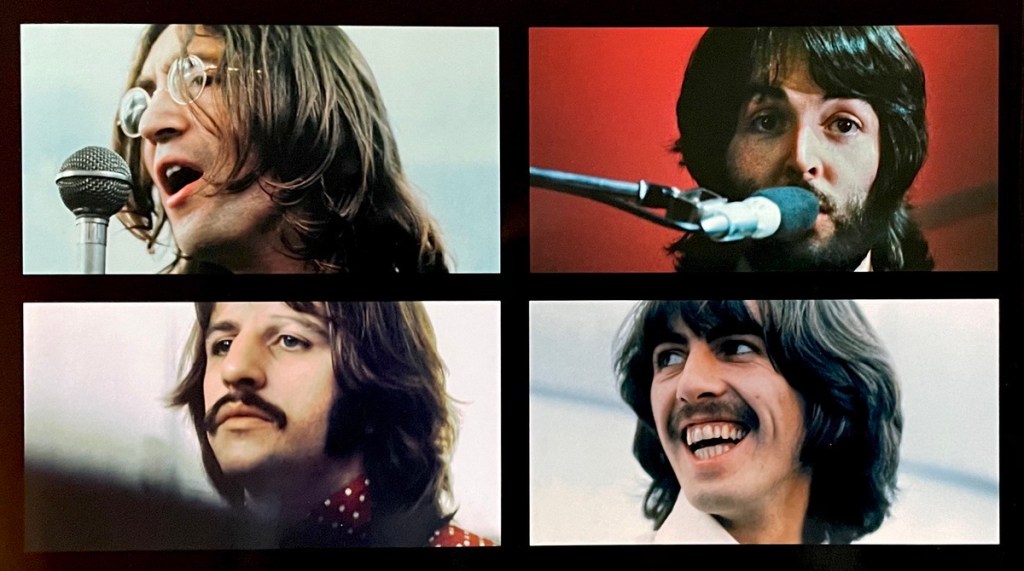
On this day in 1970, who became the first to publicly announce that he was leaving The Beatles?
Two
Name the official theme song for Mission: Impossible III; whose song it was, and who featured on it?
Three
Add up the numbers from the titles that these clues point you to, and the total sum is the answer.
The Beatles — Days of the Week (1964)
The Rolling Stones — Nervous Breakdown (1966)
Bob Marley and the Wailers — Little Birds (1977)
Bryan Adams — Summer (1985)
The Proclaimers — Miles (1988)
Vanessa Carlton — Miles
Adele — Album (2008)
Christina Perri — Years (2011)
Adele — Album (2021)
Belinda Carlisle — Loneliest Number (2025) (previously Harry Nilsson followed by Three Dog Night)
Four
Creedence Clearwater Revival topped the UK singles charts and reached number two on the Billboard Hot 100 in 1969 with a song from their Green River album, which had a three-word title. What song?
Five
Who were the four named members of the rock supergroup Crosby, Stills, Nash and Young?
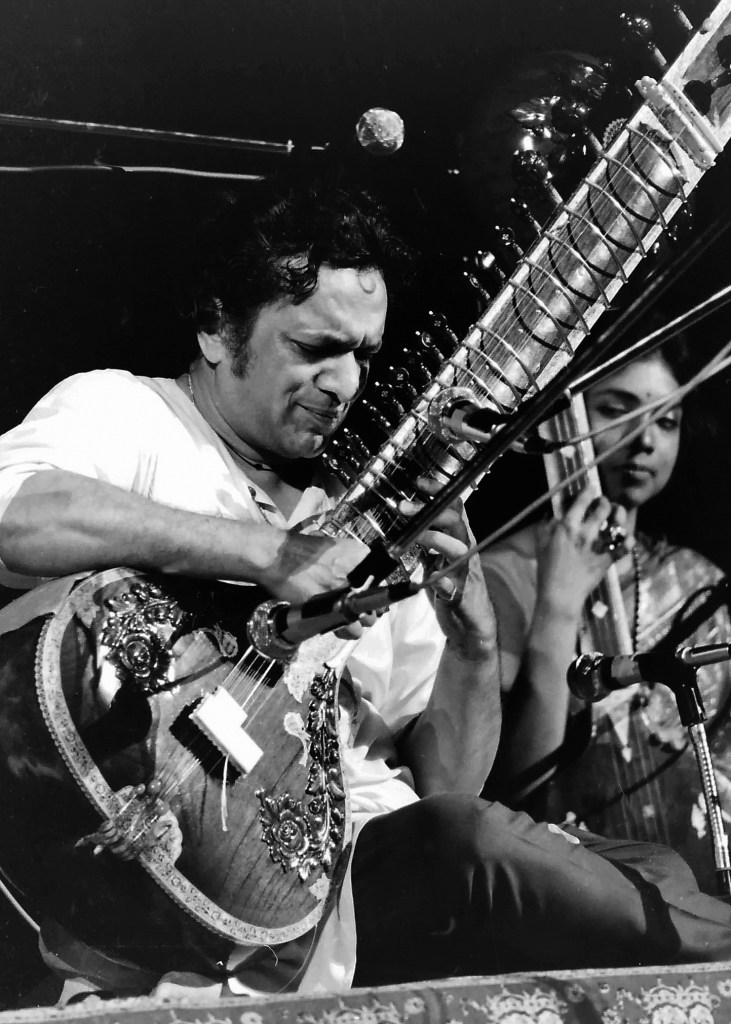
Ravi Shankar, an Indian musician and composer born in Varanasi, India on 7 April 1920, fathered a daughter in 1979. This daughter, a singer-songwriter and composer, is described by Wikipedia as blending jazz with country, blues, folk and pop. His younger daughter, Anoushka Shankar, born in 1981, is a sitarist and composer, and both daughters have won Grammy Awards. Who is the elder of his daughters?
Answer: Norah Jones.
Pandit Ravi Shankar, a renowned Indian sitarist and composer, popularised Indian classical music worldwide. He collaborated with Western musicians, such as the Beatles’ George Harrison and Yehudi Menuhin, influencing the use of Indian instruments in pop music. Shankar received numerous awards, including the Bharat Ratna and four Grammy Awards.
Two
What item of missing equipment did Spanish authorities find for the U.S. military in 1966?
Answer: Nuclear Bomb (Hydrogen Bomb).
Spanish authorities recovered a hydrogen bomb from the Mediterranean in 1966. The bomb had fallen from a U.S. B-52 after a collision with an airborne refuelling tanker, killing seven airmen.
Three
In 1939, the Albanian king went into exile after Albania became a protectorate of another nation. Who was the king? Which country declared the protectorate, and who was the prime minister of that country at the time?
Answers: King Zog; Italy and Benito Mussolini.
Appointed Prime Minister in 1922, Mussolini established a one-party dictatorship, later aspiring to a totalitarian state. His foreign policy, driven by the doctrine of spazio vitale, led to the annexation of Albania, Fiume and Ethiopia.
Four
On this day, Attila the Hun captured Metz, France, setting fire to the town and killing most of the townspeople. In what century did this occur?
Answer: 5th century.
Metz, originally ruled by the Celtic Mediomatrici tribe, became a prominent Roman town known for its trade, wine exports, and impressive infrastructure like the aqueduct and amphitheatre. The city faced invasions from Germanic tribes in the 3rd century and was eventually conquered by the Franks.
Five
Actor Russell Crowe was born this day in 1964. For what film did he win his Academy Award, and what was his character’s name in the film?
Answers: Gladiator; Maximus Decimus Meridius.
Russell Crowe, an actor and film director, is known for his intense performances and has earned numerous accolades, including an Academy Award. He gained international recognition in the late 1990s and starred in films like Gladiator, A Beautiful Mind, and Robin Hood. Crowe co-owns the National Rugby League team South Sydney Rabbitohs.
West Meets East
The post title is from an album title of a 1967 collaboration between Ravi Shankar and violinist Yehudi Menuhin.
Ravi Shankar, an Indian musician and composer born in Varanasi, India on 7 April 1920, fathered a daughter in 1979. This daughter, a singer-songwriter and composer, is described by Wikipedia as blending jazz with country, blues, folk and pop. His younger daughter, Anoushka Shankar, born in 1981, is a sitarist and composer, and both daughters have won Grammy Awards. Who is the elder of his daughters?
Two
What item of missing equipment did Spanish authorities find for the U.S. military in 1966?
Three
In 1939, the Albanian king went into exile after Albania became a protectorate of another nation. Who was the king? Which country declared the protectorate, and who was the prime minister of that country at the time?
Four
On this day, Attila the Hun captured Metz, France, setting fire to the town and killing most of the townspeople. In what century did this occur?
Five
Actor Russell Crowe was born this day in 1964. For what film did he win his Academy Award, and what was his character’s name in the film?
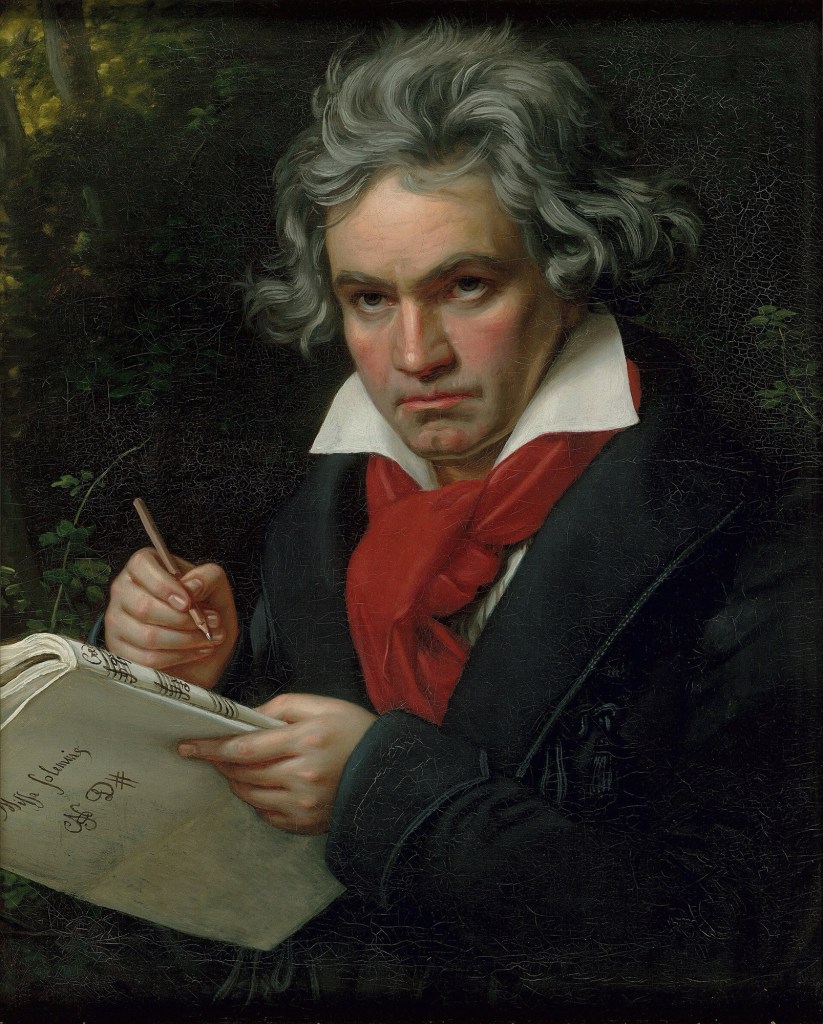
Ludwig van Beethoven with the manuscript of the Missa solemnis, 1820. Image Wikimedia Commons
On 2 April 1800, Ludwig van Beethoven led the premiere of his First Symphony, Symphony No. 1 in C major, Op. 21 in Vienna, so today’s questions are all about music.
One
When Hans von Bulow referred to three composers as ‘The three Bs’, one was Ludwig van Beethoven, but who were the other two?
Answer: Johann Sebastian Bach and Johannes Brahms.
’The Three Bs’ refers to the primacy of Bach, Beethoven and Brahms in classical music. The term originated from an expression by Peter Cornelius in 1854, who included Berlioz as the third B before Hans von Bülow substituted Brahms for Berlioz.
Two
What is the name of the priest in Eleanor Rigby ?
Answer: Father McKenzie
Eleanor Rigby by the Beatles, from their 1966 album Revolver, is a song about loneliness featuring a double string quartet arrangement. Paul McCartney, who came up with the melody and most of the lyrics has variously stated the name came from an old lady he knew; the actress Eleanor Bron; and a Bristol store, Rigby & Evens Ltd. The song topped singles charts in several countries.
Three
Who composed the opera Aida, and where was it set?
Answer: Giuseppe Verdi; Ancient Egypt.
Aida is a tragic opera in four acts by Giuseppe Verdi, set in ancient Egypt. Commissioned by Cairo’s Khedivial Opera House, it premiered there on 24 December 1871. The opera was met with great acclaim and quickly became a staple in the operatic canon, receiving performances worldwide.
Four
‘But I shot a man in Reno, just to watch him die’, are lyrics from what song, and who wrote it?
Answer: Folsom Prison Blues; Johnny Cash
Folsom Prison Blues is a song by Johnny Cash, written in 1953 and released as a single in 1955. The song, inspired by the movie Inside the Walls of Folsom Prison, combines elements of train and prison songs, and became one of Cash’s signature songs. A live version recorded at Folsom State Prison in 1968 became a number-one hit and won a Grammy Award.
Five
First performed in 1934, A Boy was Born is a choral composition by which English composer?
Answer: Benjamin Britten.
A Boy Was Born, Op. 3, is a choral composition by Benjamin Britten, subtitled Choral variations for men’s, women’s and boys’ voices, unaccompanied. Composed between 1932 and 1933, it was first performed in 1934 and revised in 1955. The work, a musical theme and six variations, sets ten different texts related to Christmas.
Ludwig van Beethoven with the manuscript of the Missa solemnis, 1820. Image Wikimedia Commons
On 2 April 1800, Ludwig van Beethoven led the premiere of his First Symphony, Symphony No. 1 in C major, Op. 21 in Vienna, so today’s questions are all about music.
One
When Hans von Bulow referred to three composers as ‘The three Bs’, one was Ludwig van Beethoven, but who were the other two?
Two
What is the name of the priest in Eleanor Rigby ?
Three
Who composed the opera Aida, and where was it set?
Four
‘But I shot a man in Reno, just to watch him die’, are lyrics from what song, and who wrote it?
Five
First performed in 1934, A Boy was Born is a choral composition by which English composer?
Here are the answers to the questions posted earlier.
These questions are all related to today, April 1st.
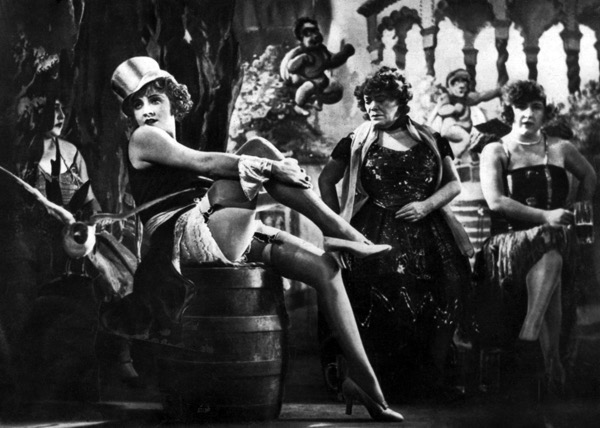
See question three. Marlene Dietrich in The Blue Angel. Image Wikimedia Commons
One
Established in 1999, Nunavut, at 135,000 square miles of land (350,000 square km), is the World’s fifth-largest country subdivision.
Of what country is Nunavut a subdivision?
What, to the nearest ten thousand, is the population of Nunavut?
Answers
1. Canada
2. 40,000
Nunavut, established in 1999, is the largest and northernmost Canadian territory, created for Inuit self-government. It covers a significant portion of Northern Canada and the Arctic Archipelago, making it the fifth-largest country subdivision globally. With a population of 36,858, it is the least densely populated major subdivision in the world.
Two
Gmail was launched on this day, in what year did this happen?
Answer: 2004.
Gmail, created by Paul Buchheit, was launched in 2004 and opened to the public in 2007, is the world’s largest email service with 1.8 billion users. It offers 15GB of free storage, supports large attachments, and integrates with Google Drive. The service is accessible from any internet-enabled device and features conversation view, integrated chat, and was briefly integrated with the social networking application Buzz.
Three
Josef von Sternberg’s Der blaue Engel (The Blue Angel) was released in Germany, and the classic film made Marlene Dietrich a star. What was Dietrich’s character name, as billed, in this film?
Answer: Lola Lola.
The Blue Angel (1930) is a German musical comedy-drama directed by Josef von Sternberg, featuring Marlene Dietrich, Emil Jannings, and Kurt Gerron. Based on Heinrich Mann’s novel Professor Unrat, it tells the tragic story of a professor’s downfall into madness due to his obsession with nightclub singer Lola Lola, played by Dietrich in her breakthrough role. This film introduced her iconic song, Falling in Love Again. Filmed in both German and English, the English version was initially lost but rediscovered and screened in 2009. The German version is preferred for its length and superior pronunciation.
Four
The Apple Computer Company, now Apple Inc., was founded in 1976, who were the three people who co-founded it?
Answer: Steve Jobs, Steve Wozniak and Ronald Wayne.
Apple Inc., founded in 1976 and headquartered in Cupertino, California, is a leading American multinational technology company renowned for its innovative consumer electronics, software, and online services. Known for its user-centric design and marketplace ecosystem, Apple revolutionised the technology sector with products like personal computers, smartphones and tablets. After nearly going bankrupt in the 1990s, the company returned to profitability under Steve Jobs’ leadership, introducing iconic products such as the iMac, iPod, iPhone and iPad. Today, Apple is the world’s largest company by market capitalisation and a major player in the PC, tablet, and mobile phone markets.
Five
In 1977, who had a U.S. number 1 and U.K. top ten hit with Got to Give It Up from the album Live at the London Palladium?
Answer: Marvin Gaye.
Marvin Gaye, an American soul singer-songwriter-producer, was a cultural icon and one of the greatest singers and songwriters of all time. He began his career with Motown Records, achieving success with hits like I Heard It Through the Grapevine and duets with Tammi Terrell. Gaye’s groundbreaking album What’s Going On showcased his musical individuality and social commentary, paving the way for other artists to take control of their music. He later produced his own albums, significantly influencing 1970s soul music and R&B sub-genres. Tragically, Gaye was shot and killed by his father on 1 April 1984.
1 GB of storage for free
The post title refers to Google offering users 1 GB of space, compared to the 2 to 4 MB that was the standard at the time.
These questions are all related to today, April 1st.
See question three. Marlene Dietrich in The Blue Angel. Image Wikimedia Commons
One
Established in 1999, Nunavut, at 135,000 square miles of land (350,000 square km), is the World’s fifth-largest country subdivision.
Of what country is Nunavut a subdivision?
What, to the nearest ten thousand, is the population of Nunavut?
Two
Gmail was launched on this day, in what year did this happen?
Three
Josef von Sternberg’s Der blaue Engel (The Blue Angel) was released in Germany, and the classic film made Marlene Dietrich a star. What was Dietrich’s character name, as billed, in this film?
Four
The Apple Computer Company, now Apple Inc., was founded in 1976, who were the three people who co-founded it?
Five
In 1977, who had a U.S. number 1 and U.K. top ten hit with Got to Give It Up from the album Live at the London Palladium?
Here are the answers to the questions I posted earlier.
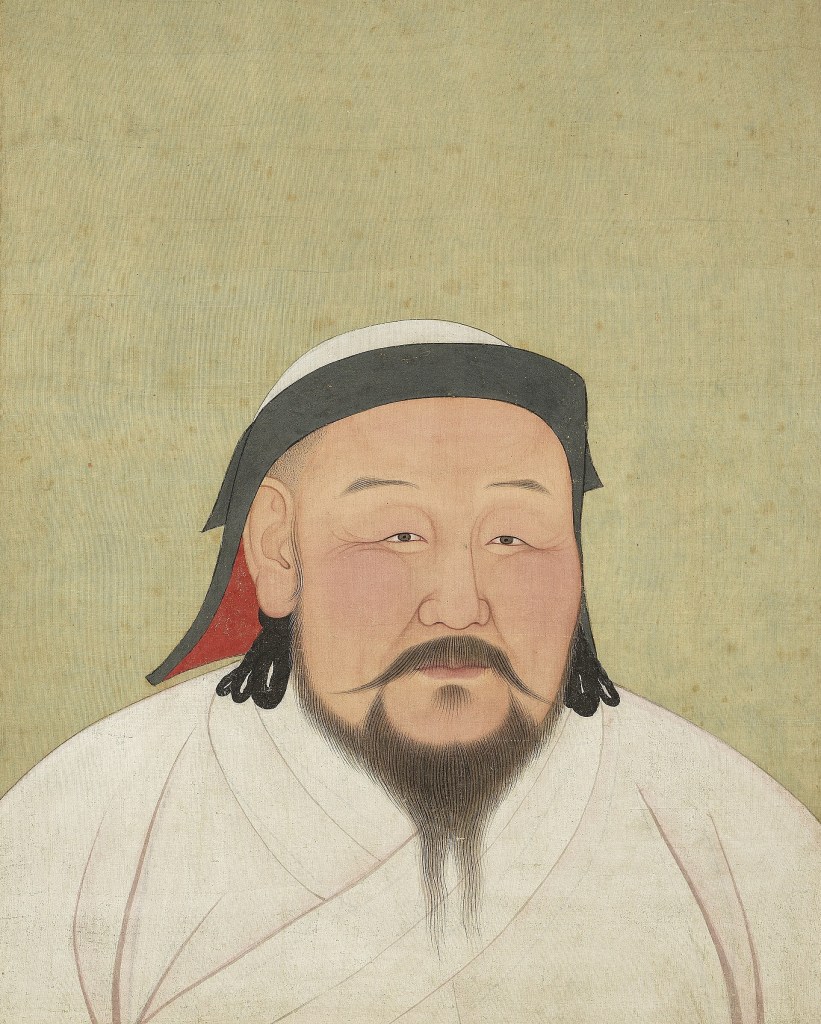
Kublai Khan, a posthumous painting executed shortly after his death in February of 1294. Image Wikimedia Commons
Finishing the alphabetical theme with the remaining letters, so six questions today with answers beginning with the letters from U to Z, with each letter being used only once, but they are not in alphabetical order. If a question has more than one part it is only the first that conforms to the theme.
One
What word links Shangdu, which was ruled by Kublai Khan and is mentioned in the first line of a Samuel Taylor Coleridge poem, with the title track of a 1980 musical of the same name?
Answer: Xanadu.
Shangdu, the summer capital of Yuan dynasty ruled by Kublai Khan, grandson of Genghis Khan. A metaphor for opulence or an idyllic place, based upon Samuel Taylor Coleridge’s description of Shangdu in his 1816 poem Kubla Khan. Xanadu is the title song from the soundtrack of the 1980 musical film of the same name. Written by Jeff Lynne of the English rock band Electric Light Orchestra (ELO), the song is performed by British-Australian singer, songwriter and actress Olivia Newton John.
Two
What professional golfer won the U.S. Masters tournament in 2007, and 2015 Open Championship at St. Andrews?
Answer: Zach Johnson.
Zachary Harris Johnson, an American professional golfer, has won 12 PGA Tour events, including two majors. He captained the unsuccessful U.S. Ryder Cup team in 2023.
Three
The Macallan, Bunnahabhain and Laphroaig are three examples of what product from the United Kingdom?
The last two mentioned, Bunnahabhain and Laphroaig, both come from what region which is well known for this product?
Answers
Whisky.
Island of Islay.
Scotch whisky, first mentioned in 1494, was originally made from malted barley. Single malt Scotch whisky, which the three examples mentioned are, must be distilled in one distillery using only water and malted barley. By 2024, Scotland boasted 151 distilleries, solidifying its reputation for this renowned spirit.
Four
Which name connects a character from a Charles Dickens’ 1850 novel to the 1972 studio album The Magician’s Birthday?
Answer: Uriah Heap.
Uriah Heep, a sycophantic character in Charles Dickens’ David Copperfield, manipulates his employer, Mr. Wickfield, into making him a partner. He later faces exposure for his frauds and is imprisoned for bank fraud. Named after the Dickens’ character Uriah Heep, an English rock band formed in 1969, pioneered hard rock, heavy metal, and progressive rock. With over 40 million albums sold worldwide, they are known for hits like Lady in Black and maintain a strong following in Europe and Asia.
Five
In what film does Tom Hanks play Joe Fox?
Answer: You’ve Got Mail.
You’ve Got Mail is a 1998 romantic comedy starring Tom Hanks and Meg Ryan, directed by Nora Ephron. The film, inspired by a Hungarian play, tells the story of two online romantics who are business rivals.
Six
This small fully independent nation-state’s independence was recognised by the Lateran Treaty of 1929. Which nation is it?
Answer: Vatican City.
Vatican City, the smallest independent nation-state, is the seat of the Roman Catholic Church and home to the Pope. It has its own infrastructure and diplomatic relations, with a population of around 882 people.
Kublai Khan, a posthumous painting executed shortly after his death in February of 1294. Image Wikimedia Commons
Finishing the alphabetical theme with the remaining letters, so six questions today with answers beginning with the letters from U to Z, with each letter being used only once, but they are not in alphabetical order. If a question has more than one part it is only the first that conforms to the theme.
One
What word links Shangdu, which was ruled by Kublai Khan and is mentioned in the first line of a Samuel Taylor Coleridge poem, with the title track of a 1980 musical of the same name?
Two
What professional golfer won the U.S. Masters tournament in 2007, and 2015 Open Championship at St. Andrews?
Three
The Macallan, Bunnahabhain and Laphroaig are three examples of what product from the United Kingdom?
The last two mentioned, Bunnahabhain and Laphroaig, both come from what region, an island which is well known for this product?
Four
Which name connects a character from a Charles Dickens’ 1850 novel to the 1972 studio album The Magician’s Birthday?
Five
In what film does Tom Hanks play Joe Fox?
Six
This small fully independent nation-state’s independence was recognised by the Lateran Treaty of 1929. Which nation is it?
Five questions with the answers beginning with the letters from A to E, with each letter being used only once, but they are not in alphabetical order.
See question two. Death in the Afternoon. Image A Couple Cooks
One
Who wrote, produced, and directed Moulin Rouge (2001) and Australia (2008)?
Answers: Baz Luhrman.
Baz Luhrmann is an Australian film director, producer, writer, and actor known for his Red Curtain Trilogy and other films like Australia, The Great Gatsby, and Elvis. He is also involved in opera, theatre, music, and the recording industries, with Grammy-nominated soundtracks and his own record label.
Two
An absinthe-Champagne cocktail was invented by an author and shares its name with his 1932 non-fiction book about a sport in a southern European nation. Who is the author, and what is the book and cocktail’s shared name?
Answers: Ernest Hemingway; Death in the Afternoon.
Death in the Afternoon, a 1932 non-fiction book by Ernest Hemingway, explores Spanish bullfighting, fear, and courage. Its namesake, a cocktail invented by Hemingway, is made with absinthe and Champagne. The drink, known for its decadence and high strength, can be made with absinthe alternatives like Absente or Pernod.
Three
Which chemical element derives its name from the Latin for ‘coal’?
Answer: Carbon.
Carbon, symbol C and atomic number 6, a non-metal which has two main forms, diamond and graphite, and which also occurs in impure form in charcoal, soot and coal. It is the 15th most abundant element in Earth’s crust and the fourth most abundant in the universe.
Four
Which small dog breed, which is not a terrier, is sometimes known as the monkey terrier?
Answer: Affenpinscher.
The Affenpinscher, a German toy dog breed, originated as a ratter and is now a popular companion worldwide. The breed, whose name is sometimes translated from German as ‘Monkey Terrier’, is believed to be ancestral to the Griffon Bruxellois and Miniature Schnauzer.
Five
The Malawian city of Blantyre was named after the Scottish birthplace of which missionary and explorer (1813-73)?
Answer: David Livingstone
Blantyre, Malawi’s second-largest city and commercial centre, was founded in 1876 by the Church of Scotland. It grew rapidly due to its role in colonial trade and became a major manufacturing centre. The city’s development was influenced by various factors, including commerce, industry, and administration, and it was merged with Limbe in 1956.