My blog will be somewhat different over the next few days. I will pose five questions each day for six days across various subjects, and each answer will begin with a distinct letter of the alphabet. As you likely deduced, five questions per day across six days yields thirty answers, each starting with a unique letter, leaving four unaccounted for. Consequently, four duplicates exist; in their order of appearance, they spell the name of a villainous figure from the eighth volume of a comic originally serialised in the first half of the 20th century. Although this character is not widely known, the aim is to correctly identify the second, duplicate iteration of these initial letters to reveal the name. The answers will not be given on the same day as the questions but at the end.
One
Moloko Plus, a barbiturate-spiked milk drink, features in which Anthony Burgess novel?
Two
What is the only planet in our solar system named after a Greek god rather than a Roman one?
Three
Israel defeated Egypt, Jordan and Syria in the deftly named 5–10 June 1967 war?
Four
What English archaeologist, army officer, diplomat and writer had the forenames Thomas Edward?
Five
Which letter represents tungsten within the periodic table of elements?
Good Luck! The answers will be posted after day six questions. More questions tomorrow.
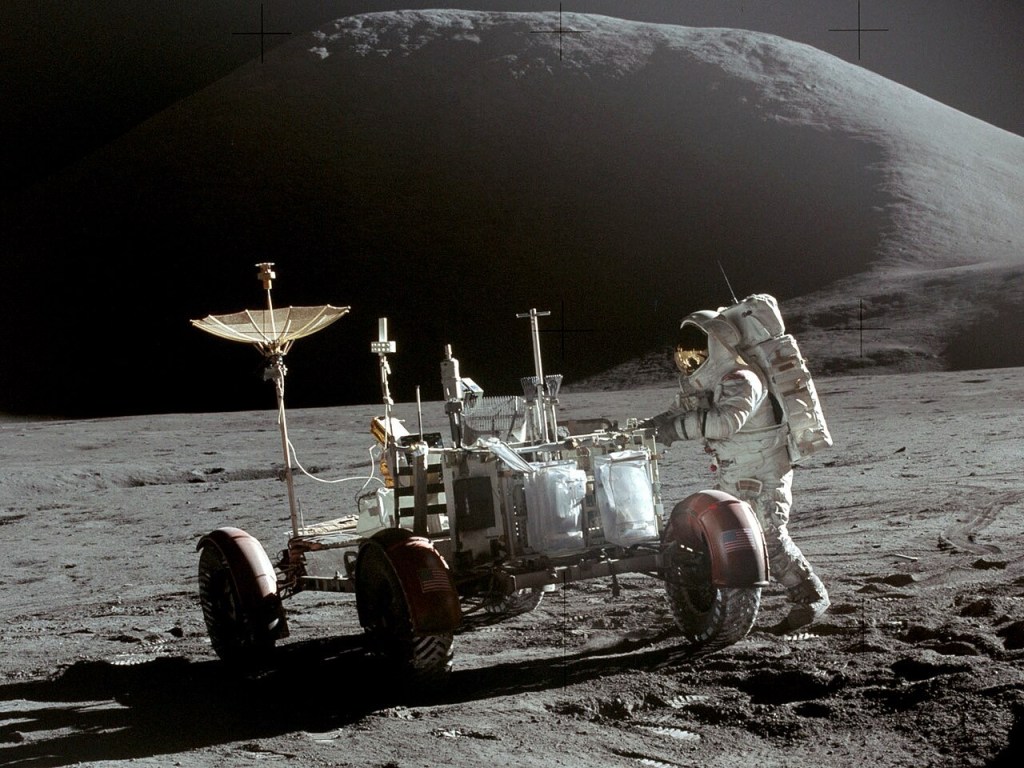
James Irwin with the Lunar Roving Vehicle on the Moon. Mons Hadley is in the background. Image NASA/David Scott via Wikimedia Commons
One to five as usual today, but you need to find ten answers. The first question is related to today’s date, 31 July, while the subsequent ones follow on from the theme created by the first.
One
On this day in 1971, Apollo 15’s astronauts first used the Lunar Roving Vehicle, which is also colloquially known as a Moon Buggy, on the Lunar surface. By the end of the Apollo program how many of these vehicles were left behind on the Moon?
Answer: Three.
The Lunar Roving Vehicle (LRV), built by Boeing Co., enabled extended travel, speed, and greater scientific activity on the Moon during the Apollo era. The first surface mission to use the LRV, Apollo 15 astronauts covered a total 17.5 miles of exploration and discovery. The historic Apollo Program sent the first U.S. astronauts into orbit around the Moon in 1968 and landed a dozen astronauts on the lunar surface between 1969 and 1972. The reach of initial Apollo surface missions was restricted to short walking distances. During each of the last three Apollo missions, between 1971 and 1972, a battery powered LRV provided transportation for two crew members and supplies several miles beyond the landing site. — NASA
Two
Set on the Moon in 1996, a short story first published in 1951 describes the discovery of a mysterious pyramid which had been placed by aliens several billion years previously. This story has an influential role in the development of a 1968 film. Three questions:
What is the story’s title?
Who was its author?
What was the title of the 1968 film?
Answers
The Sentinal
Arthur C. Clarke
2001: A Space Odyssey
The Sentinel (1951) by Arthur C. Clarke, set in 1996, follows selenologist Wilson discovering a mysterious alien structure on the Moon. After breaching its shield with atomic energy, the structure is destroyed, revealing advanced technology. Wilson theorises it was a sentinel alerting aliens to the emergence of intelligent life.
Three
The Huygens lander was the first man made object to land on a world in the outer Solar System. Where did it land?
Answer: Titan.
The Cassini–Huygens mission, a collaboration between NASA, ESA, and ASI, aimed to study Saturn and its system. It included NASA’s Cassini probe and ESA’s Huygens lander. Launched in 1997, Cassini orbited Saturn from 2004 to 2017, providing extensive data on the planet and Huygens landed on Titan. The mission included flybys of Venus, Earth, asteroid 2685 Masursky, and Jupiter, ending on September 15, 2017, by burning up in Saturn’s atmosphere to prevent contamination. It was a ‘mission of firsts’, revolutionising understanding of Saturn’s system and potential life-supporting environments in the Solar System and landing on on a world in the outer Solar System the first time.
Four
In ancient Greek mythology who was the goddess and personification of the Moon who drives her Moon chariot across the heavens?
Answer: Salene.
The air, unlit before, glows with the light of her golden crown, and her rays beam clear, whensoever bright Selene having bathed her lovely body in the waters of Ocean, and donned her far-gleaming raiment, and yoked her strong-necked, shining team, drives on her long-maned horses at full speed, at eventime in the mid-month: then her great orbit is full and then her beams shine brightest as she increases. So she is a sure token and a sign to mortal men. — Homeric Hymn to SaleneWikipedia
Five
Moon River featured in a 1961 film and won the Academy Award for Best Original Song. Four questions:
Who composed the song?
Who wrote the lyrics?
What was the 1961 film?
Who sang it in the film?
Answers
Henry Mancini
Johnny Mercer
Breakfast at Tiffany’s
Audrey Hepburn
Moon River, composed by Henry Mancini with lyrics by Johnny Mercer, was performed by Audrey Hepburn in Breakfast at Tiffany’s (1961), winning an Academy Award and two Grammys. The song relaunched Mercer’s songwriting career, stalled by rock and roll’s rise. The lyrics reflect Mercer’s Southern youth and wanderlust and an inlet near Savannah, Georgia, was named Moon River in his honour. Andy Williams made it his theme song, recording it in 1962 and in 2022, his version was preserved in the U.S. Library of Congress.
James Irwin with the Lunar Roving Vehicle on the Moon. Mons Hadley is in the background. Image NASA/David Scott via Wikimedia Commons
One to five as usual today, but you need to find ten answers. The first question is related to today’s date, 31 July, while the subsequent ones follow on from the theme created by the first.
One
On this day in 1971, Apollo 15’s astronauts first used the Lunar Roving Vehicle, which is also colloquially known as a Moon Buggy, on the Lunar surface. By the end of the Apollo program how many of these vehicles were left behind on the Moon?
Two
Set on the Moon in 1996, a short story first published in 1951 describes the discovery of a mysterious pyramid which had been placed by aliens several billion years previously. This story has an influential role in the development of a 1968 film. Three questions:
What is the story’s title?
Who was its author?
What was the title of the 1968 film?
Three
The Huygens lander was the first man made object to land on a world in the outer Solar System. Where did it land?
Four
In ancient Greek mythology who was the goddess and personification of the Moon who drives her Moon chariot across the heavens?
Five
Moon River featured in a 1961 film and won the Academy Award for Best Original Song. Four questions:
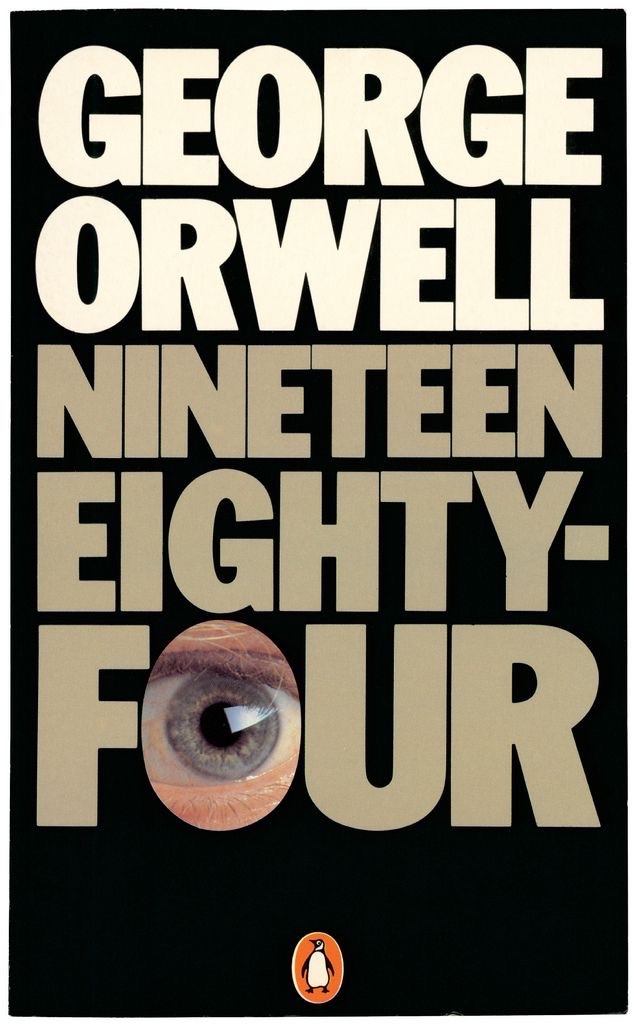
George Orwell’s Nineteen Eighty-four. Image Pinterest
Today’s questions are not related to the date; instead, they share a theme linked to the title in a subtle or hidden manner.
One
ZZ9 Plural Z Alpha, an appreciation society and their publication Mostly Harmless is connected to what science fiction franchise?
Answer: The Hitchhikers Guide to the Galaxy.
ZZ9 Plural Z Alpha organises gatherings and social events, produces the magazine Mostly Harmless and sells Beeblebears modelled on Zaphod Beeblebrox. It celebrates The Hitchhiker’s Guide to the Galaxy and Douglas Adams’s works.
Two
What single word can mean nought, a strong-lined fabric, a quick immersion, a bivalve mollusc, a lowering of the head or a bird and in which sport did the meaning ‘nought’ originate?
Answer: Duck: cricket.
All of the above are from definitions of duck.
Nought: in cricket a batter’s score of zero. Origin mid 19th century: short for duck’s egg, used for the figure 0 because of its similar outline.
Fabric: a strong cotton or linen fabric. Origin mid 17th century: from Middle Dutch doek ‘linen, linen cloth’; related to German Tuch ‘cloth’.
Immersion: to dip under water. Origin Middle English: of Germanic origin; related to Dutch duiken and German tauchen ‘dive, dip, plunge’.
Mollusc: a pure white thin-shelled bivalve mollusc found off the Atlantic coasts of America. Genus Anatina, family Mactridae.
Lowering head: lower the head or the body quickly. Origin Middle English: of Germanic origin; related to Dutch duiken and German tauchen ‘dive, dip, plunge’.
Bird: a waterbird with a broad blunt bill. Origin Old English duce, from the Germanic German tauchen ‘dive, dip, plunge’.
Three
Where is the mythical Snow Lion a celestial emblem?
Answer: Tibet.
The Snow Lion, Tibet’s celestial emblem, symbolises power, strength, fearlessness, joy, east, and earth. Featured on Tibet’s flag from 1916 to 1950, it remains used by the Tibetan Government-in-Exile. Depicted as white with a turquoise mane, it represents hermits and yogis, and is prominent in Tibetan culture.
Four
What character is named when symbols for sulphur, nobelium, oxygen, phosphorus and yttrium are placed together in order?
What are the three super-states in the novel Nineteen Eighty-four, and in which of these is London located?
Answers: Oceania, Eurasia and Eastasia; Oceania.
In April 1984, Winston Smith lives in Airstrip One (previously Great Britain), a province of Oceania, under totalitarian rule by ‘the Party’ and Big Brother. The Party enforces conformity through surveillance and Thought Police, erasing dissenters as “unpersons”. Winston, an Outer Party member at the Ministry of Truth, secretly rebels against the regime.
42-0-20-(Z 16-102–8-15-39)-13
The numbers in the title offer clues, perhaps obscure, to each of the questions in the correct order. The information breaks down like this
42: In The Hitchhiker’s Guide to the Galaxy 42 is the answer to the ultimate question of life, the universe, and everything.
0: A duck is 0 as explained above, see ‘Nought’ under the second answer.
20: The 20th letter of the alphabet ‘T’ is the initial to this answer.
(Z 16-102–8-15-39): Z is the symbol for atomic numbers and 16 is the atomic number for sulphur, 102 is nobelium 8 is oxygen 15 is phosphorus and 39 is yttrium each of which make Snoopy.
13: : ‘It was a bright cold day in April, and the clocks were striking thirteen.’ Thirteen concludes the opening line of George Orwell’s Nineteen Eighty-four.
George Orwell’s Nineteen Eighty-four. Image Pinterest
Today’s questions are not related to the date; instead, they share a theme linked to the title in a subtle or hidden manner.
One
ZZ9 Plural Z Alpha, an appreciation society and their publication Mostly Harmless is connected to what science fiction franchise?
Two
What single word can mean nought, a strong-lined fabric, a quick immersion, a bivalve mollusc, a lowering of the head or a bird and in which sport did the meaning ‘nought’ originate?
Three
Where is the mythical Snow Lion a celestial emblem?
Four
What character is named when symbols for sulphur, nobelium, oxygen, phosphorus and yttrium are placed together in order?
Five
What are the three super-states in the novel Nineteen Eighty-four, and in which of these is London located?
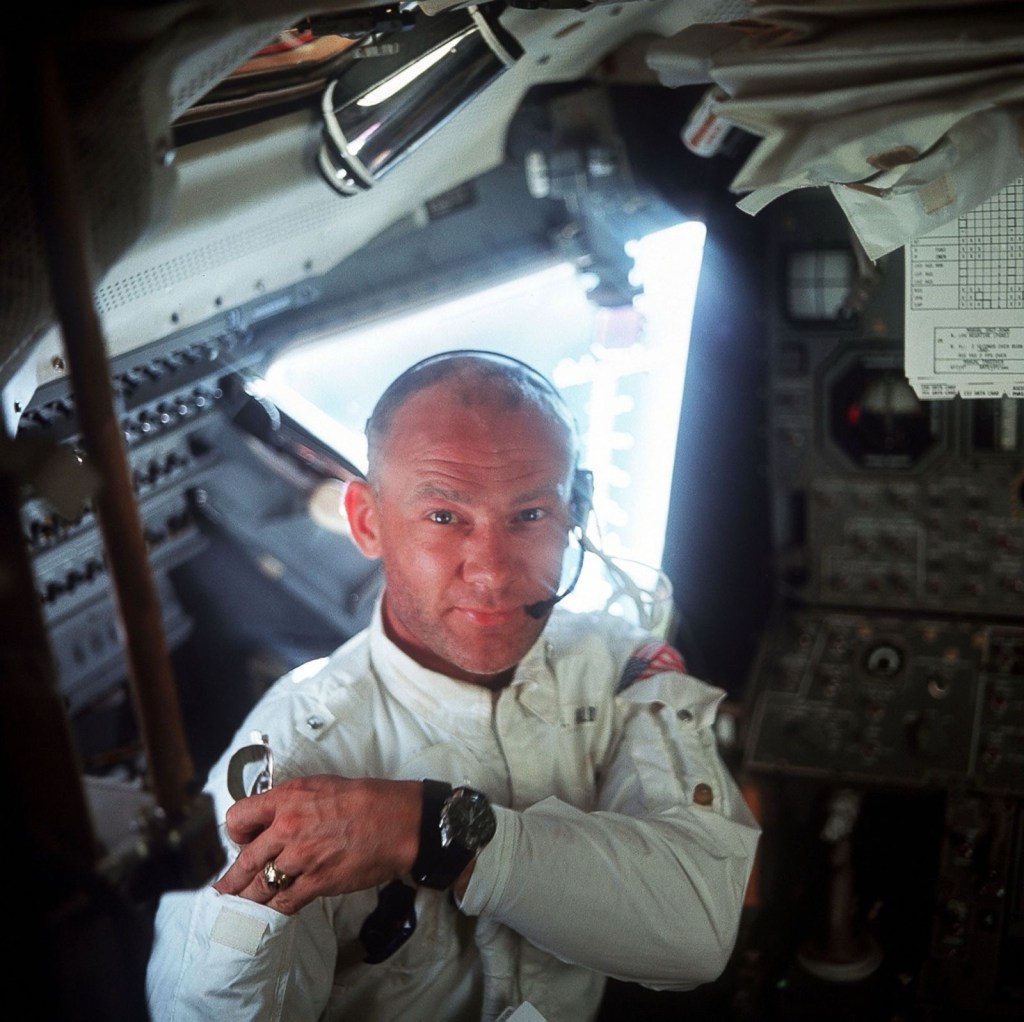
Buzz Aldrin, Apollo 11, 20 July 1969. Image ABC News
The first question relates to today’s date, 20 July. The remainder, which are not date-related, follow on a theme from the first.
One
I’d like to take this opportunity to ask every person listening in, whoever and wherever they may be, to pause for a moment and contemplate the events of the past few hours and to give thanks in his or her own way. — Buzz Aldrin, Apollo 11 on the Lunar surface, 20 July 1969
Why did Buzz Aldrin choose not to mention over the radio that he was taking Holy Communion on the Moon before the first moonwalk?
Answer: NASA was avoiding public religious broadcasts
After controversy surrounding the Apollo 8 crew’s reading from the Book of Genesis, NASA was avoiding public religious broadcasts. Aldrin Consequently observed Communion privately without mentioning it on air; instead, prior to taking Communion, Aldrin invited everyone listening to ‘pause for a moment’ and ‘give thanks in his or her own way’. His Communion kit was prepared by his pastor at Webster Presbyterian Church in Texas, which still commemorates the event using the chalice which was used on the Moon each year on the Sunday closest to 20 July.
Two
The god Khnum was once regarded as the guardian of the source of which river?
Answer: River Nile.
Khnum, an early Egyptian deity from Upper Egypt, was linked to the Nile cataract and responsible for its annual inundation. Known as the creator of human bodies and the life force ka, he used a potter’s wheel. Worshipped from the First Dynasty, his main cult centre was Herwer, later Elephantine. Khnum, depicted with ram horns symbolising fertility and rebirth, evolved from horizontally spiralled to down-turned horns in the New Kingdom. His imagery includes a crocodile head, representing Nile dominion, and he wears the atef crown or the white crown of Upper Egypt.
Three
The Rehat Maryada is a code of conduct in which religion, founded in the late 15th century?
Answer: Sikhism.
Originating in the 15th century within the Punjab region, Sikhism is a monotheistic faith shaped by Guru Nanak and nine subsequent leaders. The tradition highlights belief in one creator, equality, selfless service, and honest behaviour. Since 1699, Sikhs have regarded the Guru Granth Sahib as their eternal guide.
Four
In ancient myth, what God was the father of Heracles?
Answer: Zeus.
Heracles, a divine Greek hero and son of Zeus, was the greatest of Greek heroes and ancestor of the Heracleidae. Known as Hercules in Rome, he championed the Olympian order against monsters. Roman emperors like Commodus and Maximian identified with him, and his cult was adapted to Rome.
Five
William and Catherine Booth established an organisation in 1865 that functions as both a Methodist Christian church and an international charity. What is this organisation, and what is its motto?
Answer: Salvation Army; Blood and Fire.
The Salvation Army, founded in 1865 by William and Catherine Booth, is a Methodist Christian church and international charity with over 1.7 million members in 133 countries. It provides physical and spiritual aid, operates charity shops, shelters, and disaster relief. General Lyndon Buckingham leads as of 2023.
Buzz Aldrin, Apollo 11, 20 July 1969. Image ABC News
The first question relates to today’s date, 20 July. The remainder, which are not date-related, follow on a theme from the first.
One
I’d like to take this opportunity to ask every person listening in, whoever and wherever they may be, to pause for a moment and contemplate the events of the past few hours and to give thanks in his or her own way. — Buzz Aldrin, Apollo 11 on the Lunar surface, 20 July 1969
Why did Buzz Aldrin choose not to mention over the radio that he was taking Holy Communion on the Moon before the first moonwalk?
Two
The god Khnum was once regarded as the guardian of the source of which river?
Three
The Rehat Maryada is a code of conduct in which religion, founded in the late 15th century?
Four
In ancient myth, what God was the father of Heracles?
Five
William and Catherine Booth established an organisation in 1865 that functions as both a Methodist Christian church and an international charity. What is this organisation, and what is its motto?
Here’s the answers to the questions posted earlier.
Despite a heart condition and arthritis that forced him to use a cane, Brigadier General Roosevelt led the assault on Utah Beach. Image Wikimedia Commons
Today’s questions are a mixed bag and are not date-related. There is a bit of an alphabetical theme going on, though..
One
New York International Airport, which opened in 1948, was also commonly known by what other name?
Answer: Idlewild.
Now known as John F. Kennedy International Airport (JFK), it is a major international airport serving the New York metropolitan area. Located in Queens, New York City, it is the busiest airport in the New York airport system and the busiest international commercial airport in North America. JFK features five passenger terminals and four runways, and serves as a hub for American Airlines and Delta Air Lines.
Two
Supported by a walking stick, Brigadier General Theodore Roosevelt Jr led the assault on which D-Day beach?
Answer: Utah Beach.
At 56, Roosevelt was the oldest general to land by sea with the first wave on D-Day, alongside his son, Captain Quentin Roosevelt II, who also landed with the first wave at Omaha Beach, making them the only father-son pair to participate in the invasion that day. Brigadier General Roosevelt, with Captain Leonard T. Schroeder Jr., led the 8th Infantry Regiment and 70th Tank Battalion at Utah Beach. Despite drifting off course, Roosevelt personally reconnoitred the area, coordinated with battalion commanders, and decided to attack from their landing point, famously declaring, ‘We’ll start the war from right here!’.
Three
What two word term is commonly used in the west to refer to the mythical humanoid creature which is said to inhabit parts of the Himalayas?
Answer: Abominable Snowman.
The Yeti, or Abominable Snowman, is a mythical humanoid creature believed to inhabit the Himalayas. Its existence is debated, with evidence such as sightings, videos, photos, and footprints, many of which are hoaxes or disputed. Despite numerous claims, the Yeti remains a subject of folklore and speculation. Folklorists trace the Yeti’s origin to Sherpa folklore and misidentified animals like bears or yaks, and it is often compared to North America’s Bigfoot due to similar physical descriptions.
Four
What flower with an eight-letter common name is the official flower of the Japanese city of Hiroshima, being the first to bloom there after the city was destroyed by an atomic bomb in 1945?
Answer: Oleander.
As the very first flower to bloom on the scorched earth of Hiroshima, where it was said that nothing would grow for 75 years, the oleander flower was a source of strength and hope for the residents of the city as they worked hard on recovery efforts. Blooming in the summertime, the oleander flowers reach their peak around the August 6 Peace Memorial Day, their beautiful blossoms reminding our citizens of a great many and profound feelings. — The City of Hiroshima
Five
In Douglas Adams’ The Hitchhiker’s Guide to the Galaxy, Zaphod Beeblebrox steals the spaceship Heart of Gold. What’s the name of the ship’s computer?
Answer: Eddie.
Eddie, the Heart of Gold’s shipboard computer, is annoyingly cheerful with a Genuine People Personality, irritating the crew, especially Zaphod. He has a backup motherly personality but remains disliked. Eddie controls all ship systems and records conversations. In And Another Thing…, Zaphod’s Left Brain replaces him, being more competent
Theme
The answers started with one of English’s five vowels, although not in the correct order.
Despite a heart condition and arthritis that forced him to use a cane, Brigadier General Roosevelt led the assault on Utah Beach. Image Wikimedia Commons
Today’s questions are a mixed bag and are not date-related. There is a bit of an alphabetical theme going on, though..
One
New York International Airport, which opened in 1948, was also commonly known by what other name?
Two
Supported by a walking stick, Brigadier General Theodore Roosevelt Jr led the assault on which D-Day beach?
Three
What two word term is commonly used in the west to refer to the mythical humanoid creature which is said to inhabit parts of the Himalayas?
Four
What flower with an eight-letter common name is the official flower of the Japanese city of Hiroshima, being the first to bloom there after the city was destroyed by an atomic bomb in 1945?
Five
In Douglas Adams’ The Hitchhiker’s Guide to the Galaxy, Zaphod Beeblebrox steals the spaceship Heart of Gold. What’s the name of the ship’s computer?
Woodcut representing the waterfront of Memphis, Tennessee, published 1879. Image Wikimedia Commons
Today’s five questions form a theme, and that is all I am alluding to.
One
The Perry Index sorts fables attributed to which ancient Greek writer?
Answer: Aesop.
The Perry Index is a comprehensive index of Aesop’s Fables, attributed to the ancient Greek storyteller Aesop (620-560 BC). Created by Ben Edwin Perry, a University of Illinois classics professor, it categorises and references the fables. Modern scholarship suggests Aesop didn’t compose all of the fables attributed to him; some predate him, others appear over a millennium after him.
Two
What singer’s debut album was Age Ain’t Nothing but a Number?
Answer: Aaliyah.
Age Ain’t Nothing but a Number is Aaliyah’s debut album, released on 24 May 1994. Produced by R. Kelly, it blends R&B with new jack swing, peaking at number 18 on the US Billboard 200. It sold over three million copies in the US and six million worldwide, featuring two gold-certified singles.
Three
In 1938, which national leader was named Time magazine’s Man of the Year?
Answer: Adolf Hitler.
TIME explained what was perhaps the most controversial of its choices thus: “Hitler became in 1938 the greatest threatening force that the democratic, freedom-loving world faces today” (1/2/39).
Hitler’s rise began in 1919, when he joined the German Workers Party, which was renamed the Nazi party. Within two years he was the party’s leader. In 1933, Hitler became chancellor of Germany and soon consolidated his power, banning other parties and establishing totalitarian rule. He put the unemployed to work in public programs, rebuilt the army and sent Jews, communists and others to concentration camps. On September 1, 1939, Hitler began World War II by invading Poland. By 1941, German troops had become bogged down in Russia, and in 1944 the Allies began their advance on Germany. Hitler lived his final months in a Berlin bunker, committing suicide on April 29, 1945.
Big River, a 1984 musical, is based on which Mark Twain novel?
Answer: Adventures of Huckleberry Finn.
Roger Miller’s Big River: The Adventures of Huckleberry Finn is a musical based on Mark Twain’s novel, featuring bluegrass and country music. The 1985 Broadway production ran for over 1,000 performances and won seven Tony Awards, including Best Musical.
Five
What word describes the repetition of the same sound at the start of each word?
Answer: Alliteration.
alliteration | əˌlɪtəˈreɪʃn | noun [mass noun] the occurrence of the same letter or sound at the beginning of adjacent or closely connected words: the alliteration of ‘sweet birds sang’ | [count noun] : alliterations are clustered in the last few lines. – ORIGIN early 17th century: from medieval Latin alliteratio(n-), from Latin ad– (expressing addition) + littera ‘letter’. Oxford English Dictionary
In the Beginning
The post title refers to all the answers beginning with ‘A’.