Here are the answers to my earlier questions.
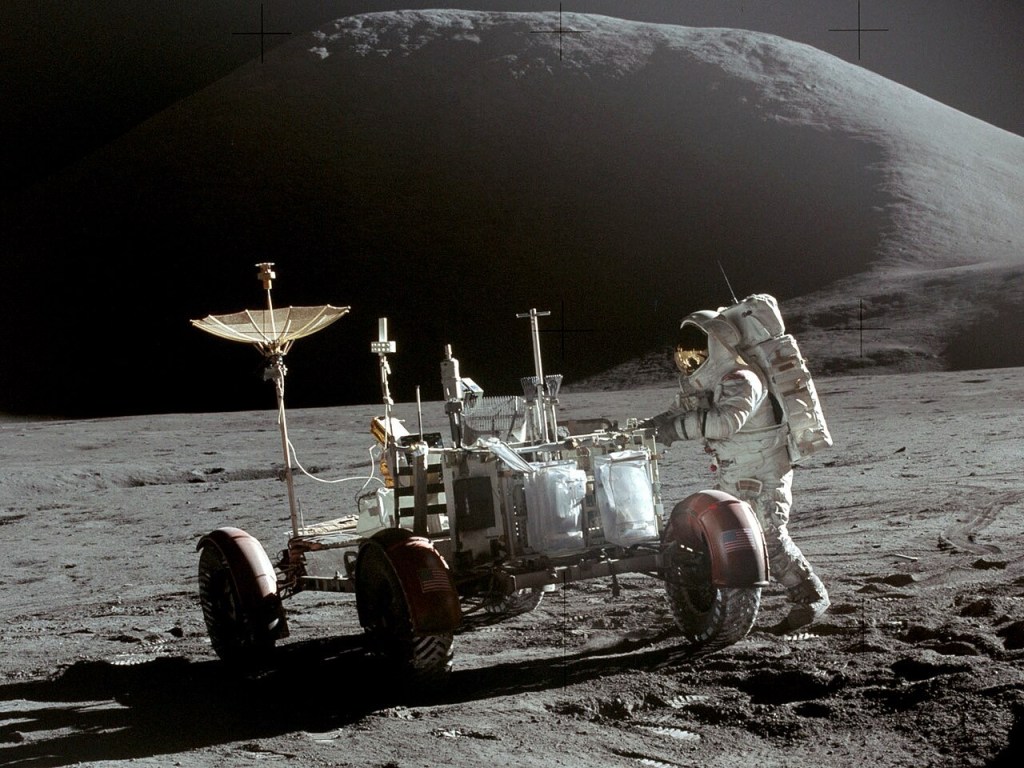
Image NASA/David Scott via Wikimedia Commons
One to five as usual today, but you need to find ten answers. The first question is related to today’s date, 31 July, while the subsequent ones follow on from the theme created by the first.
One
On this day in 1971, Apollo 15’s astronauts first used the Lunar Roving Vehicle, which is also colloquially known as a Moon Buggy, on the Lunar surface. By the end of the Apollo program how many of these vehicles were left behind on the Moon?
Answer: Three.
The Lunar Roving Vehicle (LRV), built by Boeing Co., enabled extended travel, speed, and greater scientific activity on the Moon during the Apollo era. The first surface mission to use the LRV, Apollo 15 astronauts covered a total 17.5 miles of exploration and discovery.
The historic Apollo Program sent the first U.S. astronauts into orbit around the Moon in 1968 and landed a dozen astronauts on the lunar surface between 1969 and 1972. The reach of initial Apollo surface missions was restricted to short walking distances. During each of the last three Apollo missions, between 1971 and 1972, a battery powered LRV provided transportation for two crew members and supplies several miles beyond the landing site.
— NASA
Two
Set on the Moon in 1996, a short story first published in 1951 describes the discovery of a mysterious pyramid which had been placed by aliens several billion years previously. This story has an influential role in the development of a 1968 film. Three questions:
- What is the story’s title?
- Who was its author?
- What was the title of the 1968 film?
Answers
- The Sentinal
- Arthur C. Clarke
- 2001: A Space Odyssey
The Sentinel (1951) by Arthur C. Clarke, set in 1996, follows selenologist Wilson discovering a mysterious alien structure on the Moon. After breaching its shield with atomic energy, the structure is destroyed, revealing advanced technology. Wilson theorises it was a sentinel alerting aliens to the emergence of intelligent life.
Three
The Huygens lander was the first man made object to land on a world in the outer Solar System. Where did it land?
Answer: Titan.
The Cassini–Huygens mission, a collaboration between NASA, ESA, and ASI, aimed to study Saturn and its system. It included NASA’s Cassini probe and ESA’s Huygens lander. Launched in 1997, Cassini orbited Saturn from 2004 to 2017, providing extensive data on the planet and Huygens landed on Titan. The mission included flybys of Venus, Earth, asteroid 2685 Masursky, and Jupiter, ending on September 15, 2017, by burning up in Saturn’s atmosphere to prevent contamination. It was a ‘mission of firsts’, revolutionising understanding of Saturn’s system and potential life-supporting environments in the Solar System and landing on on a world in the outer Solar System the first time.
Four
In ancient Greek mythology who was the goddess and personification of the Moon who drives her Moon chariot across the heavens?
Answer: Salene.
The air, unlit before, glows with the light of her golden crown, and her rays beam clear, whensoever bright Selene having bathed her lovely body in the waters of Ocean, and donned her far-gleaming raiment, and yoked her strong-necked, shining team, drives on her long-maned horses at full speed, at eventime in the mid-month: then her great orbit is full and then her beams shine brightest as she increases. So she is a sure token and a sign to mortal men.
— Homeric Hymn to Salene Wikipedia
Five
Moon River featured in a 1961 film and won the Academy Award for Best Original Song. Four questions:
- Who composed the song?
- Who wrote the lyrics?
- What was the 1961 film?
- Who sang it in the film?
Answers
- Henry Mancini
- Johnny Mercer
- Breakfast at Tiffany’s
- Audrey Hepburn
Moon River, composed by Henry Mancini with lyrics by Johnny Mercer, was performed by Audrey Hepburn in Breakfast at Tiffany’s (1961), winning an Academy Award and two Grammys. The song relaunched Mercer’s songwriting career, stalled by rock and roll’s rise. The lyrics reflect Mercer’s Southern youth and wanderlust and an inlet near Savannah, Georgia, was named Moon River in his honour. Andy Williams made it his theme song, recording it in 1962 and in 2022, his version was preserved in the U.S. Library of Congress.


Leave a comment