All of these questions relate to today’s date, 7 August.
One
In what sport could a ‘Salchow’ be performed?
Two
The six-month-long Battle of Guadalcanal, which began on 7 August 1942, unfolded in which country?
Three
In 1960, the country represented by the flag shown above gained independence from France. What country is it?
Four
How many persons were onboard Thor Heyerdahl’s balsa wood raft, Kon-Tiki when it reached Raroia in the Tuamotu Islands after sailing 4,300 mile (7,000 km) in 101-days?
Five
In 1926, in motor racing the first British Grand Prix was held. Where was the race held?
Bonus Question
The post title is two lines taken from a popular song, what song?
The first question relates to today’s date, 16 July. The subsequent questions follow a theme established by the first.
One
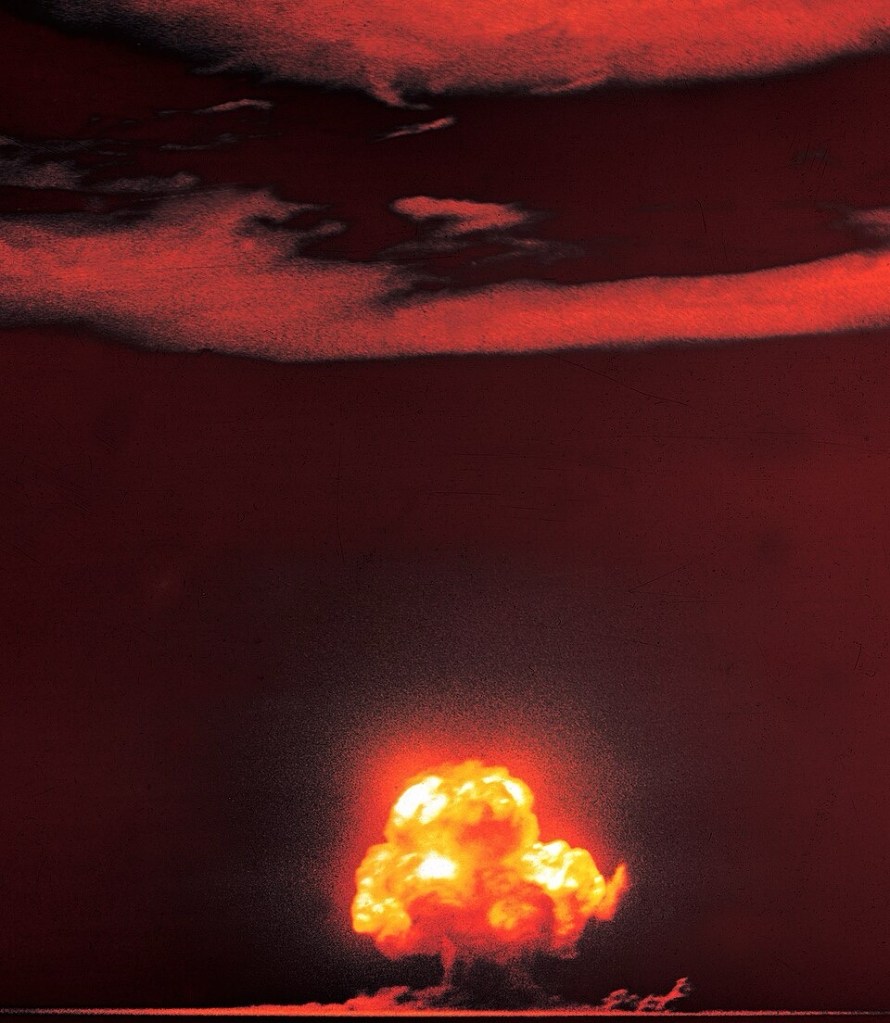
The world’s first atomic bomb exploded in a test on 16 July.
What code name was given to the test?
In what year was the test?, and
In what U.S. state was the test site located?
Answers
Trinity
1945
New Mexico
The Trinity test, the first nuclear detonation, occurred on July 16, 1945, in New Mexico as part of the Manhattan Project. Directed by Kenneth Bainbridge, it tested an implosion-design plutonium bomb, releasing 25 kilotons of energy and creating trinitite. Observed by 425 people, the site became a National Historic Landmark in 1965. The Manhattan Project established Los Alamos for nuclear weapon development, leading to the first atomic bomb, Gadget, tested at the Trinity Site. The Trinity Site is now a national historic landmark with limited public access.
Two
When asked why he chose the nuclear test code name referred to in question one above, Robert Oppenheimer alluded to the work of which English poet?
Answer: John Donne.
In 1962 Oppenheimer said:
Why I chose the name is not clear, but I know what thoughts were in my mind. There is a poem of John Donne, written just before his death, which I know and love.” Oppenheimer then quoted the sonnet “Hymn to God, My God, in My Sickness” about a man unafraid to die because he believed in resurrection.
Oppenheimer continued:
That still does not make a Trinity, but in another, better-known devotional poem Donne opens, ‘Batter my heart, three person’d God.’ Beyond this, I have no clues whatever. — Los Alamos National Laboratory
Three
Who is traditionally said to have used a clover-like plant, which is now a national symbol, as a metaphor for a Christian doctrine, and what was the plant?
Answer: St. Patrick; shamrock.
In 5th-century Ireland, Saint Patrick reportedly used the shamrock to explain the Holy Trinity to pagans. Today, the shamrock is Ireland’s national symbol and a key emblem of Saint Patrick’s Day, celebrated worldwide with parades and festivities.
Four
Which charity is the official authority for lighthouses in England and Wales?
Answer: Trinity House.
Trinity House, established in 1514, is the UK’s largest maritime charity and General Lighthouse Authority for England, Wales, the Channel Islands, and Gibraltar. It ensures maritime safety through navigation aids, pilot licensing, and audits. Annually, it donates £4m to support cadet training, retired mariners’ welfare, and sea safety education.
Five
Of the seven surviving British and Irish medieval and early modern universities founded before 1600 AD, one with a name appropriate for this theme was founded in 1592. Under what name was this 1592 establishment founded?
Answer: Trinity College Dublin (Coláiste na Tríonóide, Baile Átha Cliath).
(or in full The Provost, Fellows and Scholars of the College of the Holy and Undivided Trinity of Queen Elizabeth near Dublin (Coláiste Thríonóid Naofa Neamhroinnte na Banríona Eilís gar do Bhaile Átha Cliath)).
Trinity College Dublin, founded in 1592 by Queen Elizabeth I, is Ireland’s oldest university and a member of LERU and the Coimbra Group. It houses the Book of Kells and has notable alumni like Oscar Wilde and Jonathan Swift. The college, a major tourist destination, has an academic partnership with Oxford and Cambridge.
Now I am Become Death, the Destroyer of Worlds
Robert Oppenheimer later recalled a moment, after the Trinity Test, when the line ‘Now I am Become Death, the Destroyer of Worlds’ from the Hindu scripture the Bhagavad Gita came to mind.
The first question relates to today’s date, 16 July. The subsequent questions follow a theme established by the first.
One
The world’s first atomic bomb exploded in a test on 16 July.
What code name was given to the test?
In what year was the test?, and
In what U.S. state was the test site located?
Two
When asked why he chose the nuclear test code name referred to in question one above, Robert Oppenheimer alluded to the work of which English poet?
Three
Who is traditionally said to have used a clover-like plant, which is now a national symbol, as a metaphor for a Christian doctrine, and what was the plant?
Four
Which charity is the official authority for lighthouses in England and Wales?
Five
Of the seven surviving British and Irish medieval and early modern universities founded before 1600 AD, one with a name appropriate for this theme was founded in 1592. Under what name was this 1592 establishment founded?
Here’s the answers to the questions posted earlier.
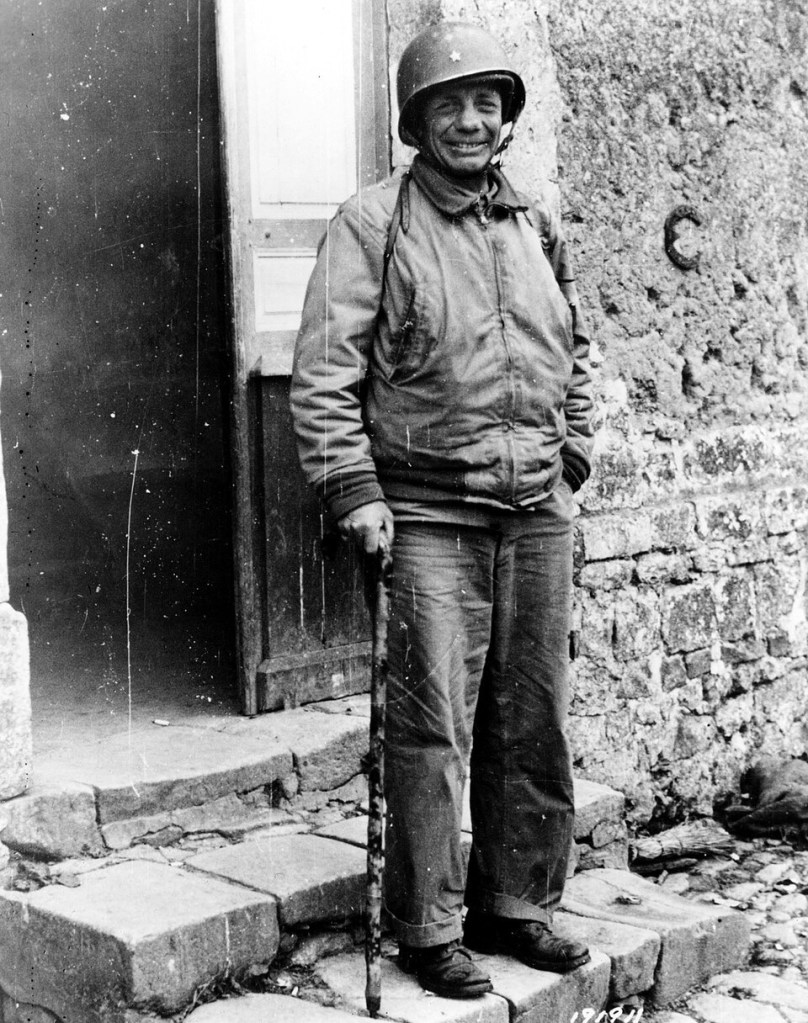
Despite a heart condition and arthritis that forced him to use a cane, Brigadier General Roosevelt led the assault on Utah Beach. Image Wikimedia Commons
Today’s questions are a mixed bag and are not date-related. There is a bit of an alphabetical theme going on, though..
One
New York International Airport, which opened in 1948, was also commonly known by what other name?
Answer: Idlewild.
Now known as John F. Kennedy International Airport (JFK), it is a major international airport serving the New York metropolitan area. Located in Queens, New York City, it is the busiest airport in the New York airport system and the busiest international commercial airport in North America. JFK features five passenger terminals and four runways, and serves as a hub for American Airlines and Delta Air Lines.
Two
Supported by a walking stick, Brigadier General Theodore Roosevelt Jr led the assault on which D-Day beach?
Answer: Utah Beach.
At 56, Roosevelt was the oldest general to land by sea with the first wave on D-Day, alongside his son, Captain Quentin Roosevelt II, who also landed with the first wave at Omaha Beach, making them the only father-son pair to participate in the invasion that day. Brigadier General Roosevelt, with Captain Leonard T. Schroeder Jr., led the 8th Infantry Regiment and 70th Tank Battalion at Utah Beach. Despite drifting off course, Roosevelt personally reconnoitred the area, coordinated with battalion commanders, and decided to attack from their landing point, famously declaring, ‘We’ll start the war from right here!’.
Three
What two word term is commonly used in the west to refer to the mythical humanoid creature which is said to inhabit parts of the Himalayas?
Answer: Abominable Snowman.
The Yeti, or Abominable Snowman, is a mythical humanoid creature believed to inhabit the Himalayas. Its existence is debated, with evidence such as sightings, videos, photos, and footprints, many of which are hoaxes or disputed. Despite numerous claims, the Yeti remains a subject of folklore and speculation. Folklorists trace the Yeti’s origin to Sherpa folklore and misidentified animals like bears or yaks, and it is often compared to North America’s Bigfoot due to similar physical descriptions.
Four
What flower with an eight-letter common name is the official flower of the Japanese city of Hiroshima, being the first to bloom there after the city was destroyed by an atomic bomb in 1945?
Answer: Oleander.
As the very first flower to bloom on the scorched earth of Hiroshima, where it was said that nothing would grow for 75 years, the oleander flower was a source of strength and hope for the residents of the city as they worked hard on recovery efforts. Blooming in the summertime, the oleander flowers reach their peak around the August 6 Peace Memorial Day, their beautiful blossoms reminding our citizens of a great many and profound feelings. — The City of Hiroshima
Five
In Douglas Adams’ The Hitchhiker’s Guide to the Galaxy, Zaphod Beeblebrox steals the spaceship Heart of Gold. What’s the name of the ship’s computer?
Answer: Eddie.
Eddie, the Heart of Gold’s shipboard computer, is annoyingly cheerful with a Genuine People Personality, irritating the crew, especially Zaphod. He has a backup motherly personality but remains disliked. Eddie controls all ship systems and records conversations. In And Another Thing…, Zaphod’s Left Brain replaces him, being more competent
Theme
The answers started with one of English’s five vowels, although not in the correct order.
Despite a heart condition and arthritis that forced him to use a cane, Brigadier General Roosevelt led the assault on Utah Beach. Image Wikimedia Commons
Today’s questions are a mixed bag and are not date-related. There is a bit of an alphabetical theme going on, though..
One
New York International Airport, which opened in 1948, was also commonly known by what other name?
Two
Supported by a walking stick, Brigadier General Theodore Roosevelt Jr led the assault on which D-Day beach?
Three
What two word term is commonly used in the west to refer to the mythical humanoid creature which is said to inhabit parts of the Himalayas?
Four
What flower with an eight-letter common name is the official flower of the Japanese city of Hiroshima, being the first to bloom there after the city was destroyed by an atomic bomb in 1945?
Five
In Douglas Adams’ The Hitchhiker’s Guide to the Galaxy, Zaphod Beeblebrox steals the spaceship Heart of Gold. What’s the name of the ship’s computer?
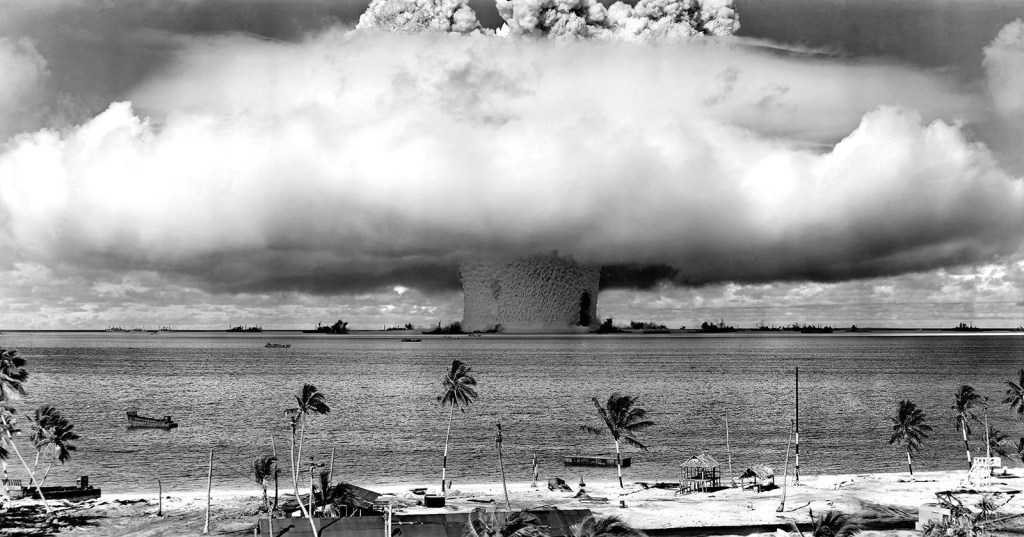
The first underwater test conducted by the U.S. of an atomic bomb at Bikini atoll. Image Encyclopædia Britannica
Today’s first question concerns the date 5 July. The subsequent questions share a theme established by the first.
One
On this day in 1946, French designer Louis Réard introduced a new swimsuit he called the Bikini, inspired by the location of recent US nuclear tests. In what island group is the Bikini Atoll situated?
Answer: Marshall Islands.
On this day in 1946, French designer Louis Réard unveiled the bikini, a two-piece swimsuit named after Bikini Atoll. The bikini became a symbol of changing attitudes towards self-expression and bodily autonomy, despite initial scandal and condemnation. Today, the bikini is celebrated as a powerful expression of agency and body positivity. The Marshall Islands atomic bomb tests by the United States from 1946 to 1958 involved 67 tests on Bikini and Enewetak atolls. The Castle Bravo thermonuclear bomb test in 1954 yielded 15 megatons, far exceeding expectations and causing widespread devastation, including vaporising three of Bikini’s islands. The U.S. has since paid compensation to affected parties but the atolls remain contaminated with radiation and uninhabitable. Bikini’s coral reefs recovered, but land and food are unsafe.
Two
A balaclava, also known as a ski mask, was named after its use by British troops at the Battle of Balaclava. Which war was this and in which decade did it occur?
Answers: Crimean War; 1850s.
A balaclava, or ski mask, is headgear exposing parts of the face, used in skiing, snowboarding, and racing. Originating from the 1854 Battle of Balaclava during the Crimean War, British troops wore knitted headgear for warmth. Similar 19th-century headgear included the Uhlan cap and Templar cap.
Three
The sturdy cotton warp-faced textile used to make jeans has a name which points to the city of origin. What is that name, and what is the city?
Answers: Denim; Nîmes.
Denim is a sturdy cotton warp-faced textile in which the weft passes under two or more warp threads, originating from the French phrase sergé de Nîmes (‘serge from Nîmes’). This durable twill-woven fabric, typically made from cotton, is known for its longevity and is yarn-dyed and mill-finished. Jeans, trousers made from denim, originated in the 19th century as workwear. They gained popularity beyond labourers, becoming associated with various cultural movements and are now valued for their versatility and ability to transcend social boundaries.
Four
What U.S. president has a short battledress-type uniform jacket named after him?
Answer: Dwight. D Eisenhower.
The Eisenhower jacket, or Ike jacket, officially the M-1944 Jacket, was developed for the U.S. Army in WWII, named after Dwight D. Eisenhower. Inspired by the British Battledress, it featured a pleated back, adjustable waist, and multiple pockets. Major General Ira C. Eaker influenced its creation.
Five
Made famous when worn by Audrey Hepburn in Roman Holiday (1953) Capri pants are named after the island of Capri. In what marginal sea is the Capri located?
Answer: Tyrrhenian Sea.
Capri pants, introduced by Sonja de Lennart in 1948, gained popularity on the Italian isle of Capri in the late 1950s and early 1960s. Iconic figures like Audrey Hepburn and Brigitte Bardot popularised them. In the U.S., Mary Tyler Moore’s character in The Dick Van Dyke Show further popularised capris.
As soon as the war ended, we located the one spot on earth that hadn’t been touched by the war and blew it to hell.
The post title is a quote from American comedian Bob Hope.
The first underwater test conducted by the U.S. of an atomic bomb at Bikini atoll. Image Encyclopædia Britannica
Today’s first question concerns the date 5 July. The subsequent questions share a theme established by the first.
One
On this day in 1946, French designer Louis Réard introduced a new swimsuit he called the Bikini, inspired by the location of recent US nuclear tests. In what island group is the Bikini Atoll situated?
Two
A balaclava, also known as a ski mask, was named after its use by British troops at the Battle of Balaclava. Which war was this and in which decade did it occur?
Three
The sturdy cotton warp-faced textile used to make jeans has a name which points to the city of origin. What is that name, and what is the city?
Four
What U.S. president has a short battledress-type uniform jacket named after him?
Five
Made famous when worn by Audrey Hepburn in Roman Holiday (1953) Capri pants are named after the island of Capri. In what marginal sea is the Capri located?
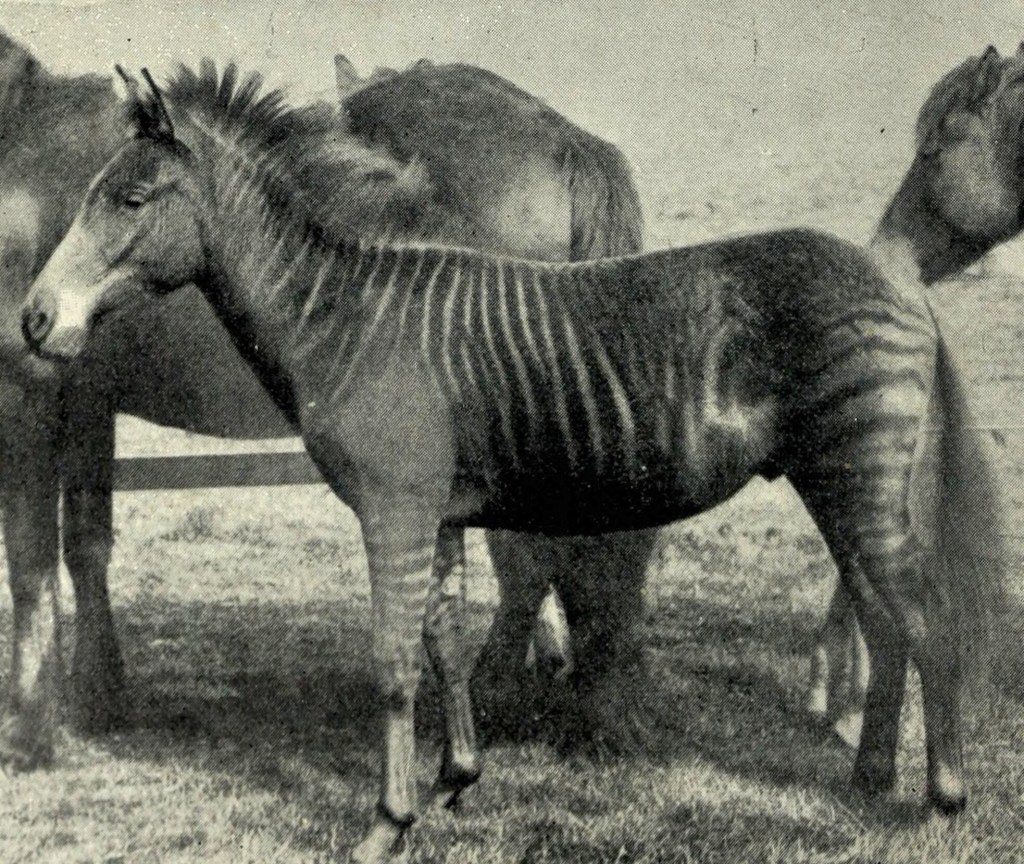
See question two. Zonkey, the hybrid offspring of a donkey and a zebra. Image Wikimedia Commons
Today’s questions are not date-related, nor are the questions related, but there is a theme concerning the answers.
One
What word completes the title of a 1965 war film starring Kirk Douglas and Richard Harris, which was based on a true story and shot in Norway: The Heroes of …?
Answer: Telemark.
The Heroes of Telemark is a 1965 British war film based on a true story. It depicts a sabotage mission against a Norwegian heavy water plant during World War II. At the time, Norway was occupied by German forces and there was a fear that the plant could aid their efforts to build an atomic bomb.
Two
What is defined in the Oxford English Dictionary as ‘the hybrid offspring of a donkey and a zebra’? (NB. The same word is used in Mexico for donkeys painted as zebras for tourist souvenir photos.)
Answer: Zonkey.
Imagine a creature that embodies the rugged resilience of a donkey and the striking elegance of a zebra. This is no mythical beast, but a living, breathing marvel known as the zonkey. A fascinating hybrid, the zonkey captures the imagination with its unique blend of features, often sporting the sturdy body of a donkey adorned with the distinctive stripes of a zebra, typically concentrated on its legs, neck, and sometimes its torso. These captivating animals are a testament to the intricate dance of genetics and the surprising outcomes that can arise when different species meet.
Dating from the first half of the 20th century from what language did the words ‘rooibos’ and ‘apartheid’ originate?
Answer: Afrikaans.
Rooibos is an evergreen South African shrub, and its leaves are used to make a tea. It originated in the early 20th century from Afrikaans, and means literally ‘red bush’. Apartheid, a system of racial segregation and discrimination, was adopted as a slogan in the 1948 election by the Afrikaner National Party in South Africa. The system was maintained until February 1991 despite domestic unrest and international isolation. Originating in the 1940s, from Afrikaans, literally ‘separateness’.
Four
Who won Best Supporting Actress Oscar for her part in The Constant Gardener?
Answer: Rachel Weisz.
The Constant Gardener is a 2005 drama thriller film directed by Fernando Meirelles, based on John le Carré’s novel. It follows a British diplomat in Kenya investigating his wife’s murder. A critical and box office success, it achieved four Oscar nominations, with Weisz winning Best Supporting Actress.
Five
What body of water was home to the British Fleet during both the First and Second World Wars, as well as being the site of the 1919 scuttling of the interred German High Sea Fleet and the 1939 sinking of HMS Royal Oak?
Answer: Scapa Flow.
Scapa Flow, a sheltered body of water in the Orkney Islands, Scotland, has historical significance as a Viking anchorage and UK naval base. HMS Royal Oak is a war grave for over 800 seamen who perished when the ship was torpedoed by a German U-boat. Today, it is known for its diving sites and as a location for oil and LNG transfers.
Russian Caesars
The post title Russian Caesars refers to Tzar (also Tsar or Czar) in plural, TZARS which gives the start letter for each of the above answers.
See question two. ?, the hybrid offspring of a donkey and a zebra. Image Wikimedia Commons
Today’s questions are not date-related, nor are the questions related, but there is a theme concerning the answers.
One
What word completes the title of a 1965 war film starring Kirk Douglas and Richard Harris, which was based on a true story and shot in Norway: The Heroes of …?
Two
What is defined in the Oxford English Dictionary as ‘the hybrid offspring of a donkey and a zebra’? (NB. The same word is used in Mexico for donkeys painted as zebras for tourist souvenir photos.)
Three
Dating from the first half of the 20th century from what language did the words ‘rooibos’ and ‘apartheid’ originate?
Four
Who won Best Supporting Actress Oscar for her part in The Constant Gardener?
Five
What body of water was home to the British Fleet during both the First and Second World Wars, as well as being the site of the 1919 scuttling of the interred German High Sea Fleet and the 1939 sinking of HMS Royal Oak?
Today’s first question is the only one connected to the date 11 June. The others continue a theme created in the first.
One
Born in 1910, this French author, explorer, inventor, diver, and biologist was awarded the Legion of Honour, the highest and most prestigious French national order of merit, for espionage work while a member of the French resistance during World War II. Who is this?
Answer: Jacques Cousteau.
Jacques Cousteau (1910–1997) was a French naval officer, ocean explorer, filmmaker and co-inventor of the Aqua-Lung, which revolutionised scuba diving. A World War II resistance member and decorated naval officer, he pioneered underwater research, photography, and filmmaking. Using his research vessel Calypso (pictured), he led expeditions worldwide and helped popularise ocean exploration through books, documentaries and television. Cousteau also directed Monaco’s Oceanographic Museum, developed underwater habitats, and founded organisations dedicated to marine conservation and environmental protection.
Two
This actor, who links Hamlet and Ealing comedies with adaptations of John Le Carré’s novels and Star Wars, commanded a World War II landing craft during the invasions of Sicily and Elba. Who is he?
Answer: Alec Guinness.
Sir Alec Guinness, born Alec Guinness de Cuffe, was a renowned English actor, noted for his roles in nine of the BFI’s 100 most important British films. He won numerous awards, including an Academy Award, BAFTA, Golden Globe, Tony, and Volpi Cup. Knighted in 1959, he starred in films like Great Expectations, Lawrence of Arabia, and was Obi-Wan Kenobi in the original Star Wars trilogy. Guinness also excelled in theatre and television, notably as George Smiley in Tinker, Tailor, Soldier, Spy and Smiley’s People.
Three
This actress, who played Delilah in 1949’s Samson and Delilah, was the co-inventor of a 1941 torpedo radio guidance system which utilised pioneering spread spectrum and frequency hopping technology to prevent jamming. Who was she?
Answer: Hedy Lamarr.
Hedy Lamarr, an Austrian-American actress and inventor, co-invented a radio guidance system during World War II with composer George Antheil. Their invention utilised spread spectrum and frequency hopping technology to protect Allied torpedoes from Axis jamming. Lamarr received numerous awards for her contributions to spread-spectrum technology, including the Electronic Frontier Foundation’s Pioneer Award, the BULBIE Gnass Spirit of Achievement Award, and the Viktor Kaplan Medal. Its principles are utilised for secure wireless networking, such as Bluetooth and early versions of Wi-Fi, which use variants of spread spectrum to protect data from interception and interference. She was posthumously inducted into the National Inventors Hall of Fame.
Four
This actor, who worked in Royal Air Force Intelligence during World War II, links all of these: Count Dracula; a 1970s Bond villain; baddies in The Lord of the Rings and The Hobbit; a High Councillor in The Golden Compass and the voice of Death in animated versions from Terry Pratchett’s Discworld. Who is he?
Answer: Christopher Lee.
He was renowned for his portrayal of Count Dracula in Hammer Horror films, starting with Dracula (1958). He also starred as Bond villain Francisco Scaramanga in The Man with the Golden Gun (1974), Count Dooku in the Star Warsprequel trilogy (2002–2005), and Saruman in The Lord of the Rings and The Hobbit film trilogies (2001–2003 and 2012–2014, respectively). Lee voiced the character Death in two animated fantasy-comedy television series adaptations of the Discworld novels Soul Music and Wyrd Sisters (both 1997).
Five
An actor who flew US Liberator bombers over Europe during World War II had a starring role in 1939 in which he ‘went to Washington’. The following year, a ‘tale about Philadelphia’ won him a Best Actor Oscar. Who was this actor and pilot whose time in the Air Force and Air Force Reserve spanned 1941 to 1968?
Answer: James Stewart.
The two films referenced in the question are Mr. Smith Goes to Washington (1939) and The Philadelphia Story (1940). James Stewart, initially rejected for being underweight, enlisted in 1941 after gaining weight. An experienced pilot, he served in the Air Corps, becoming a second lieutenant in 1942. His celebrity aided recruitment, leading to 150,000 new troops. Volunteering for combat, he flew a B-24 Liberator in Europe, earning promotions to Major in 1944 and Colonel in 1945. Stewart received the Distinguished Flying Cross, French Croix de Guerre, and Air Medal. He served in the Air Force Reserve until 1968, retiring as a brigadier general.
The Best Way to Observe a Fish is to Become a Fish
The post title is a quote from Jacques Cousteau
“The best way to observe fish is to become a fish,” wrote Jacques-Yves Cousteau in 1952. “And the best way to become a fish…is to don an underwater breathing device called the Aqua-Lung.” — Time magazine