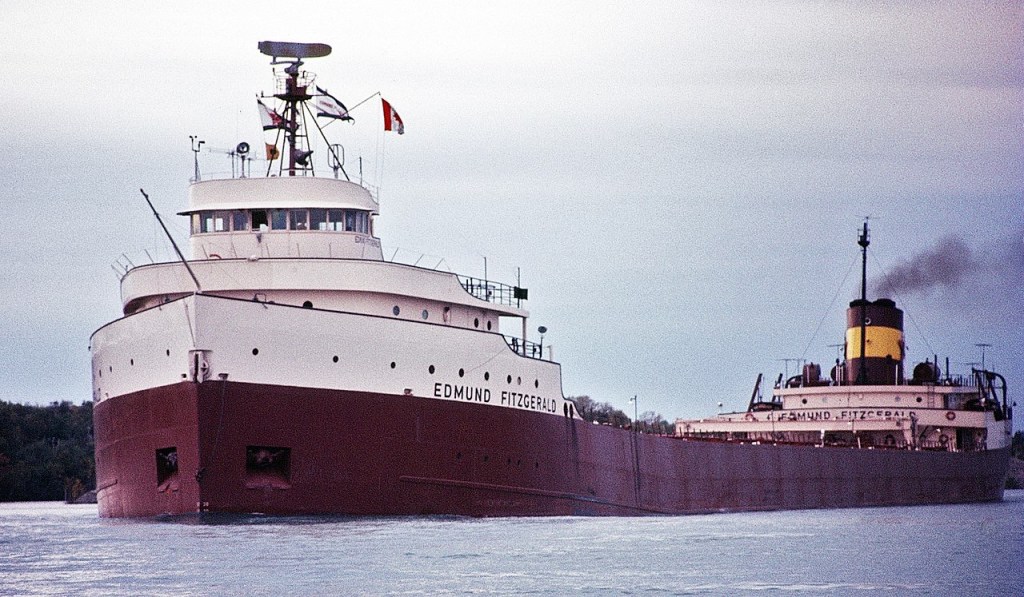
On which of the Great Lakes did the SS Edmund Fitzgerald sink with the loss of her entire crew in 1975?
Lake Michigan
Lake Ontario
Lake Superior
Two
This Eurasian woodland plant, Allium uranium, with broad shiny leaves and round heads of flowers, producing a strong aroma of garlic is also called wild garlic. What is it?
Larsons
Ramsons
Tamsons
Three
What letter(s) is the symbol which represents the element tungsten?
T
Gs
W
Four
Who, on a sixties album, released a version of the Christmas carol Silent Night with a simulated 7 O’clock News, which featured events from the preceding summer, being read over it?
Crosby, Stills and Nash
Joni Mitchell
Simon & Garfunkel
Five
In which Scottish body of water was the German High Seas Fleet scuttled in June 1919?
Here are the answers to the questions I posted earlier.
These are five questions which are related to today, February 5th.
Section of the border between East and West Germany. Image Wikimedia Commons
One
The term ‘Iron Curtain’ described the political and physical boundary dividing Europe from the end of World War II until the end of the Cold War. Who popularised its use in a speech at Westminster College, Fulton, Missouri, on 5 March 1946?
Answer: Winston Churchill.
…an iron curtain has descended across the Continent. Behind that line lie all the capitals of the ancient states of Central and Eastern Europe. — Winston Churchill, Former British prime minister, 5 March 1946, Westminster College, Fulton, Missouri
The Iron Curtain was a political and physical boundary dividing Europe from 1945 to 1990/1991, symbolising the ideological divide between the Soviet-controlled Eastern Bloc and the Western nations. Popularised by Winston Churchill in 1946, the term originally described physical barriers but later encompassed broader cultural and ideological differences. The Iron Curtain largely dissolved in 1989-90 with the fall of communism.
Two
A 31-year-old American country singer, who was born Virginia Patterson Hensley in Virginia, died in a 1963 plane crash in Tennessee. She had enjoyed an eight-year recording career, which included two number ones as well as other major chart hits. By what name was she known professionally?
Answer: Patsy Cline.
Patsy Cline, born Virginia Patterson Hensley, was an American singer known for her crossover success from country to pop music. She achieved major hits like Walkin’ After Midnight and I Fall to Pieces, becoming a trailblazer for women in country music. Although, she died in a plane crash in 1963, her legacy endures through her influential music and posthumous recognition.
Three Cigarettes in an Ashtray
The post title, Three Cigarettes in an Ashtray, was the title of a Patsy Cline single from 1957.
Three
In 1616, 73 years after publication, On the Revolutions of the Heavenly Spheres (De revolutionibus orbium coelestium) was added to the Index of Forbidden Books (Index Librorum Prohibitorum) by the Sacred Congregation of the Index. Which astronomer had written On the Revolutions of the Heavenly Spheres?
Answer: Nicolaus Copernicus
Copernicus’s book placed the Sun rather than the Earth at the centre, meaning the Earth and other planets orbited the Sun. The Index Librorum Prohibitorum, active from 1560 to 1966, was a list of publications deemed heretical or immoral by the Catholic Church. It banned thousands of books, including works by theologians, astronomers, philosophers, and unapproved Bible editions, to protect church members from potentially disruptive ideas.
Four
In 1942 Japanese forces captured what is now Jakarta, Indonesia. At that time, what was the city called and of where was it the capital?
Answers: Batavia; Dutch East Indies.
Batavia, now known as Jakarta, was founded in 1619 by the Dutch East India Company (VOC) as a strategic trading post in the Dutch colonial empire. It became the capital of the Dutch East Indies and was pivotal for their trade routes, especially in spices and other commodities. Following Indonesia’s declaration of independence in 1945, Batavia was renamed Jakarta. The city evolved from a colonial outpost to a major urban centre reflecting Indonesia’s diversity and is a bustling metropolis and the capital of Indonesia. It is a hub for culture, economy, and politics in Southeast Asia.
Five
In 1496, England’s Henry VII issued letters patent authorising a navigator and his sons to explore unknown lands. This led to what is the earliest known exploration of the North American Atlantic coast since the Norse visits to Vinland in the eleventh century. Who was Henry VII’s explorer?
Answer: John Cabot.
John Cabot was an Italian navigator and explorer. His 1497 voyage to North America, commissioned by Henry VII, King of England, is the earliest known European exploration of the region’s coast since the Norse visits to Vinland in the eleventh century. To commemorate the 500th anniversary of Cabot’s expedition, both Canadian and British governments declared Cape Bonavista, Newfoundland, as his first landing site. However, alternative locations have also been suggested.
These are five questions which are related to today, February 5th.
Section of the border between East and West Germany. Image Wikimedia Commons
One
The term ‘Iron Curtain’ described the political and physical boundary dividing Europe from the end of World War II until the end of the Cold War. Who popularised its use in a speech at Westminster College, Fulton, Missouri, on 5 March 1946?
Two
A 31-year-old American country singer, who was born Virginia Patterson Hensley in Virginia, died in a 1963 plane crash in Tennessee. She had enjoyed an eight-year recording career, which included two number ones as well as other major chart hits. By what name was she known professionally?
Three
In 1616, 73 years after publication, On the Revolutions of the Heavenly Spheres (De revolutionibus orbium coelestium) was added to the Index of Forbidden Books (Index Librorum Prohibitorum) by the Sacred Congregation of the Index. Which astronomer had written On the Revolutions of the Heavenly Spheres?
Four
In 1942 Japanese forces captured what is now Jakarta, Indonesia. At that time, what was the city called and of where was it the capital?
Five
In 1496, England’s Henry VII issued letters patent authorising a navigator and his sons to explore unknown lands. This led to what is the earliest known exploration of the North American Atlantic coast since the Norse visits to Vinland in the eleventh century. Who was Henry VII’s explorer?
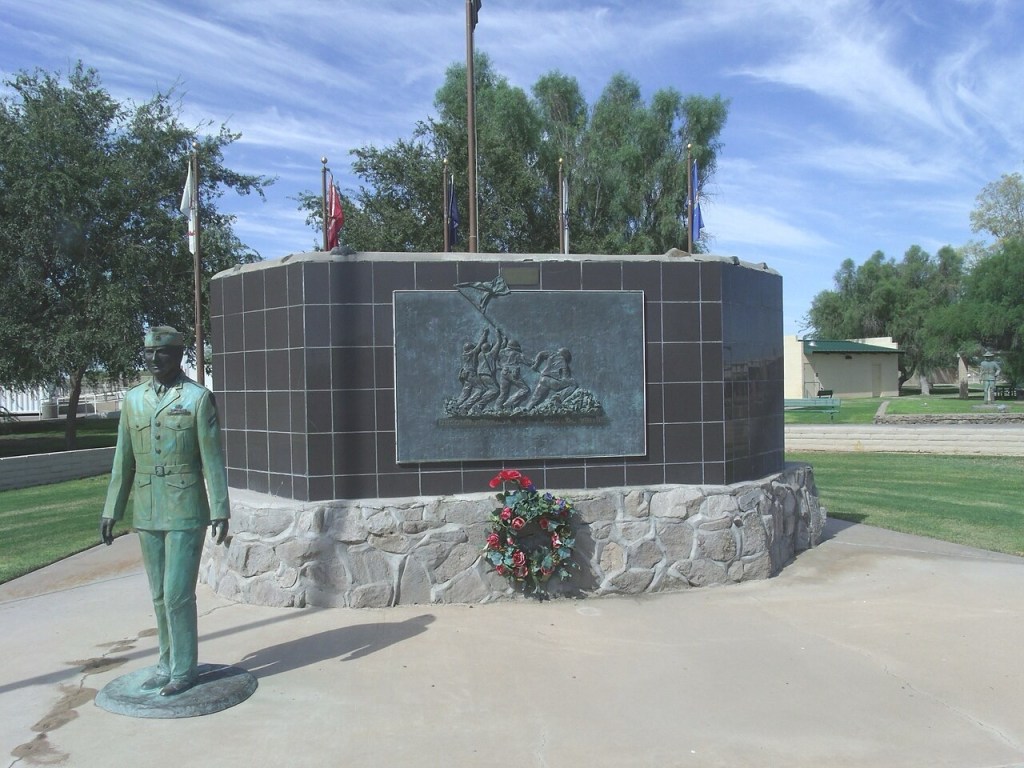
Which famous photograph featuring US Marine Ira Hayes shows him and fellow servicemen raising the American flag during a pivotal World War II battle?
Answer: Raising the Flag on Iwo Jima
The photograph, taken by Joe Rosenthal during the Battle of Iwo Jima atop Mount Suribachi on 23 February 1945, became one of the most reproduced images in history and later inspired the U.S. Marine Corps War Memorial in Arlington, Virginia. Among the six men in the iconic Raising the Flag on Iwo Jima photograph was Ira Hamilton Hayes, a US Marine and Gila River Indian Community member who fought in WWII’s Bougainville and Iwo Jima campaigns. Hayes later struggled with PTSD and alcoholism and died in 1955, being commemorated in art, film, and song, The Ballad of Ira Hayes. The lyrics are copied at the end of the post.
Two
Goodbye, Norma Jeane Though I never knew you at all You had the grace to hold yourself While those around you crawled They crawled out of the woodwork And they whispered into your brain They set you on the treadmill And they made you change your name
Goodbye England’s rose May you ever grow in our hearts You were the grace that placed itself Where lives were torn apart You called out to our country And you whispered to those in pain Now you belong to heaven And the stars spell out your name
This song has two versions, and the first verse of each is shown above. The first was written in 1973, and it was adapted 24 years later; both were written about different people. There are several questions…
What’s the song title in each case?
Who were the songwriters?
Who is the subject of each respective version?
Answers
Candle in the Wind and Candle in the Wind 1997
Elton John and Bernie Taupin
Marilyn Monroe and Diana, princess of Wales
Candle in the Wind is a song written by Elton John and Bernie Taupin, originally in honour of Marilyn Monroe. A rewritten version, Candle in the Wind 1997, was performed as a tribute to Diana, Princess of Wales at her funeral. Adapted from Elton John’s 1973 song, Candle in the Wind 1997 became the best-selling single in UK and US chart history and won a Grammy Award.
Three
This 20th-century singer-songwriter wrote about the 1959 plane crash referred to as ‘The Day the Music Died’. He also wrote a song about a 19th-century artist whose opening line references a painting often mistaken for the song’s title. There are four questions…
Who is the singer-songwriter?
What are the titles of the two songs?
Who were the three rock and roll musicians who died in the crash?
Finally, who was the artist?
Answers
Don McLean
American Pie and Vincent
Buddy Holly, Ritchie Valens and The Big Bopper
Vincent van Gogh
American Pie by Don McLean, released in 1971, was a number-one hit in the US and several other countries. Known for its length and cryptic lyrics, the song reflects on the musicians deaths, the cultural changes and loss of innocence experienced by McLean’s generation. In 2017, the original recording was selected for preservation in the US National Recording Registry. McLean also wrote Vincent as a tribute to Vincent van Gogh, which topped the UK Singles Chart in 1972 and was ranked No. 94 by Billboard for that year.
Four
Lori Lieberman co-wrote this song with lyrics about Don McLean after watching him in performance. Arguably the best known version is Roberta Flack’s 1973 cover which became a number-one hit in the US, Australia and Canada, and a top ten hit in the UK. What is the song?
Answer: Killing Me Softly with His Song.
Killing Me Softly with His Song, composed by Charles Fox with lyrics by Norman Gimbel, was inspired by a Don McLean performance. Roberta Flack’s 1973 version topped charts worldwide, winning Grammy Awards. The Fugees’ 1996 cover also achieved global success, winning a Grammy and topping the Billboard Hot 100.
Five
Je t’aime… moi non plus was written in 1967 by Serge Gainsbourg. The best known version of it was Gainsbourg’s 1969 duet with Jane Birkin which topped the UK charts. Who, often referred to as ‘B.B.’, had Gainsbourg originally written the song for?
Answer: Brigitte Bardot.
Je t’aime… moi non plus (meaning ‘I love you… me neither’) is a 1967 song written by Serge Gainsbourg for Brigitte Bardot. In 1969, Gainsbourg recorded a popular duet version with British actress Jane Birkin. While this version topped the charts in Birkin’s native United Kingdom, becoming the first foreign-language song to achieve this feat and reaching number two in Ireland, it faced censorship in several countries due to its explicit sexual content. In 1976, Gainsbourg directed Birkin in an erotic film of the same name.
The Ballad Of Ira Hayes By Peter La Farge
Ira Hayes, Ira Hayes
[CHORUS:] Call him drunken Ira Hayes He won’t answer anymore Not the whiskey drinkin’ Indian Nor the Marine that went to war
Gather round me people there’s a story I would tell About a brave young Indian you should remember well From the land of the Pima Indian A proud and noble band Who farmed the Phoenix valley in Arizona land
Down the ditches for a thousand years The water grew Ira’s peoples’ crops ‘Till the white man stole the water rights And the sparklin’ water stopped
Now Ira’s folks were hungry And their land grew crops of weeds When war came, Ira volunteered And forgot the white man’s greed
[CHORUS:] Call him drunken Ira Hayes He won’t answer anymore Not the whiskey drinkin’ Indian Nor the Marine that went to war
There they battled up Iwo Jima’s hill, Two hundred and fifty men But only twenty-seven lived to walk back down again
And when the fight was over And when Old Glory raised Among the men who held it high Was the Indian, Ira Hayes
[CHORUS:] Call him drunken Ira Hayes He won’t answer anymore Not the whiskey drinkin’ Indian Nor the Marine that went to war
Ira returned a hero Celebrated through the land He was wined and speeched and honored; Everybody shook his hand
But he was just a Pima Indian No water, no crops, no chance At home nobody cared what Ira’d done And when did the Indians dance
[CHORUS:] Call him drunken Ira Hayes He won’t answer anymore Not the whiskey drinkin’ Indian Nor the Marine that went to war
Then Ira started drinkin’ hard; Jail was often his home They’d let him raise the flag and lower it like you’d throw a dog a bone!
He died drunk one mornin’ Alone in the land he fought to save Two inches of water in a lonely ditch Was a grave for Ira Hayes
[CHORUS:] Call him drunken Ira Hayes He won’t answer anymore Not the whiskey drinkin’ Indian Nor the Marine that went to war
Yeah, call him drunken Ira Hayes But his land is just as dry And his ghost is lyin’ thirsty In the ditch where Ira died
Which famous photograph featuring US Marine Ira Hayes shows him and fellow servicemen raising the American flag during a pivotal World War II battle?
Two
Goodbye, Norma Jeane Though I never knew you at all You had the grace to hold yourself While those around you crawled They crawled out of the woodwork And they whispered into your brain They set you on the treadmill And they made you change your name
AZ Lyrics
Goodbye England’s rose May you ever grow in our hearts You were the grace that placed itself Where lives were torn apart You called out to our country And you whispered to those in pain Now you belong to heaven And the stars spell out your name
AZ Lyrics
This song has two versions, and the first verse of each is shown above. The first was written in 1973, and it was adapted 24 years later; both were written about different people. There are several questions…
What’s the song title in each case?
Who were the songwriters?
Who is the subject of each respective version?
Three
This 20th-century singer-songwriter wrote about the 1959 plane crash referred to as ‘The Day the Music Died’. He also wrote a song about a 19th-century artist whose opening line references a painting often mistaken for the song’s title. There are four questions…
Who is the singer-songwriter?
What are the titles of the two songs?
Who were the three rock and roll musicians who died in the crash?
Finally, who was the artist?
Four
Lori Lieberman co-wrote this song with lyrics about Don McLean after watching him in performance. Arguably the best known version is Roberta Flack’s 1973 cover which became a number-one hit in the US, Australia and Canada, and a top ten hit in the UK. What is the song?
Five
Je t’aime… moi non plus was written in 1967 by Serge Gainsbourg. The best known version of it was Gainsbourg’s 1969 duet with Jane Birkin which topped the UK charts. Who, often referred to as ‘B.B.’, had Gainsbourg originally written the song for?
Here are the answers to the questions I posted earlier.
Todays questions are all related to the date, February 22nd.
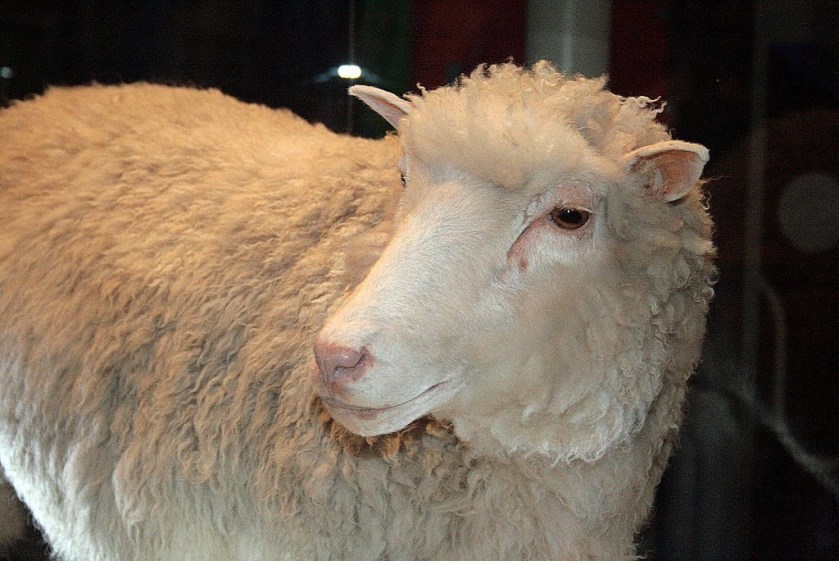
Dolly the Sheep. The taxidermy mount of Dolly on exhibit at the National Museum of Scotland, 2009. Image Wikimedia Commons
One
On this day in 1997, the world was introduced to Dolly the sheep. Cloned at a Scottish institute sharing a name with a nearby chapel featured in a Dan Brown novel and film, both the institute and chapel’s names originate from that of a village with multiple spellings. What is it?
Answer: Roslin (Institute) or Rosslyn (Chapel) or Roslyn.
Dolly the Sheep was cloned at the Roslin Institute, the first mammal to be cloned from an adult cell. The nearby Rosslyn Chapel, founded in 1446 by Sir William St. Clair, is a remarkable example of ornate Gothic architecture. The chapel, known as a ‘Bible in stone’, features intricate carvings and sculptures, including the Apprentice Pillar, which is the subject of much speculation. Despite its association with the Knights Templar and the Holy Grail, the chapel’s true significance lies in its historical and architectural value. It featured in Dan Brown’s novel and film The Da Vinci Code.
Two
George Washington, the first president of the United States, was born on 22 February 1732 in Westmoreland, Virginia. This Virginian county was named after the British County of Westmorland, but on what island was this latter county found?
Answer: Great Britain.
Westmorland, a former county in North West England, is situated on the island of Great Britain. It encompassed part of the Lake District and the southern Vale of Eden. In 1974 it was incorporated into Cumbria and now forms part of the larger Westmorland and Furness unitary authority area.
Three
Exactly 200 years after the birth of George Washington, a United States politician was born into a political dynasty on this day. Who was he?
Answer: Ted Kennedy (in full Edward Moore Kennedy).
Edward Moore Kennedy, a prominent American politician and member of the Democratic Party, served as a United States Senator from Massachusetts from 1962 until his death in 2009. Known for his oratorical skills and liberal views, Kennedy championed numerous significant pieces of legislation, including the Immigration and Nationality Act of 1965 and the Americans with Disabilities Act of 1990. Despite his political achievements, his career was marred by the Chappaquiddick incident in 1969.
Four
In 1942, three members of an anti-Nazi group were executed by beheading in Munich. Over the following months, others were also executed and many more imprisoned for alleged connections to the group. The group’s two-word name was that of a colour and a flower; what was this name?
Answer: White Rose.
The White Rose was a non-violent resistance group in Nazi Germany, led by students and a professor. They conducted a leaflet and graffiti campaign against the Nazi regime, denouncing its crimes and calling for resistance. Their activities ended with further arrests and executions in 1943.
Five
On this date, NASCAR held the first Daytona 500. In what year was this, and which driver won the race?
Answers: 1959; Lee Petty.
The 1959 Daytona 500, the second race of the NASCAR Grand National Series season, was the inaugural race at the newly built Daytona International Speedway. The track, built by NASCAR founder Bill France, Sr., is a 2.5-mile superspeedway and is considered the most prestigious race on the NASCAR calendar.
Todays questions are all related to the date, February 22nd.
Dolly the Sheep. The taxidermy mount of Dolly on exhibit at the National Museum of Scotland, 2009. Image Wikimedia Commons
One
On this day in 1997, the world was introduced to Dolly the sheep. Cloned at a Scottish institute sharing a name with a nearby chapel featured in a Dan Brown novel and film, both the institute and chapel’s names originate from that of a village with multiple spellings. What is it?
Two
George Washington, the first president of the United States, was born on 22 February 1732 in Westmoreland, Virginia. This Virginian county was named after the British County of Westmorland, but on what island was this latter county found?
Three
Exactly 200 years after the birth of George Washington, a United States politician was born into a political dynasty on this day. Who was he?
Four
In 1942, three members of an anti-Nazi group were executed by beheading in Munich. Over the following months, others were also executed and many more imprisoned for alleged connections to the group. The group’s two-word name was that of a colour and a flower; what was this name?
Five
On this date, NASCAR held the first Daytona 500. In what year was this, and which driver won the race?
Here are the answers to my Walter posted questions.
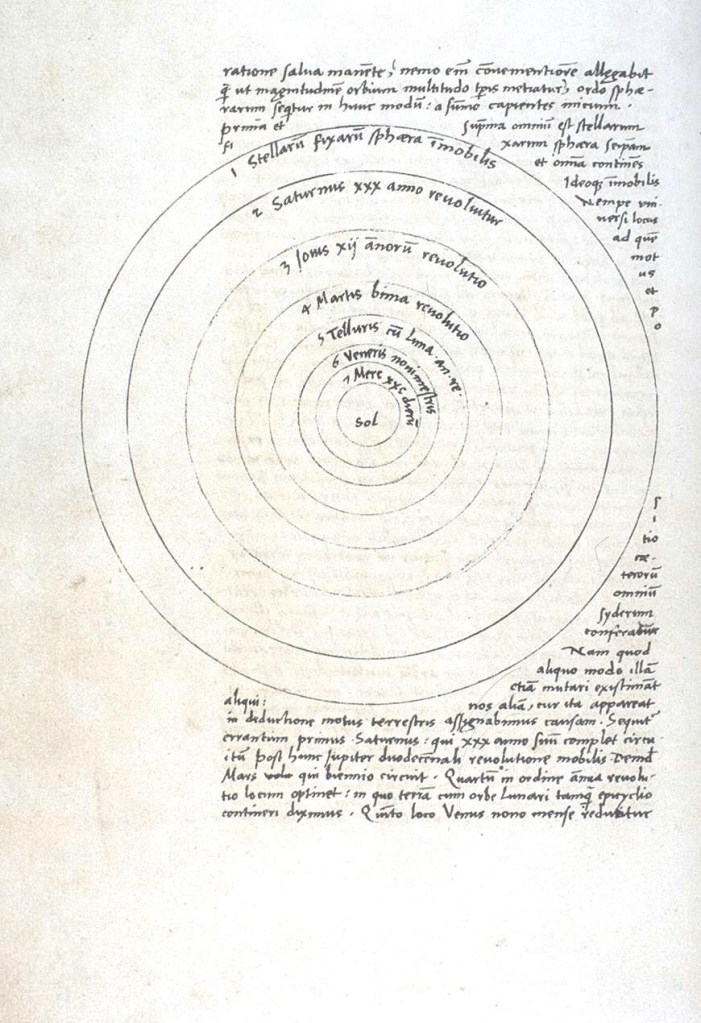
Diagram of the Solar System from Copernicus’ manuscript of De revolutionibus orbium coelestium. Image Wikimedia Commons
All of today’s questions relate to the date, February 19th.
One
In what century was Polish astronomer Nicolaus Copernicus born?
Answer: 15th century.
Born in 1473, Nicolaus Copernicus, a Renaissance polymath, formulated a heliocentric model of the universe, placing the Sun at its centre. His work, published in De revolutionibus orbium coelestium (On the Revolutions of the Heavenly Spheres) triggered the Copernican Revolution and significantly contributed to the Scientific Revolution.
Two
In 1945, the Battle of Iwo Jima began when US Marines invaded the Japanese volcanic island of Iwo Jima. What does the name Iwo Jima mean in English?
Answer: Sulfur Island.
Iwo Jima, a volcanic island in the Ogasawara Archipelago, is administered by Tokyo. It was the site of a major WWII battle between Japan and the US, resulting in over 20,000 casualties on each side. Today, the island has no permanent inhabitants except for a Self-Defence Force base and is owned by a combination of individuals, the village, and the Japanese government.
Three
Andrew Mountbatten-Windsor was born in 1960 and was known as Prince Andrew. He would later also be known as the Duke of York. For the first 22 years of his life, he was second in the line of succession to the British throne, who, born in 1982, replaced him as second in the line of succession?
Answer: Prince William (The eldest son of Charles, Prince of Wales (now King Charles III) and Diana, Princess of Wales).
Andrew Mountbatten-Windsor faced controversy due to his friendship with Jeffrey Epstein. He denied allegations of sexual abuse but settled a civil lawsuit with Virginia Giuffre in 2022. In 2025, Charles III removed Andrew’s royal styles and honours, restricted his titles, and relocated him to private accommodation.
Four
Born in 1924, this actor was a decorated World War II veteran, where he served in the U.S. Marines. He won an Oscar for Best Actor for Cat Ballou (1965) where he played both Kid Shelleen and Tim Strawn. He appeared in The Dirty Dozen (1967) and Gorky Park (1983). He died in 1987. Who is this actor?
Answer: Lee Marvin.
Marvin, an American actor known for his tough-guy roles, received an Academy Award for his performance in Cat Ballou. He was also a decorated World War II veteran and a descendant of the Lee family of Virginia.
Five
In 1913, Pedro Lascuráin assumed the role of President of Mexico. What connects the number 45 to his presidency? Was it
45 marriages (he was married 45 times during his presidency)
45 minutes (he was in office for only 45 minutes)
45 murders (he was connected to 45 murders during his presidency)
Answer: 45 minutes (he was in office for only 45 minutes)
During the Ten Tragic Days coup, Victoriano Huerta captured President Madero and convinced him to resign. Lascuráin, next in line, briefly assumed the presidency before appointing Huerta as his successor, making Lascuráin’s presidency the shortest in history of not only Mexico but the world.
Diagram of the Solar System from Copernicus’ manuscript of De revolutionibus orbium coelestium. Image Wikimedia Commons
All of today’s questions relate to the date, February 19th.
One
In what century was Polish astronomer Nicolaus Copernicus born?
Two
In 1945, the Battle of Iwo Jima began when US Marines invaded the Japanese volcanic island of Iwo Jima. What does the name Iwo Jima mean in English?
Three
Andrew Mountbatten-Windsor was born in 1960 and was known as Prince Andrew. He would later also be known as the Duke of York. For the first 22 years of his life, he was second in the line of succession to the British throne, who, born in 1982, replaced him as second in the line of succession?
Four
Born in 1924, this actor was a decorated World War II veteran, where he served in the U.S. Marines. He won an Oscar for Best Actor for Cat Ballou (1965) where he played both Kid Shelleen and Tim Strawn. He appeared in The Dirty Dozen (1967) and Gorky Park (1983). He died in 1987. Who is this actor?
Five
In 1913, Pedro Lascuráin assumed the role of President of Mexico. What connects the number 45 to his presidency? Was it
45 marriages (he was married 45 times during his presidency)
45 minutes (he was in office for only 45 minutes)
45 murders (he was connected to 45 murders during his presidency)
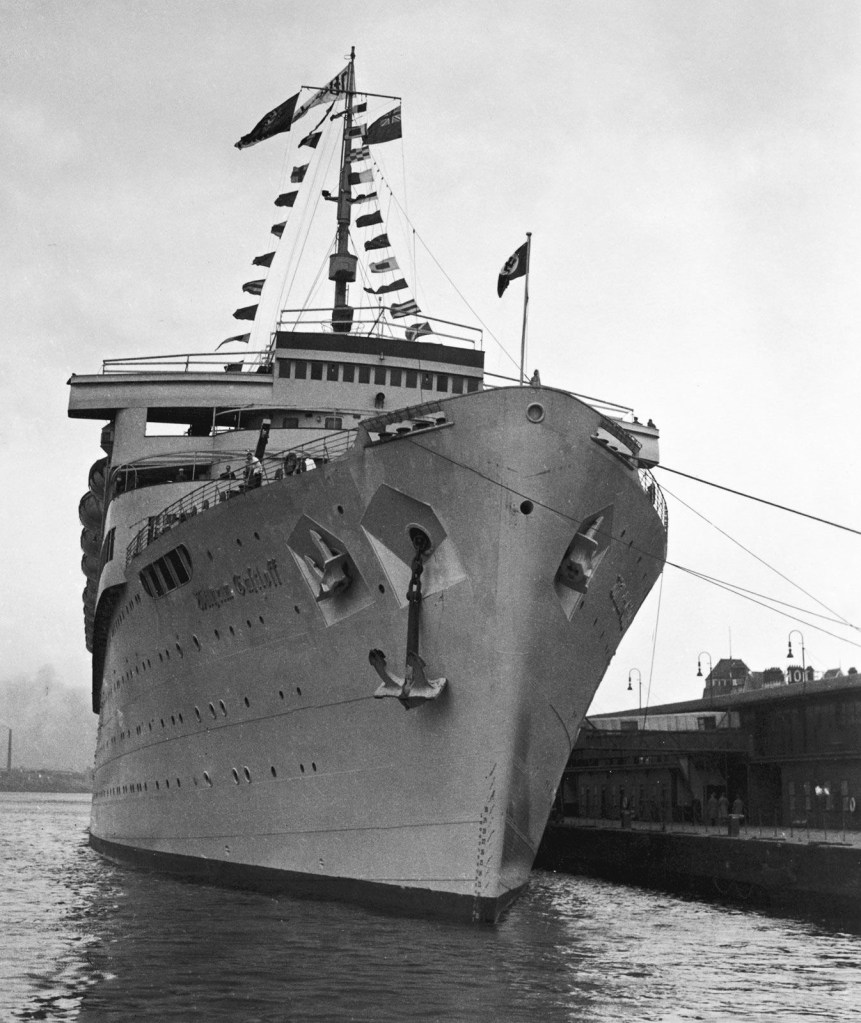
On 30 January 1945, the greatest maritime disaster in history occurred as the German ocean liner Wilhelm Gustloff was sunk. In what body of water was this sinking, and approximately how many people perished?
Answer: Baltic Sea; ≈ 9,000 lives were lost
The MV Wilhelm Gustloff, a German ocean liner originally built as a cruise ship for the Nazi Strength Through Joy organisation, was sunk by a Soviet submarine S-13 in the Baltic Sea on 30 January 1945, during Operation Hannibal. The ship, carrying an estimated 10,000 people, including refugees and military personnel, sank in one hour after being hit by three torpedoes. This disaster resulted in the greatest maritime disaster in history, with an estimated 8,761 to 9,343 casualties. Despite the high civilian death toll, the sinking is not considered a war crime due to the presence of military personnel and weapons on board.
Two
On this day in 1847, Yerba Buena became what North American city?
Answer: San Francisco
Yerba Buena (good herb), now San Francisco, was claimed by the US in 1846 during the Mexican-American War. The city became a US military territory in 1848 and was admitted to the Union as a state in 1850.
Three
Charles I, king of England, Scotland, and Ireland, was executed in London. In what decade did this occur?
Answer: 1640s
Charles I, King of England, Scotland, and Ireland from 1625 to 1649, believed in the divine right of kings and clashed with Parliament over his policies, including taxation without consent and religious reforms. His actions led to the English Civil War, his defeat, and his execution for high treason in 1649. The monarchy was abolished but restored in 1660 with his son, Charles II.
Four
Oliver Cromwell was one of the regicides responsible for Charles I’s execution. What happened to Cromwell two years after his own death?
Answer: He was disinterred and ritually executed.
Oliver Cromwell, who had died in 1658, was subjected to a posthumous execution. His body was disinterred, hanged at Tyburn, and beheaded. Then it was thrown into a pit and his head placed on a spike at the end of Westminster Hall facing the spot where Charles I had been executed.
Five
On this day in 1931 City Lights premiered. The film was written, produced, directed by, and starred whom?
Answer: Charlie Chaplin
City Lights is a 1931 American romantic comedy-drama film written, produced, directed by, and starring Charlie Chaplin. The film, which follows the Tramp’s misadventures, was released with a synchronised musical score and sound effects despite the rise of talking pictures. City Lights was a critical and commercial success, and is considered one of Chaplin’s greatest films.
Good Herb
The post title is the translation of Yerba Buena, which is now the city of San Francisco. See question two.