Over the next nine days, 46 questions will be posed, one for each letter of the alphabet plus 20 others (There will be six one day). The 20 others appear as duplicate letters, and these duplicates spell out the name of the Roman Fortification which in CE 150 to 160 was the furthest boundary from the city of Rome, and the country that it was situated in. It is a three-word answer with eight letters in the first part of the name and four in the second part; the country has eight letters in its name. BTWFit, as used in the post title, is an archaic term meaning ‘a division of a song, ballad, or story’.
Twenty-six
What word is defined as ‘a field where rice is grown’?
Twenty-seven
Q is a frequently recurring character who is either mentioned or appears in various of the James Bond series of novels and films. What does the designation ‘Q’ stand for?
Twenty-eight
… one of the least-populated countries in Europe, albeit with the highest population growth rate…
— Wikipedia
The country described above has a name which originated from a word meaning ‘Little Fortress’. What country?
Twenty-nine
Name the production company which made Raiders of the Lost Ark?
Thirty
A federal organisation, often known by a nickname or four initials, gifted Burmese to Queen Elizabeth II in 1969. The same organisation, to mark its 150th anniversary in 2023, gifted Noble to King Charles III. What is the full name of this organisation, and what word best describes Burmese and Noble?
Good luck! I’ll post the answers once all the questions have been asked.
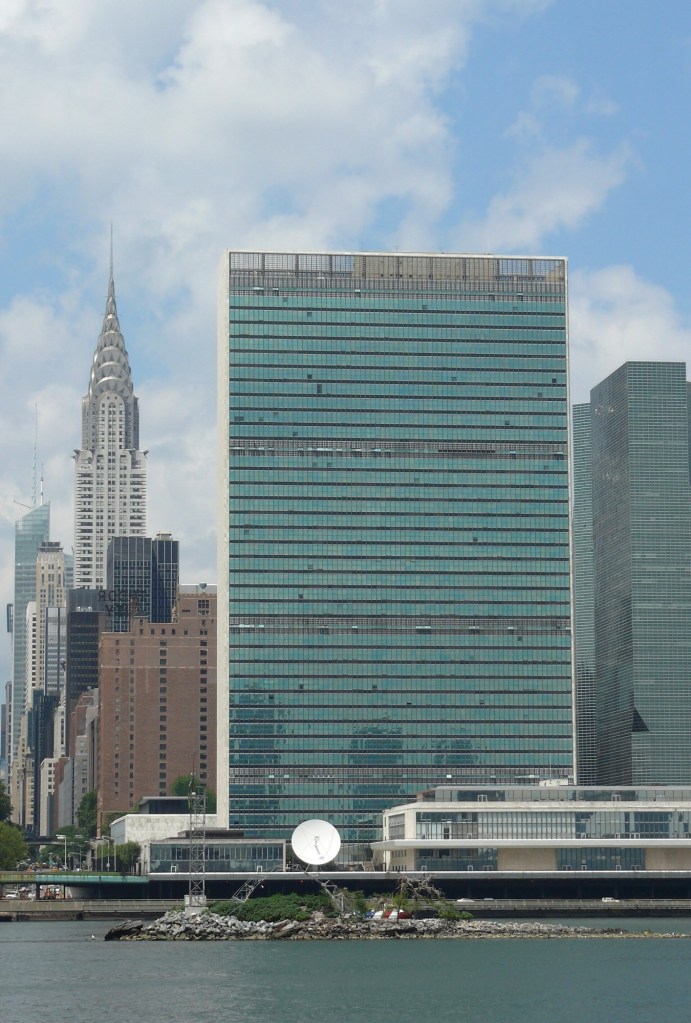
United Nations Building, New York City. See question five. Image Wikimedia Commons
Five unassociated questions.
One
Travelling west along the Trans-Canada Highway (TCH) from its western terminus, how many provincial and territorial capitals do you pass through, and what, in geographical order, are their names along with their respective province or territory?
Answers: Six; Victoria, British Columbia; Regina, Saskatchewan; Winnipeg, Manitoba; Québec City, Quebec; Fredericton, New Brunswick; St. John’s, Newfoundland and Labrador.
The Trans-Canada Highway is a transcontinental highway system spanning all ten Canadian provinces, with its main route covering 7,821 kilometres from Victoria, British Columbia, to St. John’s, Newfoundland and Labrador. Construction began in 1950, the highway officially opened in 1962, and the final section was completed in 1971. The entire system, including routes such as the Yellowhead Highway, totals about 12,800 kilometres. Design standards vary along its length, although most sections remain two-lane, undivided highways. The longest continuous divided section extends for about 1,500 kilometres from the Rocky Mountains to the Manitoba–Ontario border. Although the network does not extend into Canada’s three territories or to the U.S. border, it forms part of the National Highway System. In addition to passing through six provincial capitals, the Trans-Canada Highway also serves Canada’s national capital, Ottawa.
Two
A fictitious error deliberately placed in a reference work is a what?
Ballicatter
Frauendienst
Mountweazel
Answer: Mountweazel.
A fictitious entry is a deliberate error in reference works used as a copyright trap. Types include Mountweazel, trap street, and paper town. Henry Alford coined “Mountweazel” after a fake entry in the 1975 New Columbia Encyclopaedia. These entries are also known as nihilartikel.
Three
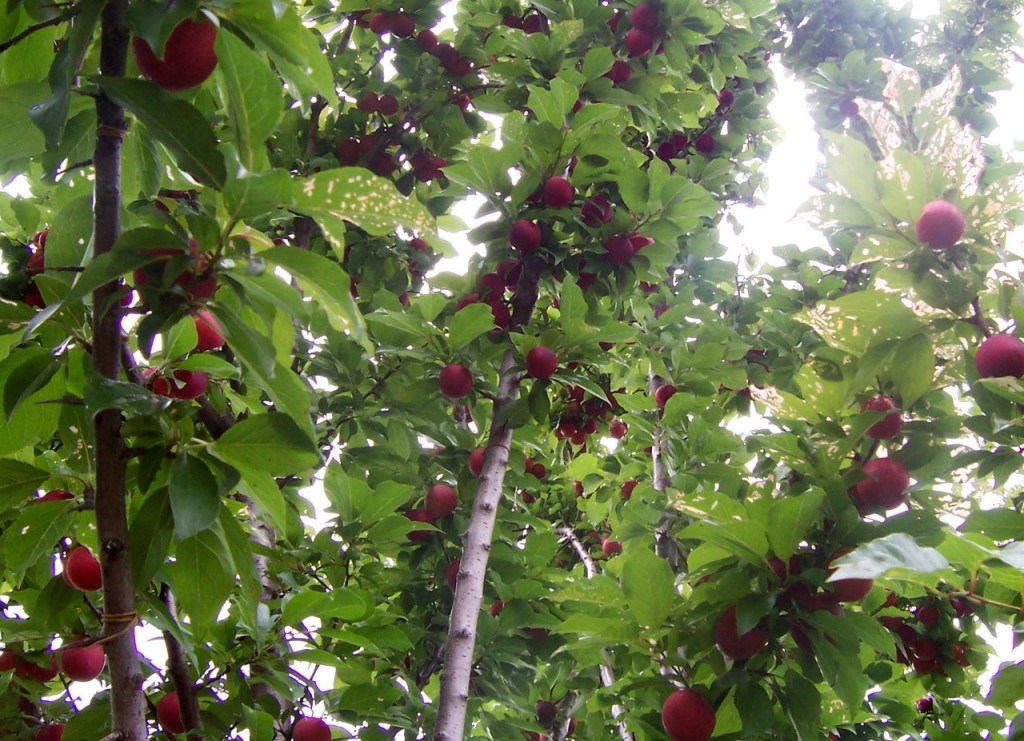
The title of a 2017, single by Drake shares its name with a fruit, the flower of which is shown above. What was the title of the single?
Answer: Passionfruit.
Passionfruit by Drake, featuring Zoë Kravitz, is a tropical house, R&B, pop, and dancehall song from his 2017 mixtape More Life. It peaked at number 8 on the US Billboard Hot 100 and number 2 on the Canadian Hot 100.
Four
Three questions based the standard UK and US editions of monopoly.
What on the UK edition is the equivalent of the American Marvin Gardens?
The British Leicester Square is the equivalent of what on the American edition?
What colour are these properties on both the British and American versions?
Answers
Piccadilly
Atlantic Avenue
Yellow
Monopoly, derived from Lizzie Magie’s 1903 game, involves moving tokens to buy properties and bankrupt opponents. Parker Brothers published it in 1935; Hasbro acquired it in 1991. It has sold 275 million copies across 113 countries.
Five
In this post, No. 3 was appointed on 30 November 1962. The first, Gladwyn Jebb, serving in an ‘acting’ capacity and therefore unnumbered, held the post for 101 days in 1945/46. Nos. 1 and 2 were Scandinavian, while No. 3 was the first non-European. What is this post, who was No. 3, and what was his nationality?
Answers: Secretary-General of the United Nations; U Thant and Burmese.
The secretary-general of the United Nations oversees the Secretariat under Chapter XV of the Charter, appointed by the General Assembly after a Security Council recommendation, with any permanent member able to veto. Precedent excludes permanent members’ citizens, favours regional rotation and gender equality, and all appointees are career diplomats. Since 1971, five-year terms are standard, with reselection common. The secretary-general’s duties include advocacy, diplomacy, and civil service, with informal powers for dispute prevention.
United Nations Building, New York City. See question five. Image Wikimedia Commons
Five unassociated questions.
One
Travelling west along the Trans-Canada Highway (TCH) from its western terminus, how many provincial and territorial capitals do you pass through, and what, in geographical order, are their names along with their respective province or territory?
Two
A fictitious error deliberately placed in a reference work is a what?
Ballicatter
Frauendienst
Mountweazel
Three
The title of a 2017, single by Drake shares its name with a fruit, the flower of which is shown above. What was the title of the single?
Four
Three questions based the standard UK and US editions of monopoly.
What on the UK edition is the equivalent of the American Marvin Gardens?
The British Leicester Square is the equivalent of what on the American edition?
What colour are these properties on both the British and American versions?
Five
In this post, No. 3 was appointed on 30 November 1962. The first, Gladwyn Jebb, serving in an ‘acting’ capacity and therefore unnumbered, held the post for 101 days in 1945/46. Nos. 1 and 2 were Scandinavian, while No. 3 was the first non-European. What is this post, who was No. 3, and what was his nationality?
pomology /pə(ʊ)ˈmɒlədʒi/ ▶ noun [mass noun] the science of fruit-growing. → pomological /pə(ʊ)məˈlɒdʒɪk(ə)l/ adjective → pomologist /pə(ʊ)ˈmɒlədʒɪst/ noun early 19th century: from Latin pomum ‘fruit’ + -logy. — Oxford English Dictionary
Two
What word is a noun which means a person who collects postcards?
Answer: Deltiologist.
deltiologist /ˌdɛltiˈɒlədʒɪst/ ♫ ▶ noun a person who collects postcards as a hobby. → deltiology noun 1940s: from Greek deltion (diminutive of deltos ‘writing tablet’) + -logist. — Oxford English Dictionary
Three
Potamology is the scientific study of which geographical features?
Answer: Rivers.
Potamology, a branch of hydrology, studies rivers, including their hydrological processes, morphometry, channel processes, and sediment regime.
Four
What is the scientific study of trees?
Answer: Dendrology.
Dendrology, or xylology, is the study of woody plants, focusing on their taxonomic classifications. It encompasses both economically useful and all woody plants in a region, distinguishing it from the study of sylvics, which focusses on autecology.
Five
In etymology, which botanical term is used to mean the earliest form of a word?
Answer: Root.
A root is the basic part of a word that can’t be broken down into smaller, meaningful pieces. It’s like the core of a word, and you can add prefixes or suffixes to it to change its meaning. Roots are important because they carry the main meaning of a word and are part of a word family. Sometimes, ‘root’ also refers to a word without its endings that show tense or number, but with its main meaning intact. In some languages, roots can stand alone as words, but in others, they need to be combined with other parts to form words. Roots are often marked with a special symbol to distinguish them from other parts of a word.
Ologies
Ology (plural ologies) a subject of study; a branch of knowledge: the word originates in the early 19th century: from –ology, a combining form that typically forms part of the name of sciences and subjects of study (see -logy). — Oxford English Dictionary
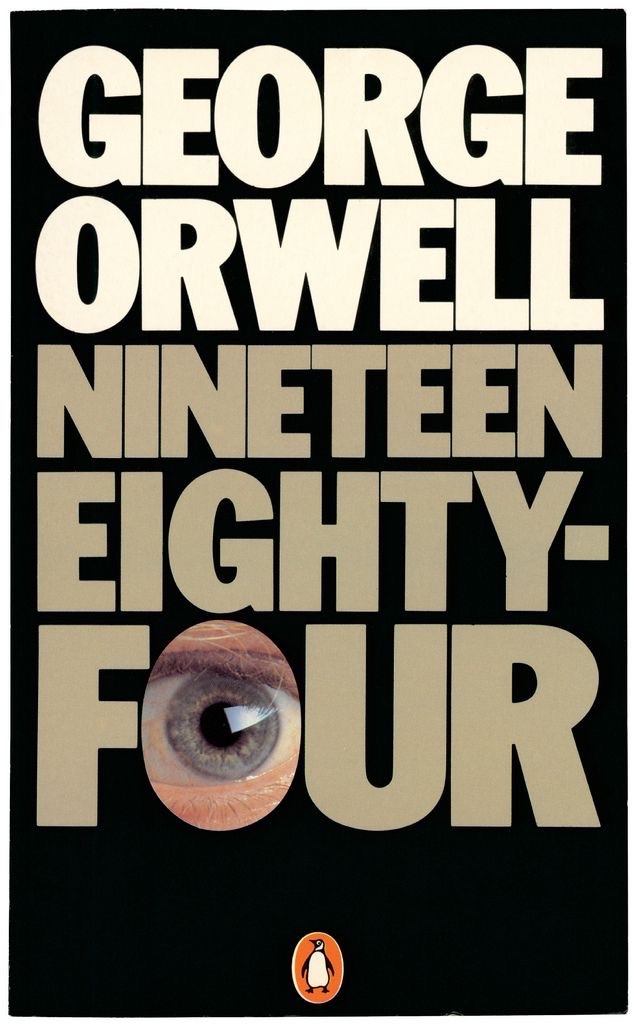
George Orwell’s Nineteen Eighty-four. Image Pinterest
Today’s questions are not related to the date; instead, they share a theme linked to the title in a subtle or hidden manner.
One
ZZ9 Plural Z Alpha, an appreciation society and their publication Mostly Harmless is connected to what science fiction franchise?
Answer: The Hitchhikers Guide to the Galaxy.
ZZ9 Plural Z Alpha organises gatherings and social events, produces the magazine Mostly Harmless and sells Beeblebears modelled on Zaphod Beeblebrox. It celebrates The Hitchhiker’s Guide to the Galaxy and Douglas Adams’s works.
Two
What single word can mean nought, a strong-lined fabric, a quick immersion, a bivalve mollusc, a lowering of the head or a bird and in which sport did the meaning ‘nought’ originate?
Answer: Duck: cricket.
All of the above are from definitions of duck.
Nought: in cricket a batter’s score of zero. Origin mid 19th century: short for duck’s egg, used for the figure 0 because of its similar outline.
Fabric: a strong cotton or linen fabric. Origin mid 17th century: from Middle Dutch doek ‘linen, linen cloth’; related to German Tuch ‘cloth’.
Immersion: to dip under water. Origin Middle English: of Germanic origin; related to Dutch duiken and German tauchen ‘dive, dip, plunge’.
Mollusc: a pure white thin-shelled bivalve mollusc found off the Atlantic coasts of America. Genus Anatina, family Mactridae.
Lowering head: lower the head or the body quickly. Origin Middle English: of Germanic origin; related to Dutch duiken and German tauchen ‘dive, dip, plunge’.
Bird: a waterbird with a broad blunt bill. Origin Old English duce, from the Germanic German tauchen ‘dive, dip, plunge’.
Three
Where is the mythical Snow Lion a celestial emblem?
Answer: Tibet.
The Snow Lion, Tibet’s celestial emblem, symbolises power, strength, fearlessness, joy, east, and earth. Featured on Tibet’s flag from 1916 to 1950, it remains used by the Tibetan Government-in-Exile. Depicted as white with a turquoise mane, it represents hermits and yogis, and is prominent in Tibetan culture.
Four
What character is named when symbols for sulphur, nobelium, oxygen, phosphorus and yttrium are placed together in order?
What are the three super-states in the novel Nineteen Eighty-four, and in which of these is London located?
Answers: Oceania, Eurasia and Eastasia; Oceania.
In April 1984, Winston Smith lives in Airstrip One (previously Great Britain), a province of Oceania, under totalitarian rule by ‘the Party’ and Big Brother. The Party enforces conformity through surveillance and Thought Police, erasing dissenters as “unpersons”. Winston, an Outer Party member at the Ministry of Truth, secretly rebels against the regime.
42-0-20-(Z 16-102–8-15-39)-13
The numbers in the title offer clues, perhaps obscure, to each of the questions in the correct order. The information breaks down like this
42: In The Hitchhiker’s Guide to the Galaxy 42 is the answer to the ultimate question of life, the universe, and everything.
0: A duck is 0 as explained above, see ‘Nought’ under the second answer.
20: The 20th letter of the alphabet ‘T’ is the initial to this answer.
(Z 16-102–8-15-39): Z is the symbol for atomic numbers and 16 is the atomic number for sulphur, 102 is nobelium 8 is oxygen 15 is phosphorus and 39 is yttrium each of which make Snoopy.
13: : ‘It was a bright cold day in April, and the clocks were striking thirteen.’ Thirteen concludes the opening line of George Orwell’s Nineteen Eighty-four.
George Orwell’s Nineteen Eighty-four. Image Pinterest
Today’s questions are not related to the date; instead, they share a theme linked to the title in a subtle or hidden manner.
One
ZZ9 Plural Z Alpha, an appreciation society and their publication Mostly Harmless is connected to what science fiction franchise?
Two
What single word can mean nought, a strong-lined fabric, a quick immersion, a bivalve mollusc, a lowering of the head or a bird and in which sport did the meaning ‘nought’ originate?
Three
Where is the mythical Snow Lion a celestial emblem?
Four
What character is named when symbols for sulphur, nobelium, oxygen, phosphorus and yttrium are placed together in order?
Five
What are the three super-states in the novel Nineteen Eighty-four, and in which of these is London located?
These are not date-related but there is a theme at the End of the Line.
One
What word means “an explanation of the history of a particular word”?
Answer: Etymology.
Etymology is the study of word origins and evolution, tracing their sounds and meanings across time. Etymologists use historical texts and comparative linguistics to reconstruct word histories and trace their roots to shared parent languages.
Two
This Skoda compact SUV, named after a cryptozoological creature, was superseded by both the Karoq and the Kamiq?
Answer: Yeti.
The Škoda Yeti, a compact crossover SUV, debuted in 2009 and won Top Gear Magazine’s Family Car of the Year.
Three
The Kabul River originates in the Hindu Kush mountains and flows 700 kilometres to empty into the … What is the watery destination missing from the end of the above statement?
Answer: Indus.
The Kabul River, originating in Afghanistan’s Hindu Kush mountains, flows 435 miles (700 km) to join the Indus in Pakistan. The Indus, a significant waterway in Asia, originates in Tibet and flows through disputed Kashmir, Pakistan, and empties into the Arabian Sea. Spanning 1,976 miles (3,180 km), it supports diverse ecosystems and has a rich historical significance, including the rise of the Indus Valley Civilisation. The river’s course is shaped by geological formations, including the Indus-Yarlung suture zone.
Four
This fictional Great Dane first graced our screens in 1969 and continues to be a beloved figure on television and in both live-action and animated films. Who is this remarkable dog?
Answer: Scooby-Doo.
Scooby-Doo is an American media franchise created in 1969, featuring four teenagers and their talking Great Dane solving mysteries. The franchise includes numerous shows, films, and specials, with the most recent series, Scooby-Doo and Guess Who?, premiering in 2019.
Five
Peter Cullen, Tesshō Genda and others have voiced which character from a media franchise that started with toys in the 1980s and has since spawned at least a dozen films?
Answer: Optimus Prime.
Transformers is a highly successful media franchise centred around the Autobots and Decepticons, two alien robot factions. The franchise, which began in 1984, includes toys, animation, comics, video games, and films, generating over ¥2 trillion in revenue. Ownership is split between Hasbro and Takara Tomy.
End of Line
The last letter at the ‘End of the Line’ of the first answer is the initial letter of the next answer and so on. This includes the final answer’s ‘E’ from Prime which starts the first answer, Etymology.
These are not date-related but there is a theme at the End of the Line.
One
What word means “an explanation of the history of a particular word”?
Two
This Skoda compact SUV, named after a cryptozoological creature, was superseded by both the Karoq and the Kamiq?
Three
The Kabul River originates in the Hindu Kush mountains and flows 700 kilometres to empty into the … What is the watery destination missing from the end of the above statement?
Four
This fictional Great Dane first graced our screens in 1969 and continues to be a beloved figure on television and in both live-action and animated films. Who is this remarkable dog?
Five
Peter Cullen, Tesshō Genda and others have voiced which character from a media franchise that started with toys in the 1980s and has since spawned at least a dozen films?
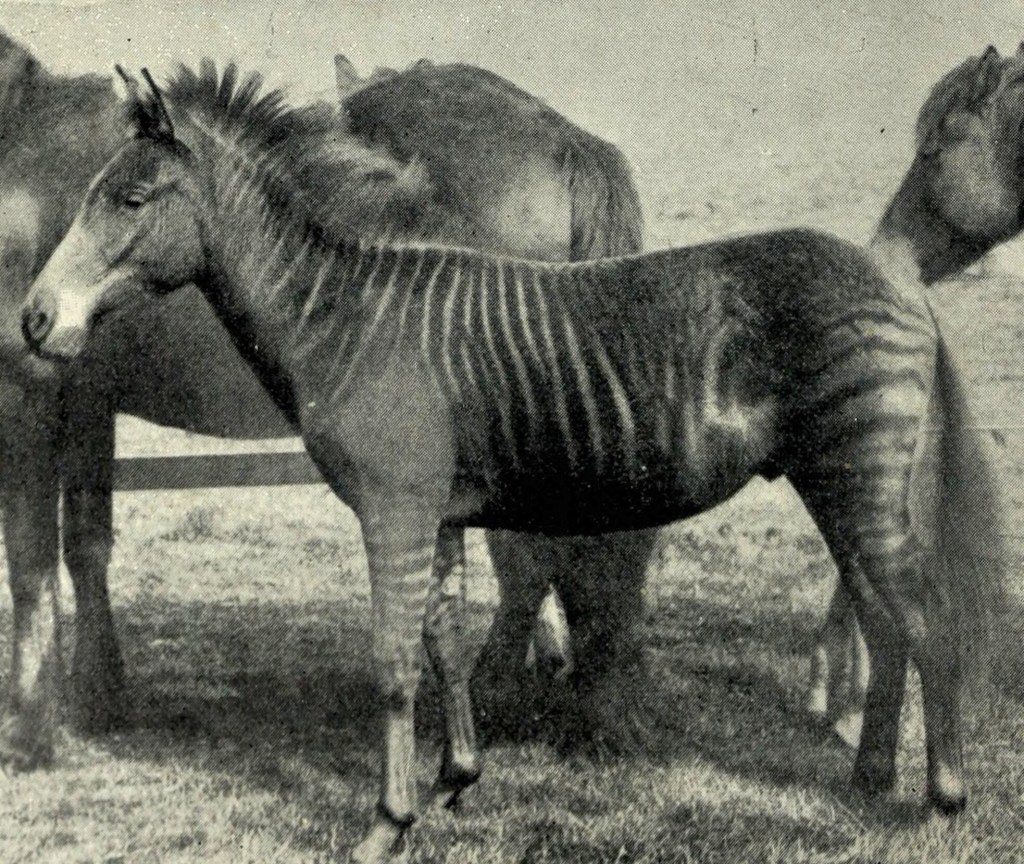
See question two. Zonkey, the hybrid offspring of a donkey and a zebra. Image Wikimedia Commons
Today’s questions are not date-related, nor are the questions related, but there is a theme concerning the answers.
One
What word completes the title of a 1965 war film starring Kirk Douglas and Richard Harris, which was based on a true story and shot in Norway: The Heroes of …?
Answer: Telemark.
The Heroes of Telemark is a 1965 British war film based on a true story. It depicts a sabotage mission against a Norwegian heavy water plant during World War II. At the time, Norway was occupied by German forces and there was a fear that the plant could aid their efforts to build an atomic bomb.
Two
What is defined in the Oxford English Dictionary as ‘the hybrid offspring of a donkey and a zebra’? (NB. The same word is used in Mexico for donkeys painted as zebras for tourist souvenir photos.)
Answer: Zonkey.
Imagine a creature that embodies the rugged resilience of a donkey and the striking elegance of a zebra. This is no mythical beast, but a living, breathing marvel known as the zonkey. A fascinating hybrid, the zonkey captures the imagination with its unique blend of features, often sporting the sturdy body of a donkey adorned with the distinctive stripes of a zebra, typically concentrated on its legs, neck, and sometimes its torso. These captivating animals are a testament to the intricate dance of genetics and the surprising outcomes that can arise when different species meet.
Dating from the first half of the 20th century from what language did the words ‘rooibos’ and ‘apartheid’ originate?
Answer: Afrikaans.
Rooibos is an evergreen South African shrub, and its leaves are used to make a tea. It originated in the early 20th century from Afrikaans, and means literally ‘red bush’. Apartheid, a system of racial segregation and discrimination, was adopted as a slogan in the 1948 election by the Afrikaner National Party in South Africa. The system was maintained until February 1991 despite domestic unrest and international isolation. Originating in the 1940s, from Afrikaans, literally ‘separateness’.
Four
Who won Best Supporting Actress Oscar for her part in The Constant Gardener?
Answer: Rachel Weisz.
The Constant Gardener is a 2005 drama thriller film directed by Fernando Meirelles, based on John le Carré’s novel. It follows a British diplomat in Kenya investigating his wife’s murder. A critical and box office success, it achieved four Oscar nominations, with Weisz winning Best Supporting Actress.
Five
What body of water was home to the British Fleet during both the First and Second World Wars, as well as being the site of the 1919 scuttling of the interred German High Sea Fleet and the 1939 sinking of HMS Royal Oak?
Answer: Scapa Flow.
Scapa Flow, a sheltered body of water in the Orkney Islands, Scotland, has historical significance as a Viking anchorage and UK naval base. HMS Royal Oak is a war grave for over 800 seamen who perished when the ship was torpedoed by a German U-boat. Today, it is known for its diving sites and as a location for oil and LNG transfers.
Russian Caesars
The post title Russian Caesars refers to Tzar (also Tsar or Czar) in plural, TZARS which gives the start letter for each of the above answers.