Here are the answers to my earlier questions.
Today the questions all relate to February 11th.
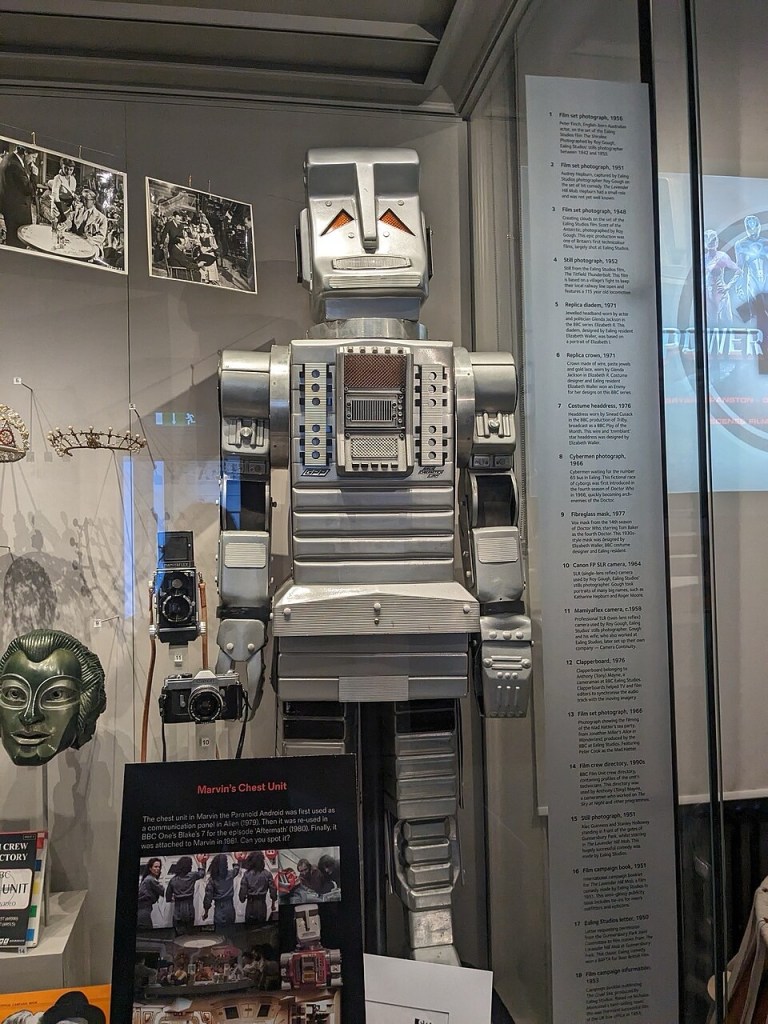
Marvin the Paranoid Android from
The Hitchhiker’s Guide to the Galaxy,
Gunnersbury park museum, London
Image Wikimedia Commons
One
In what decade was the first science fiction television programme broadcast?
Answer: 1930s.
The first known science fiction television programme was produced by the BBC’s pre-war television service in Great Britain. On 11 February 1938, a 35-minute adapted extract of the play R.U.R., written by the Czech playwright Karel Čapek, was broadcast live from the BBC’s Alexandra Palace studios. Concerning a future world in which robots rise up against their human masters, it was the only piece of science fiction to be produced before the television service was suspended for the duration of the war. Today’s post title is a hint towards this play, using the same initials, but the play’s ‘R.U.R.’ stands for Rossumovi Univerzální Roboti—Rossum’s Universal Robots—and not Really Useful Robots.
Two
On this day in 1929, a treaty was signed recognising papal sovereignty over Vatican City. What was the treaty’s name and who was the Italian signatory?
Answer: Lateran Treaty; Benito Mussolini.
The Lateran Treaty of 1929 established Vatican City as an independent state and settled the Roman question between Italy and the Holy See. The treaty was named after the Lateran Palace where it was signed on 11 February 1929. It was revised in 1984, ending Catholicism as Italy’s sole state religion.
Three
Today marks the traditional date for Jimmu’s founding of which country’s empire in 660 BCE?
Answer: Japan.
Emperor Jimmu, the legendary first emperor of Japan, is said to have ascended the throne in 660 BCE. His story, recounted in the Nihon Shoki and Kojiki, involves a divine lineage from the sun goddess Amaterasu and a military expedition from Kyushu to Yamato. While his existence is debated by scholars, Jimmu’s legacy endures as a symbol of Japan’s imperial lineage and is celebrated annually on February 11th as National Foundation Day.
Four
In 1858, 14-year-old Mademoiselle Soubirous had visions of the Virgin Mary. Where did this occur, and what was Mademoiselle Soubirous’s first name?
Answer: Lourdes, France; Bernadette.
In February 1858, 14-year-old Bernadette Soubirous reported seeing visions of a ‘small young lady’ at the grotto of Massabielle in Lourdes, later believed to be the Virgin Mary. The apparitions, which continued daily for two weeks despite scepticism from local authorities and clergy, including Father Peyramale, instructed Bernadette to perform acts of penance. On 25 March, Bernadette claimed the Virgin revealed herself as the ‘Immaculate Conception’, prompting further investigation and increasing pilgrimages. The growing number of witnesses to Bernadette’s visions led to widespread attention and speculation.
Five
On this date, and in what year did the World Health Organisation officially name the coronavirus outbreak COVID-19? And up to February 2026, to the nearest million, how many people have died from COVID-19?
Answer: 2020; 7 million.
The COVID-19 pandemic has resulted in an estimated 7.1 million confirmed deaths worldwide. Estimates indicate that the total number of deaths could range from 19.1 to 36 million.
 Quizology.Online
Leave a comment