Here are today’s answers.
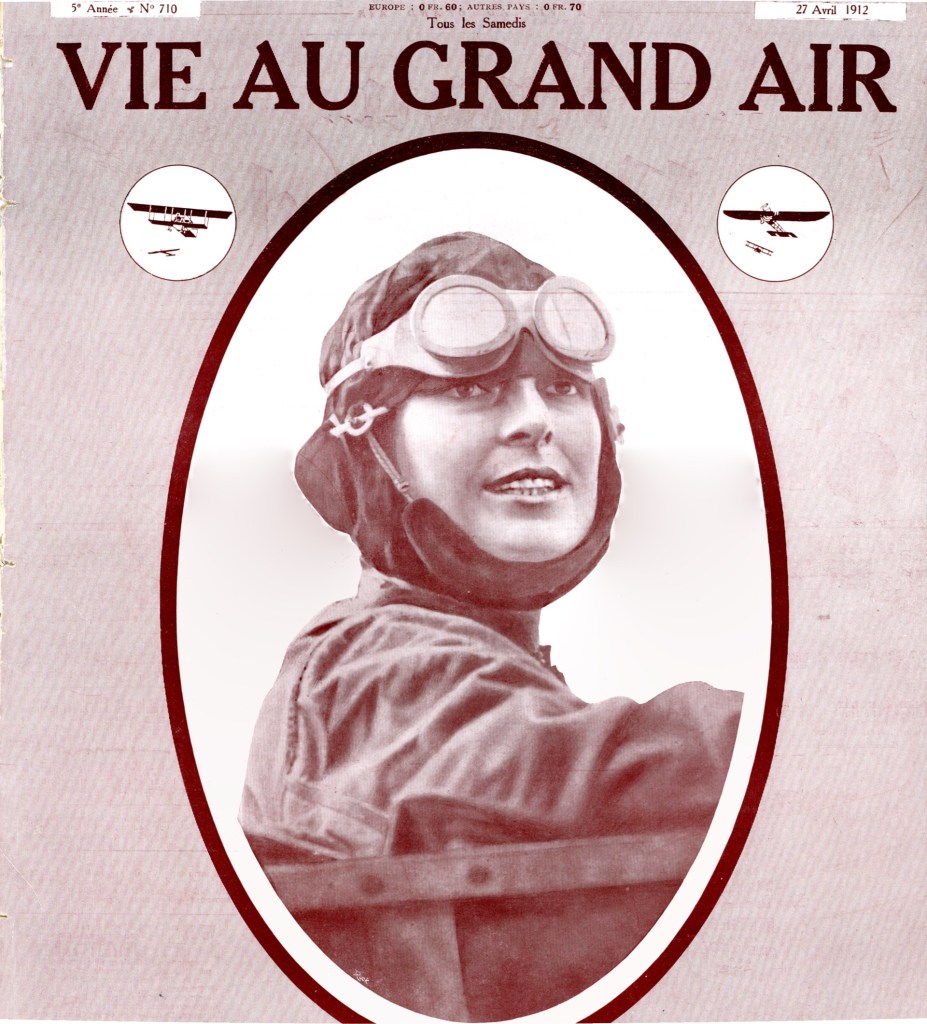
Image Wikimedia Commons
The first question today relates to the date, April 16th, with the remainder following the theme created by the first.
One
On this day in 1912, American aviator Harriet Quimby became the first woman to fly across an arm of the Atlantic Ocean from one country to another. What was the body of water she crossed, and what countries did she fly between?
Answers: English Channel; England to France.
Harriet Quimby, born in 1875, was an American aviator and the first female pilot to cross the English Channel. Initially a writer and drama critic, she became interested in aviation by 1910 and earned her pilot’s license in 1911. On April 16, 1912, she flew her Blériot monoplane from Dover to Hardelot, achieving international acclaim. Quimby participated in several air meets but tragically died on July 1, 1912, when she lost control over Dorchester Bay.
The remaining questions continue the aviation theme.
Two
The first major aerial combat involving jet fighters took place between US F-86 Sabres and Russian MiG-15s. Which conflict and decade did this occur in?
Answers: Korean War; 1950s.
F-86 Sabres, despite being outmatched in some areas, achieved air superiority over MiG-15s in Korea due to superior handling. In 1958, Sabres, flown by Chinese Nationalists, became the first jets to fire guided missiles in combat.
Three
What V/STOL aircraft developed in the UK in the 1960s was used by both the Royal Air Force and Royal Navy and later by the US Marine Corps?
Answer: Harrier.
The Hawker Siddeley Harrier is a British jet-powered attack aircraft known for its V/STOL capabilities, developed from the Hawker Siddeley Kestrel. First flown in 1967, it entered RAF service in 1969 and was used by the USMC as the AV-8A. Positioned in West Germany during the Cold War, it provided close air support and dispersed forces. The Harrier and Sea Harrier were crucial in the 1982 Falklands War. Later, it evolved into the AV-8B Harrier II and British Aerospace Harrier II.
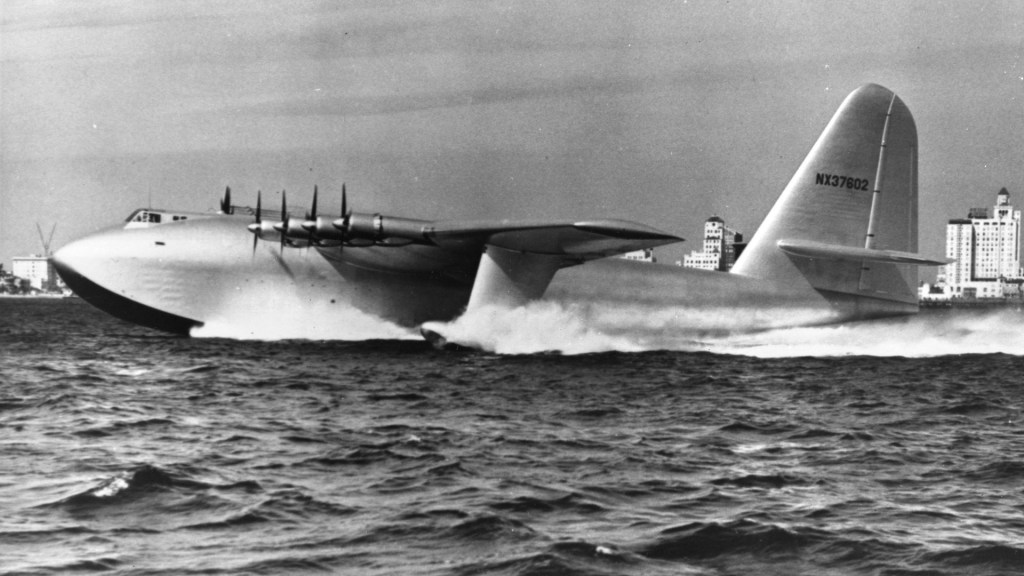
Image 19fortyfive.com
Four
Howard Hughes’s H-4 Hercules flying boat, the ‘Spruce Goose’, was made almost entirely of what wood?
Answer: Birch.
The Hughes H-4 Hercules, also known as the Spruce Goose (registration NX37602), is a prototype strategic airlift flying boat by Hughes Aircraft Company. Designed for transatlantic transport during World War II, it was completed too late for wartime use. The aircraft made its only flight on November 2, 1947, and the project remained a prototype, never advancing further. Built from birch using the Duramold process due to wartime aluminium restrictions, the aircraft was nicknamed the Spruce Goose despite being mostly birch. Mechanics allegedly called it the Birch Bitch. The Hercules, the largest seaplane ever built, held the record for the largest wingspan until the Stratolaunch flew in 2019. It remains in good condition, displayed in Long Beach from 1980 to 1992, then moved to the Evergreen Aviation & Space Museum in Oregon. It was listed on the National Register of Historic Places in 2024.
Five
In what decade of the 20th century did Igor Sikorsky fly the prototype of the first mass-produced helicopter?
Answer: 1930s.
In 1939 Sikorsky designed and flew the Vought-Sikorsky VS-300, the first viable American helicopter. This pioneering design introduced the single main rotor and single antitorque tail rotor configuration that’s standard in most helicopters today. Sikorsky then modified the VS-300 into the Sikorsky R-4, which became the world’s first mass-produced helicopter in 1942.


Leave a Reply