Image source
The first question in today’s post refers to a book published today with subsequent questions following a theme.
One
…the first major animal story in children’s literature. The author wrote it “to induce kindness, sympathy, and an understanding treatment of horses”… — Encyclopædia Britannica
The above quote from Encyclopædia Britannica refers to what book published today in 1877, and who was the author?
Answers: Black Beauty; Anna Sewell.
British author Anna Sewell wrote Black Beauty, a fictional horse autobiography aimed at inducing kindness and ending checkrein cruelty. Crippled early, she drove carriages and edited her mother’s works before writing the classic during her final invalid years.
Two
Which children’s novel by Katherine Paterson follows Jesse Aarons and his new neighbour Leslie Burke and in what year was it first published?
Answers: Bridge to Terabithia; 1977.
Bridge to Terabithia is a 1977 Newbery Medal-winning children’s novel by Katherine Paterson. It follows fifth-grader Jesse Aarons, whose life transforms when he befriends his new neighbour, Leslie Burke, and they create an imaginary kingdom called Terabithia. Inspired by the real-life death of the author’s son’s friend in 1974, the book has faced frequent censorship and was adapted into films in 1985 and 2007.
Three
Which writer connects Ivan the Terrible (2007) to the 1993 movie Mrs. Doubtfire, and which of their 1987 publications is directly tied to the film?
Answer: Anne Fine: Madame Doubtfire.
Anne Fine is a British children’s author who has written more than seventy books, including two Carnegie Medal winners and three highly commended runners-up. She won the Guardian Prize, a Smarties Prize, two Whitbread Awards, and was twice named Children’s Author of the Year. Her 1987 book Madame Doubtfire was adapted into the 1993 film Mrs. Doubtfire, and she served as the UK’s second Children’s Laureate from 2001 to 2003.
Four
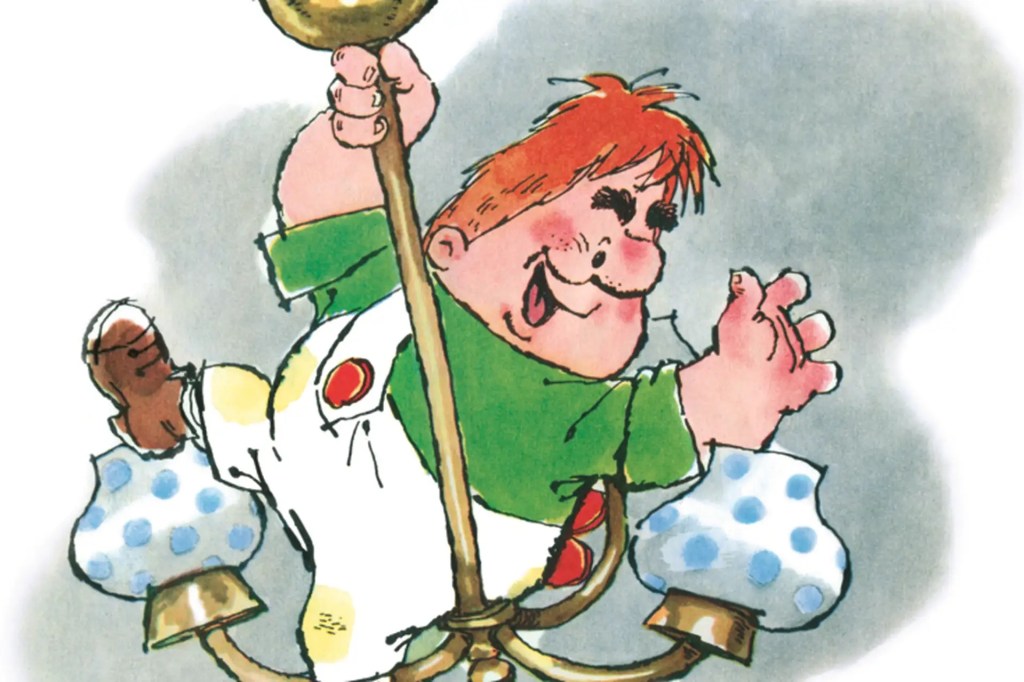
Which author created the character Karlsson-on-the-Roof and what nationality is that author?
Answer: Astrid Lindgren; Swedish.
Karlsson-on-the-Roof is mischievous and pranks others, often leaving Lillebror to face the consequences. Though initially thought to be imaginary, Karlsson is eventually accepted by Lillebror’s family and friends. Fröken Bock, a strict nanny, also changes after meeting him.
According to Swedish television in 2022 a Ukrainian military unit opposing the Russian invasion is named the ‘Karlsson-on-the-Roof Battalion’.
Five
An academic who could be a method or system of calculation; a wire fox terrier who any ‘Hedwig’ could partially describe; and a marine creature, Melanogrammus aeglefinus, from the North Atlantic.
The above clues point to the English identities of characters who have been around since the 1920s. In what work of fiction do they make regular appearances? Under what pen name was it originally written and what is the real name of that person?
Answers: The Adventures of Tintin; Hergé; Georges Remi.
The clues were as follows:
An academic who could be a method or system of calculation: Professor Calculus.
A wire fox terrier who any ‘Hedwig’ could partially describe: second part first — from Harry Potter where Hedwig is a snowy owl. Snowy, who is such a terrier.
A marine creature, Melanogrammus aeglefinus, from the North Atlantic: Haddock, so Captain Haddock.
Professor Calculus, Snowy and Captain Haddock are all characters in The Adventures of Tintin, a series of 24 comic albums written and illustrated by Belgian cartoonist Hergé (Georges Remi). As one of the most popular European comics of the 20th century, it has been published in more than 70 languages with over 200 million copies sold by 2007, and adapted for radio, television, theatre, and film. The stories span genres including fantasy, mystery, political thrillers, and science fiction, blending slapstick humour with political or cultural commentary.
Billions of Bilious Blue-Blistering Barnacles!
The title Billions of Bilious Blue Blistering Barnacles! comes from Tintin. Hergé faced a moral dilemma when balancing Captain Haddock’s expected colourful sailor language with the requirements of a Catholic children’s magazine. The solution was to give Captain Haddock strange or difficult words to use as if they were strong swearwords, despite not being offensive in themselves. The most famous of Haddock’s expressions is any of a number of permutations of ‘Billions of blue blistering barnacles!’


Leave a Reply