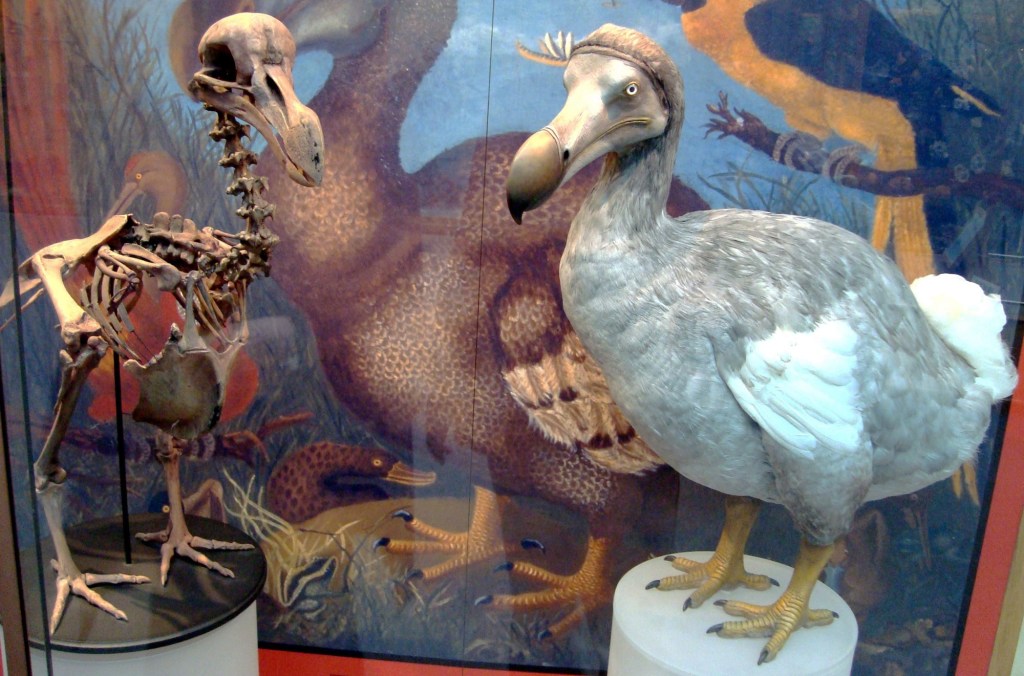
Cast and model of dodo. Oxford University Natural History Museum. Image Wikimedia Commons
Today’s questions have no date connection, but there is a theme.
One
This Sebastian Faulks novel published in 1993 is partly set during a major conflict. What is the novel and in what conflict is it partly set?
Two
Columbine, pertaining to the family Columbidae, refers to what?
Three
The dodo is an extinct flightless bird. To where was it native, and in what century was one last seen alive?
Four
The UK’s Hawker Siddeley Harrier evolved from the Hawker P.1127 prototype and which evaluation aircraft? Which branch of the US military also took delivery of more than 100 of these V/STOL aircraft?
Five
Three birds feature on the Australian coat of arms; how many can you name?
There is no date connection today, but there is a theme.
One
This links Max Yasgur’s dairy farm to C. Brown’s dog?
Answer: Woodstock.
Woodstock in 1969 took place on Max Yasgur’s farm, while in the Peanuts cartoons Snoopy, Charlie Brown’s dog, has a bird companion called Woodstock.
Two
What is the name of the pet owl in Disney’s The Sword in the Stone (1963) and what character’s pet was he?
Answer: Archimedes; Merlin.
Archimedes is Merlin’s educated but grouchy pet owl who can speak. He is loyal to Merlin but frequently points out the wizard’s flaws. The character is based on the talking owl from the book The Sword in the Stone, where he also teaches Wart how to fly.
Three
In the Harry Potter stories, what is the name and species of Ron Weasley’s pet owl?
Answers: Pigwidgeon; Scops owl.
Pigwidgeon, nicknamed ‘Pig’, is a tiny, hyperactive Scops owl given to Ron Weasley by Sirius Black to replace his lost pet rat, Scabbers. Named by Ginny Weasley, Pigwidgeon is known for being loud, bothersome, and a bit of a show-off, often annoying other owls. Despite his small size, he was used to deliver letters, including heavy loads, and was borrowed by Harry Potter to communicate with Sirius during the Triwizard Tournament. He stayed at The Burrow when Ron left to hunt Horcruxes with Harry and Hermione.
Four
What 2016 film featured a kingfisher named Kiki?
Answer: Robinson Crusoe (aka The Wild Life).
Robinson Crusoe, released in North America as The Wild Life, is a 2016 3D animated film directed by Vincent Kesteloot and Ben Stassen. Based on Daniel Defoe’s novel from the animals’ perspective, it grossed $42.4 million against a $13 million budget despite negative reviews.
Five
What song gave Fleetwood Mac their only UK number one hit?
Answer: Albatross.
The Fleetwood Mac instrumental Albatross, composed by Peter Green and released in 1968, was the band’s only number-one single in the UK. It was later re-released in 1973, reaching number two.
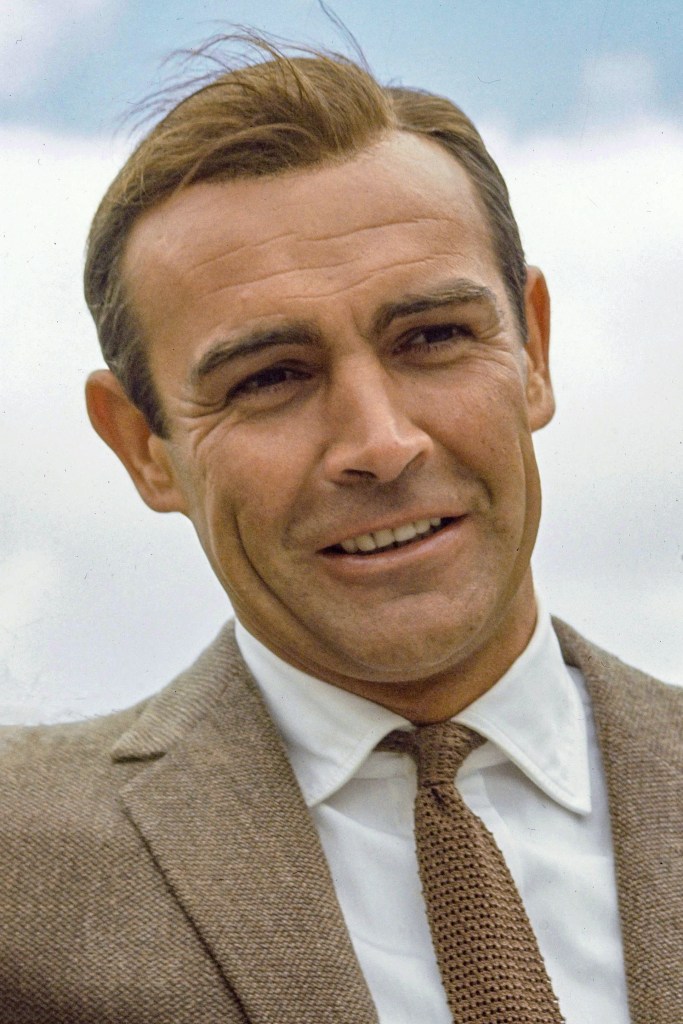
Sean Connery as James Bond. See question four. Image Wikimedia Commons
One
On 5 October 1969, I was in my mid-teens and interested in aviation, so I settled in to watch a new BBC TV series at its debut. Although it turned out to be unrelated to flight, it was excellent and became a turning point for television comedy: what was the programme, and who were the half-dozen people who created, wrote, and performed in it?
Answers: Monty Python’s Flying Circus; Graham Chapman, John Cleese, Eric Idle, Terry Jones, Michael Palin, and Terry Gilliam.
Monty Python’s Flying Circus is a British surreal sketch comedy series created by the “Pythons”—Graham Chapman, John Cleese, Eric Idle, Terry Jones, Michael Palin, and Terry Gilliam. Premiering in 1969, the show aired 45 episodes over four series until 1974 and is known for its absurd situations, observational sketches without punchlines, and unique animations by Gilliam. The troupe also produced five films including Monty Python and the Holy Grail (1975) and Monty Python’s Life of Brian (1979).
Two
Born on this day in 1975, this actress portrayed Ophelia, Rose, Hester, and Iris across five years starting in the mid-nineties. Who is she, and in which four films did she assume these roles?
Answer: Kate Winslet; Hamlet; Titanic; Enigma and Iris.
Kate Winslet is an English actress known for her roles as headstrong women in independent films and period dramas. Born in 1975, she has won numerous accolades, including an Academy Award, two Emmys, five BAFTAs, and five Golden Globes, and was appointed a CBE in 2012. She studied at Redroofs Theatre School and made her screen debut at age fifteen.
Three
In October 1970 PBS began broadcasting on American television taking over many of the functions of what predecessor organisation; and what children’s show featuring live-action, sketch comedy, animation, and puppetry were one of its great successes?
Answer: National Educational Television (NET).
PBS, a nonprofit in Arlington, Virginia, distributes educational programmes via over 350 member stations. Funding includes dues, pledges, sponsorships and donations; Corporation for Public Broadcasting support runs from 1969 to 2025. Standards prevent funding influence.
Four
In 1962, the first ‘official’ Bond movie by Eon Productions premiered on this day. What was the film and what actress, although she is not to appear on the screen in this film, is widely regarded as the first ‘Bond girl’ and what was her role?
Answers: Dr. No; Ursula Andress as Honey Ryder.
Dr. No, directed by Terence Young and starring Sean Connery, launched the James Bond series in 1962. Bond investigates a disappearance in Jamaica, uncovering Dr. No’s plot against Cape Canaveral. It established iconic elements and achieved financial success. Although Honey Rider is widely regarded as the first Bond girl, Eunice Gayson as Sylvia Trench and Zena Marshall as Miss Taro.
Five
In 1961, the comedy Breakfast at Tiffany’s premiered. Your answers are four names: who starred as Holly Golightly and Paul Varjak; who directed the film; and who wrote the novella the film was based on?
Answers: Audrey Hepburn and George Peppard; Blake Edwards; Truman Capote.
Directed by Blake Edwards from George Axelrod’s screenplay, Breakfast at Tiffany’s (1961) stars Audrey Hepburn and George Peppard. It earned two Academy Awards and was preserved in the National Film Registry, though Mickey Rooney’s role caused controversy as being perceived as racist.
And Now For Something Completely Different
The post title was frequently used in Monty Python often as a transition between sketches and was also the title of the troupe’s first film released in 1971.
Sean Connery as James Bond. See question four. Image Wikimedia Commons
One
On 5 October 1969, I was in my mid-teens and interested in aviation, so I settled in to watch a new BBC TV series at its debut. Although it turned out to be unrelated to flight, it was excellent and became a turning point for television comedy: what was the programme, and who were the half-dozen people who created, wrote, and performed in it?
Two
Born on this day in 1975, this actress portrayed Ophelia, Rose, Hester, and Iris across five years starting in the mid-nineties. Who is she, and in which four films did she assume these roles?
Three
In October 1970 PBS began broadcasting on American television taking over many of the functions of what predecessor organisation; and what children’s show featuring live-action, sketch comedy, animation, and puppetry were one of its great successes?
Four
In 1962, the first ‘official’ Bond movie by Eon Productions premiered on this day. What was the film and what actress, although she is not to appear on the screen in this film, is widely regarded as the first ‘Bond girl’ and what was her role?
Five
In 1961, the comedy Breakfast at Tiffany’s premiered. Your answers are four names: who starred as Holly Golightly and Paul Varjak; who directed the film; and who wrote the novella the film was based on?
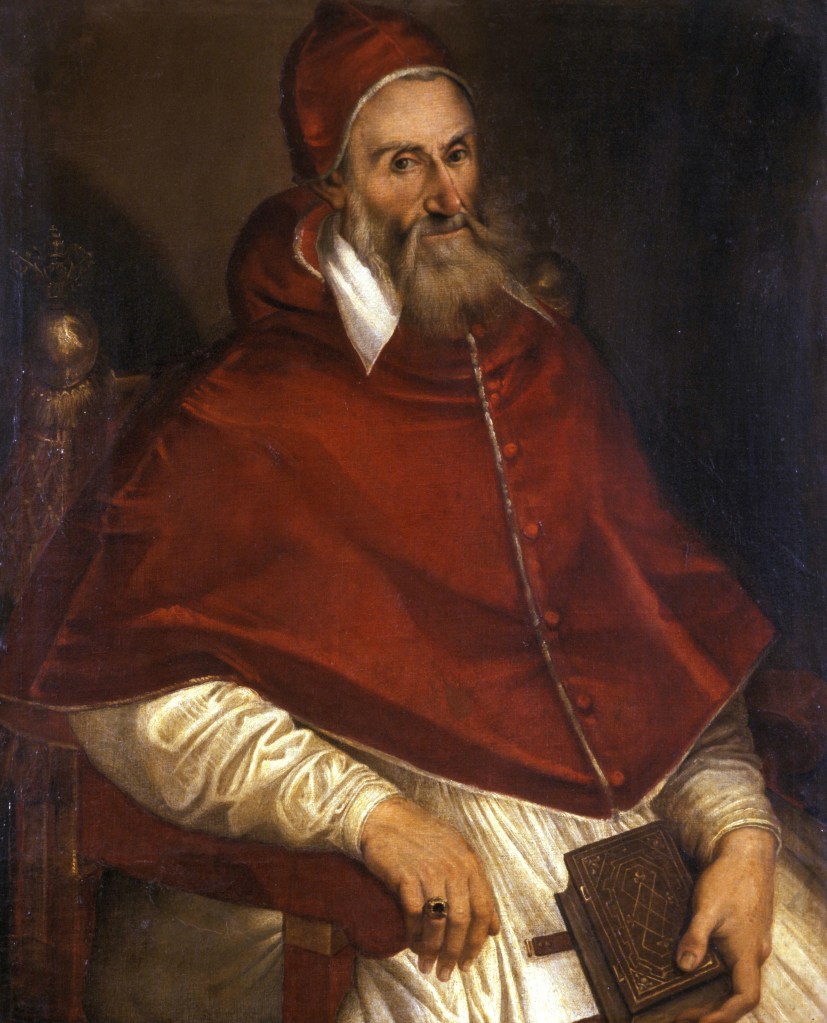
Pope Gregory XIII, portrait attributed to Bartolomeo Passarotti. Image Wikimedia Commons
Today’s first question is date-related being connected to today, 4 October. Subsequently, the questions are not date-related but maybe they really are!
One
This day in 1582 saw the introduction of the Gregorian calendar to replace the … calendar meaning that Thursday 4 October 1582 was followed by Friday … — what calendar’s name, and date complete the previous sentence?
Answer: Julian (calendar); and (Friday) 15 October 1582.
The Gregorian calendar was introduced by Pope Gregory XIII in 1582 to correct the Julian calendar’s 11-minute yearly drift. By dropping 10 days and adjusting the leap year rule for century years, it realigned the calendar with the vernal equinox. Although adoption was gradual, most of continental Catholic Europe adopted the new calendar in 1582, while Great Britain and Ireland waited until 1752. More recent shifts occurred with Greece in 1923 and Saudi Arabia in 2016 and it is now the primary international dating system.
Two
Which song featuring lyrics by Howard Greenfield contains these lines, and which singer wrote the music?
Released in December 1960, Calendar Girl by Neil Sedaka and Howard Greenfield reached No. 1 for Sedaka in Canada and Japan, and made the top ten in both the UK and US. Inspired by Lloyd Price, Al Jolson, Eddie Cantor and Ricky Nelson, it uses monthly imagery including Betty Grable and Marilyn Monroe. Stan Applebaum and Gary Chester provided instrumentation.
Three
What secular device and tradition is associated with the beginning of the Christian liturgical year?
Answer: Advent Calendar.
An Advent calendar is a decorative tool used to count down the days leading up to Christmas, typically spanning from December 1 or the First Sunday of Advent through December 24 or 25. While often secular today, the practice originated with German Lutherans as a period of spiritual preparation for the birth of Jesus Christ. Early 19th-century traditions included lighting candles or marking doors to track the days. The modern format—featuring compartments, flaps, or pockets that reveal images, stories, Bible verses, or small gifts like chocolate—emerged in early 20th-century Germany. Following a decline during World War II, the tradition gained global popularity.
Four
Clues to this fitting novel are immersed in the following: it marked its author’s debut in 1984; sales rose after US President Ronald Reagan noted his enjoyment; a film with a former James Bond followed in 1990. What were the titles of the book and film; who wrote the book; and what was the former Bond actor’s character name?
Answers: The Hunt for Red October; Tom Clancy; Marko Ramius.
Tom Clancy’s debut novel, The Hunt for Red October, published by Naval Institute Press in 1984, features Soviet captain Marko Ramius allegedly defecting with the revolutionary new ballistic submarine Red October; CIA analyst Jack Ryan must try to assist Ramius’s defection and capture the submarine.
Five
This list from 1793 arranged names in sequence: vintage, mist, frost, snow, rain, wind, seedtime, blossom, meadow, harvest, heat and fruits. What did these terms denote; what system were they part of; and in what year was it replaced by a more international choice?
Answers: Months; the French Republican calendar (also called the French Revolutionary calendar); 1806.
Adopted on 5 October 1793, the French republican calendar replaced the Gregorian system with a secular structure of 12 months and supplementary days. It was abandoned by Emperor Napoleon on 1 January 1806.
Ox, Tiger, Dragon, Monkey, Rooster And Pig
The post title is a list of a few of the animals from the Chinese calendar. Although questions two to five are not date-related as in connected to 4 October they are date-related in being connected to calendars in general and calendars are collections of dates.
Pope Gregory XIII, portrait attributed to Bartolomeo Passarotti. Image Wikimedia Commons
Today’s first question is date-related being connected to today, 4 October. Subsequently, the questions are not date-related but maybe they really are!
One
This day in 1582 saw the introduction of the Gregorian calendar to replace the … calendar meaning that Thursday 4 October 1582 was followed by Friday … — what calendar’s name, and date complete the previous sentence?
Two
Which song featuring lyrics by Howard Greenfield contains these lines, and which singer wrote the music?
What secular device and tradition is associated with the beginning of the Christian liturgical year?
Four
Clues to this fitting novel are immersed in the following: it marked its author’s debut in 1984; sales rose after US President Ronald Reagan noted his enjoyment; a film with a former James Bond followed in 1990. What were the titles of the book and film; who wrote the book; and what was the former Bond actor’s character name?
Five
This list from 1793 arranged names in sequence: vintage, mist, frost, snow, rain, wind, seedtime, blossom, meadow, harvest, heat and fruits. What did these terms denote; what system were they part of; and in what year was it replaced by a more international choice?
Today’s first question is date-related to 3 October. The subsequent questions are not date-related but follow on a theme created in the first.
One
On this date, episode 1 of The Dick Van Dyke Show premiered. The show starred Dick Van Dyke as Rob Petrie, but who played his wife, Laura; and in what year did this episode air?
Answers: Mary Tyler Moore; 1961.
The Dick Van Dyke Show was an American sitcom that aired from 3 October 1961, to 1 June 1966, consisting of 158 episodes across five seasons. Created and produced by Carl Reiner, the series starred Dick Van Dyke, Mary Tyler Moore, Rose Marie, and others. The show focused on the life of Rob Petrie (Dick Van Dyke), a television comedy writer for the fictional Alan Brady Show. Petrie lived in suburban New Rochelle with his wife, Laura Petrie (Mary Tyler Moore), and young son, Ritchie (Larry Mathews). The series achieved critical success, winning 15 Emmy Awards, and has maintained a strong reputation among critics and industry groups, earning high rankings on lists from TV Guide and the Writers Guild of America.
Two
Which of these was a character in an episode in the first season of The Flintstones; and what was Fred a member of at that time?
Hot Lips Hannigan; Loyal Order of Dinosaurs
Radar Rockpile; Loyal Order of Woolly Mammoths
Spearchucker Stone; Loyal Order of Pteranodon
Answers: Hot Lips Hannigan
The Hot Lips character predates MAS*H by some 10 years, and the Loyal Order of Water Buffaloes replaced the dinosaurs in later episodes. The Flintstones, produced by Hanna-Barbera, was the first prime-time animated sitcom on ABC, set in a romanticised Stone Age. Its popularity stems from blending modern concerns with this setting; it was the most successful animated series for three decades.
Three
It is well known that the stars of Friends negotiated their contracts collectively, but this was only true for part of their ten-season run. In which season or seasons did they get different salaries; and in which season(s) did they receive $1 million per episode? (Answers will be number(s) between 1 and 10.)
Answers: Season 2; Season 9 and 10.
Wikipedia explains it as follows:
In their original contracts for the first season, cast members were paid $22,500 per episode. The cast members received different salaries in the second season, beginning from the $20,000 range to $40,000 per episode. Before their salary negotiations for the third season, the cast decided to enter collective negotiations, despite Warner Bros.’ preference for individual deals. The stars were each paid $75,000 per episode in season three, $85,000 in season four, $100,000 in season five, $125,000 in season six, $750,000 in seasons seven and eight, and $1 million in seasons nine and ten, making Aniston, Cox, and Kudrow the highest-paid TV actresses of all time.
What two actors were the co-creators and co-writers of the British sitcom Fawlty Towers, and who played the Spanish waiter Manuel in the same series?
Answers: John Cleese and Connie Booth; Andrew Sachs.
In May 1970, the members of Monty Python stayed at the Gleneagles Hotel in Torquay, where owner Donald Sinclair’s rudeness, including discarding Eric Idle’s briefcase, influenced John Cleese and Connie Booth. The building was demolished and replaced by a nursing home, Sachs Lodge, which was named after the late Andrew Sachs.
Five
In Frasier, the lead character returns to his hometown to present a radio psychiatry programme. Which two cities mark his move from and to, and which two actors played Frasier’s father and brother?
Answers: Boston, Massachusetts, to Seattle, Washington; John Mahoney (as his father Martin Crane) David Hyde Pierce (as his brother Niles Crane).
Frasier, an NBC sitcom created by David Angell, Peter Casey and David Lee, followed Frasier Crane’s return to Seattle. It won 37 Primetime Emmys, including five consecutive Outstanding Comedy Series awards.
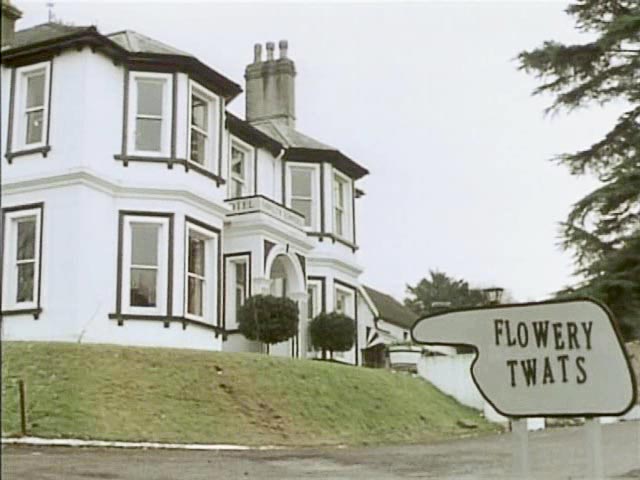
Flowery Twats
The title draws from the opening sequence of Fawlty Towers, where the hotel sign shifts into forms such as Farty Towels and Fatty Owls; however, Flowery Twats in the penultimate episode is the sole arrangement using every letter of Fawlty Towers.
Today’s first question is date-related to 3 October. The subsequent questions are not date-related but follow on a theme created in the first.
One
On this date, episode 1 of The Dick Van Dyke Show premiered. The show starred Dick Van Dyke as Rob Petrie, but who played his wife, Laura; and in what year did this episode air?
Two
Which of these was a character in an episode in the first season of The Flintstones; and what was Fred a member of at that time?
Hot Lips Hannigan; Loyal Order of Dinosaurs
Radar Rockpile; Loyal Order of Woolly Mammoths
Spearchucker Stone; Loyal Order of Pteranodon
Three
It is well known that the stars of Friends negotiated their contracts collectively, but this was only true for part of their ten-season run. In which season or seasons did they get different salaries; and in which season(s) did they receive $1 million per episode? (Answers will be number(s) between 1 and 10.)
Four
What two actors were the co-creators and co-writers of the British sitcom Fawlty Towers, and who played the Spanish waiter Manuel in the same series?
Five
In Frasier, the lead character returns to his hometown to present a radio psychiatry programme. Which two cities mark his move from and to, and which two actors played Frasier’s father and brother?
Today’s questions all relate to this date, 2 October, but have nothing else in common. Although numbered one to five there are seven answers.
One
On this day, Charles Darwin returned to the United Kingdom after his five-year voyage making observations and gathering specimens, which led to his theory of evolution. In what decade did he return to the UK; and what connects this voyage to Charlie Brown’s dog?
Answers: 1830s; Beagle
In 1836, Charles Darwin returned to Britain from his voyage on HMS Beagle, and Charlie Brown’s dog Snoopy is a beagle.
Two
Mummy brown, a shade of brown which appeared in the news on this day in 1964 was a colour which was named so because it was:
The mother of all shades of brown
The colour of habit worn by the Superior Mother Superior of the Carmelite Order
A pigment made from the flesh of mummies
Answer: A pigment made from the flesh of mummies.
Mummy brown, made from mummies, pitch and myrrh, was popular among Western European artists and Pre-Raphaelites such as Delacroix and Burne-Jones. Demand fell by 1915 and supply ended mid-twentieth century due to scarcity and poor quality.
Three
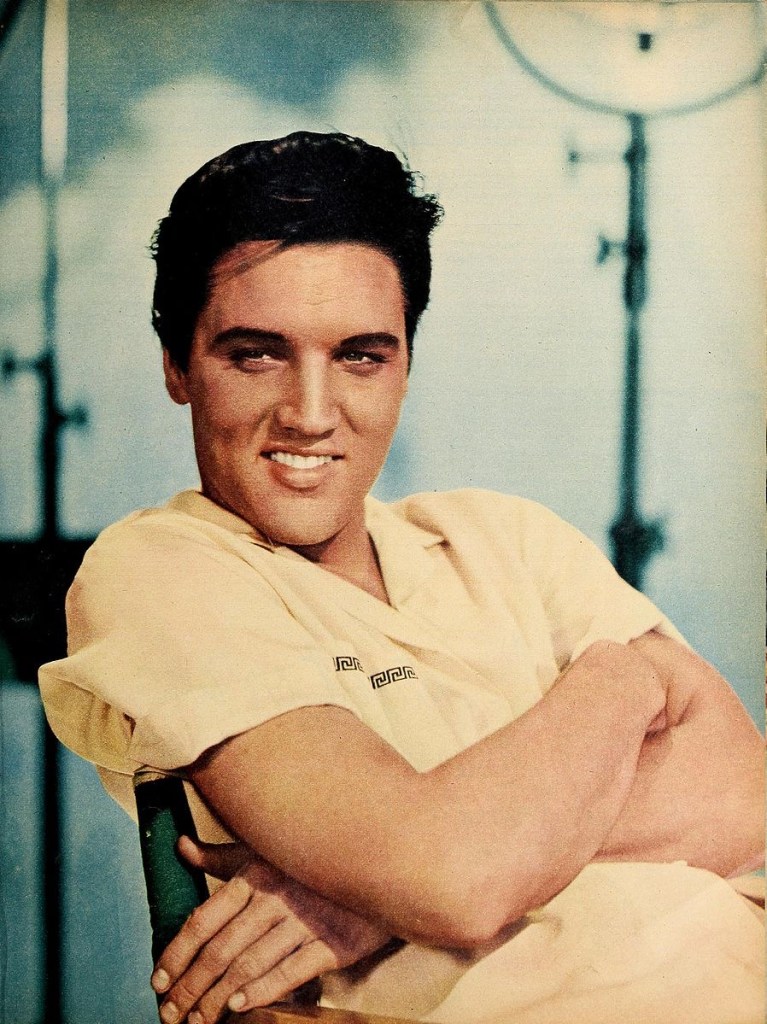
In 1954, Elvis Presley appeared on the radio show the Grand Ole Opry On how many occasions in total did he appear on this show?
Once
Twice
Three Times
Answer: Once.
The appearance on 2 October 1954, which received a mediocre reaction. was his only appearance on the Grand Ole Opry. He had more success with an appearance on the rival Louisiana Hayride show.
Four
In 1937, a speech by the Dominican Republic’s Dictator, Rafael Trujillo, led attacks by Dominican soldiers that resulted in the deaths of thousands of Haitians. By what name is this known?
Parsley Massacre
Poppy Pogrom
Pot Genocide
Answer: Parsley Massacre.
In October 1937, Dominican Army troops ordered by Rafael Trujillo killed an estimated 20,000 Haitians in the northwestern frontier and Cibao region. Known as the Parsley massacre, victims were killed or fled across the Dajabón River; the name stems from a reported pronunciation test, where Haitians had to pronounce the Spanish word for parsley, perejil, to the satisfaction of the interrogators, though scholars consider this mythic.
Five
On this day in 1957, a classic war film had it premiere. The film which featured the River Kwai in its title went on to win the Academy Award for the Best Picture. What was the film’s full title; and who starred as Colonel Nicholson, the senior British officer in the prisoner of war camp?
Answer: The Bridge on the River Kwai; Alec Guinness.
The 1957 epic war film The Bridge on the River Kwai, directed by David Lean and based on Pierre Boulle’s novel. It notes that while the story is fictional, it is set against the historical construction of the Burma Railway in 1942–1943. The film stars William Holden, Alec Guinness, and Jack Hawkins. The Bridge on the River Kwai was the highest-grossing film of 1957, won seven Academy Awards including Best Picture, and is preserved in the National Film Registry. It appears on the American Film Institute’s best list and was ranked 11th by the British Film Institute.