The answers to my earlier post are shown in bold below. I have included the questions simply for your information.

Image Wikipedia
- Which moon of Jupiter is pictured?
- Europa—Europa, one of Jupiter’s four Galilean moons, is an icy moon with a smooth surface, possibly due to a subsurface ocean. It is believed to have an iron-nickel core and a water-ice shell, with a thin atmosphere composed primarily of oxygen. Europa was discovered by Galileo Galilei in 1610 and named after Europa, a lover of Zeus in Greek mythology.
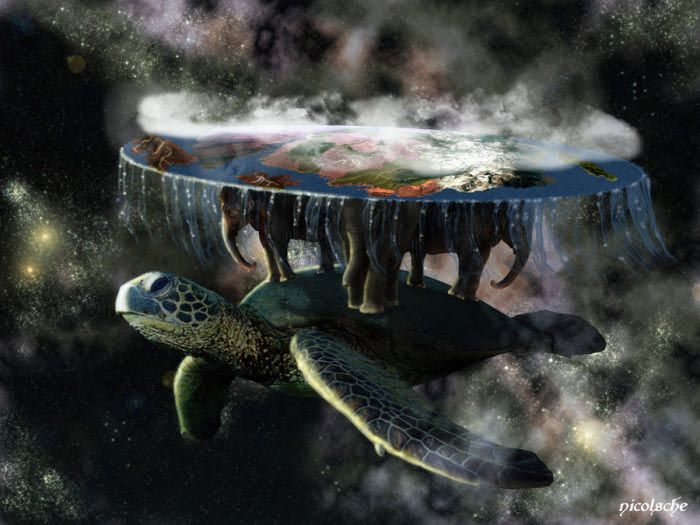
Discworld supported by four giant elephants on the back of Great A’Tuin, the Giant Star Turtle.
Image Pinterest
- Europa—Europa, one of Jupiter’s four Galilean moons, is an icy moon with a smooth surface, possibly due to a subsurface ocean. It is believed to have an iron-nickel core and a water-ice shell, with a thin atmosphere composed primarily of oxygen. Europa was discovered by Galileo Galilei in 1610 and named after Europa, a lover of Zeus in Greek mythology.
- In Terry Pratchett’s Discworld what are Berilia, Tubul, Great T’Phon and Jerakeen?
- Elephants—Great A’Tuin is the Giant Star Turtle (of the fictional species Chelys galactica) who travels through the Discworld universe’s space, carrying four giant elephants, named Berilia, Tubul, Great T’Phon and Jerakeen, who in turn carry the Discworld.

Alligator in a cypress dome, Everglades National Park.
Image Wikipedia
- Elephants—Great A’Tuin is the Giant Star Turtle (of the fictional species Chelys galactica) who travels through the Discworld universe’s space, carrying four giant elephants, named Berilia, Tubul, Great T’Phon and Jerakeen, who in turn carry the Discworld.
- The largest remaining subtropical wilderness in the continental USA is which National Park?
- Everglades National Park—Established in 1947, Everglades National Park protects 1.5 million acres of wetland, forest, and marine habitats, providing drinking water and recreational opportunities.

Jane Austen.
Portrait by Cassandra Austen, c. 1810.
Image Wikipedia
- Everglades National Park—Established in 1947, Everglades National Park protects 1.5 million acres of wetland, forest, and marine habitats, providing drinking water and recreational opportunities.
- Name a Jane Austen novel, published in 1816, which is set in the village of Highbury?
- Emma—a novel by Jane Austen, is set in the fictional village of Highbury and explores the relationships of its inhabitants. The story follows Emma Woodhouse, a wealthy and intelligent young woman who meddles in the love lives of others, leading to humorous misadventures.
- Emma—a novel by Jane Austen, is set in the fictional village of Highbury and explores the relationships of its inhabitants. The story follows Emma Woodhouse, a wealthy and intelligent young woman who meddles in the love lives of others, leading to humorous misadventures.
- Which part of a newt is mentioned as a potion ingredient by the second witch in Shakespeare’s Macbeth?
- Eye—see quote below from Macbeth Act 4, Scene 1 (line 10)
In the poisones entrails throw.
Toad, that under cold stone
Days and nights has thirty-one
Sweated venom sleeping got,
Boil thou first in the charmed pot.
Double, double toil and trouble;
Fire burn and cauldron bubble.Fillet of a fenny snake,
In the cauldron boil and bake;
Eye of newt and toe of frog,
Wool of bat and tongue of dog,
Adder’s fork and blindworm’s sting,
Lizard’s leg and howlet’s wing.
For charm of powerful trouble,
Like a hell-broth boil and bubble.
Double, double toil and trouble;
Fire burn and couldron bubble.Scale of dragon,tooth of wolf,
Witch’s mummy, maw and gulf
Of the ravin’d salt-sea shark,
Root of hemlock digg’d in the dark,
Liver of blaspheming Jew;
Gall of goat; and slips of yew
silver’d in the moon’s eclipse;
Nose of Turk, and Tartar’s lips;
Finger of birth-strangled babe
Ditch-deliver’d by the drab,-
Make the gruel thick and slab:
Add thereto a tiger’s chaudron,
For ingredients of our cauldron.
Double, double toil and trouble,
Fire burn and cauldron bubble.
 Quizology.Online
Leave a comment