The answers to my earlier post are shown below.
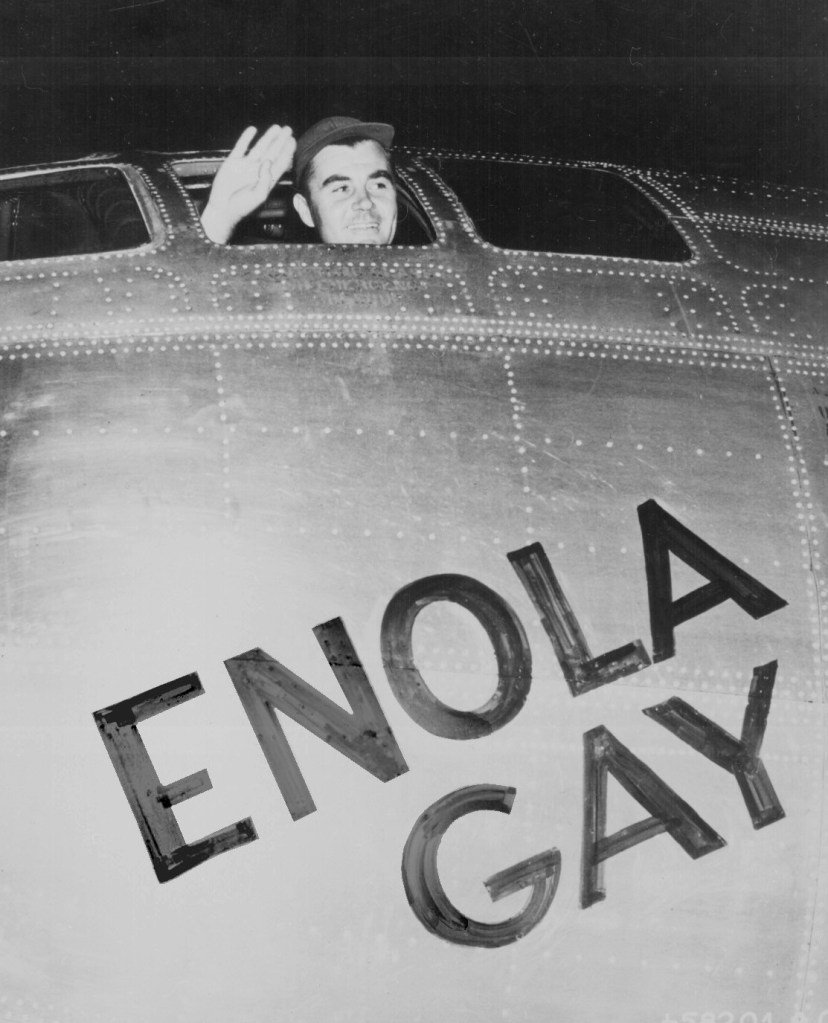
Image Wikipedia
One
On 6 August 1945, the United States dropped an atomic bomb on the Japanese city of Hiroshima. Firstly, what was the name of the bomb, and secondly, what name did the pilot of the aircraft which dropped the bomb give to that aircraft?
Answer: Little Boy and Enola Gay
On this day in 1945, the United States dropped an atomic bomb on Hiroshima, Japan, killing more than 70,000 people and destroying most of the city in an effort to hasten the end of World War II. The blast, caused by the atomic bomb Little Boy dropped by the U.S. B-29 Enola Gay, resulted in around 70,000 instant deaths, with tens of thousands more dying in subsequent years from burns and radiation poisoning.
The B-29 Superfortress Enola Gay was named after Enola Gay Tibbets by the pilot, her son, Colonel Paul Tibbets.
Two
Scottish bacteriologist Alexander Fleming, who was born on on the 6 August 1881, revolutionised antibiotics in 1928 with the discovery of…
Answer: Penicillin
Alexander Fleming, who was born on 6 August 1881 at Lochfield Farm, Darvel, Ayrshire, was a Scottish bacteriologist best known for discovering penicillin in 1928, which revolutionised antibiotics and earned him the Nobel Prize in 1945.
Three
This actor, who was born 6 August 1917, portrayed Sheriff J.P. Harrah in the 1966 western El Dorado and was Charles Shaughnessy in Ryan’s Daughter (1970). Who is he?
Answer: Robert Mitchum
Robert Mitchum, an American actor known for his antihero roles and film noir appearances, received numerous accolades including an Academy Award nomination and a star on the Hollywood Walk of Fame. He starred in numerous films, including Out of the Past and Cape Fear, and was praised by critics for his deep voice and weary eyes.
Four
The Old Man of Hoy, a 449-foot sea stack, was first climbed by three mountaineers including Chris Bonnington, born on 6 August 1934. This sea stack is located in which British archipelago?
Answer: Orkney
The Old Man of Hoy is a 449-foot sea stack on Hoy, in the Orkney archipelago, Scotland. Formed from Old Red Sandstone, it is popular with climbers and may soon collapse. It was first climbed in 1966 by mountaineers Chris Bonington, Rusty Baillie and Tom Patey.
Five
A poet born on this day in 1809, penned the lines quoted
Someone had blundered.
Theirs not to make reply,
Theirs not to reason why,
Theirs but to do and die.
Who was the poet and what poem are the lines from?
Answer: Alfred, Lord Tennyson and The Charge of the Light Brigade
Alfred Tennyson, 1st Baron Tennyson, was an English poet and Poet Laureate during Queen Victoria’s reign. He is known for his short lyrics, classical mythological themes, and blank verse, with many of his phrases becoming commonplace in the English language.
The lines quoted were from The Charge of the Light Brigade which is a narrative poem by Tennyson (The full poem is shown bellow). It describes the Charge of the Light Brigade, a disastrous British cavalry attack against heavily defended Russian troops at the Battle of Balaklava in October 1854 during the Crimean War. The suicidal assault placed the British light horse brigade, commanded by the Earl of Cardigan, against a Russian infantry and cavalry defence supported by heavy artillery batteries that commanded three sides of a narrow valley.
The Charge of the Light Brigade
ALFRED, LORD TENNYSON
I
Half a league, half a league,
Half a league onward,
All in the valley of Death
Rode the six hundred.
“Forward, the Light Brigade!
Charge for the guns!” he said.
Into the valley of Death
Rode the six hundred.
II
“Forward, the Light Brigade!”
Was there a man dismayed?
Not though the soldier knew
Someone had blundered.
Theirs not to make reply,
Theirs not to reason why,
Theirs but to do and die.
Into the valley of Death
Rode the six hundred.
III
Cannon to right of them,
Cannon to left of them,
Cannon in front of them
Volleyed and thundered;
Stormed at with shot and shell,
Boldly they rode and well,
Into the jaws of Death,
Into the mouth of hell
Rode the six hundred.
IV
Flashed all their sabres bare,
Flashed as they turned in air
Sabring the gunners there,
Charging an army, while
All the world wondered.
Plunged in the battery-smoke
Right through the line they broke;
Cossack and Russian
Reeled from the sabre stroke
Shattered and sundered.
Then they rode back, but not
Not the six hundred.
V
Cannon to right of them,
Cannon to left of them,
Cannon behind them
Volleyed and thundered;
Stormed at with shot and shell,
While horse and hero fell.
They that had fought so well
Came through the jaws of Death,
Back from the mouth of hell,
All that was left of them,
Left of six hundred.
VI
When can their glory fade?
O the wild charge they made!
All the world wondered.
Honour the charge they made!
Honour the Light Brigade,
Noble six hundred!
 Quizology.Online
Leave a comment