Here are the answers to my earlier questions.
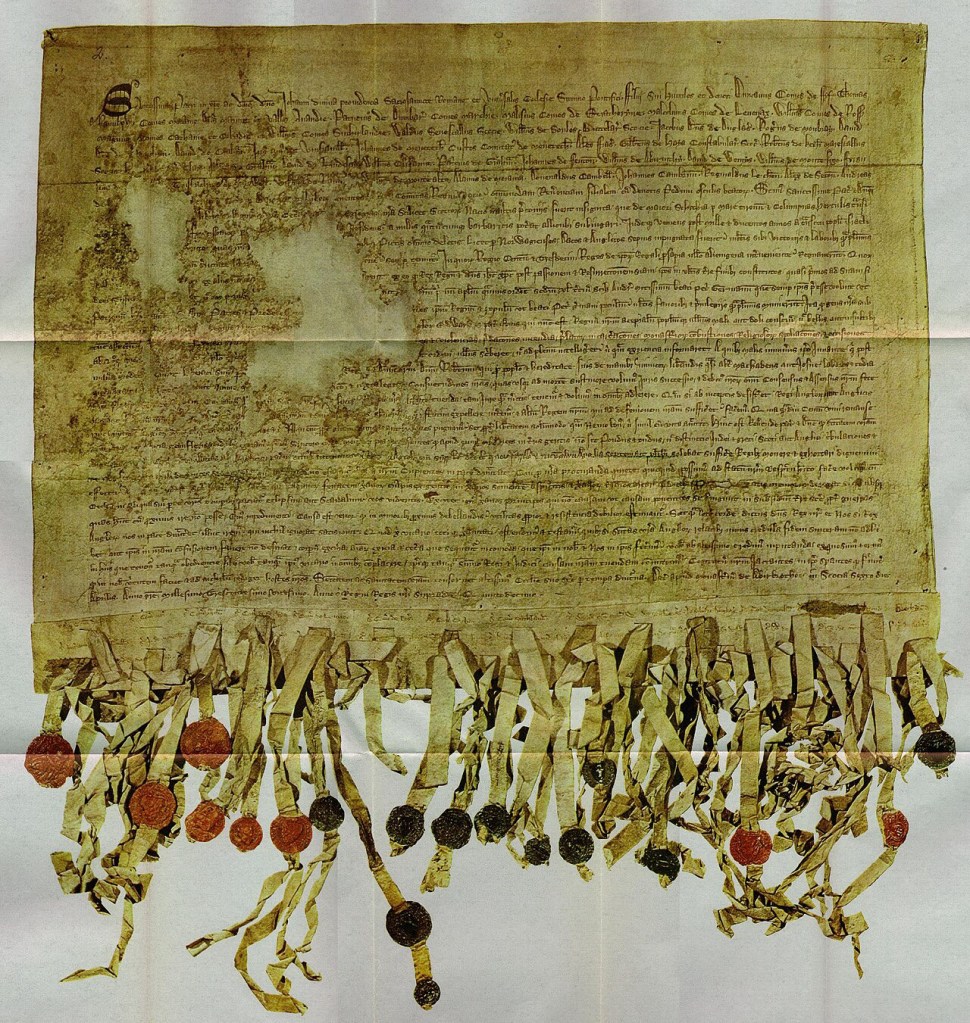
The ‘Tyninghame’ copy
National Library of Scotland
Image Wikimedia Commons
The first question concerns a national declaration and is linked to today’s date, April 6th. The other questions aren’t date-related but continue the declaration theme with some slightly more modern examples.
One
On this day in 1320, the Declaration of Arbroath was signed. It declared and asserted the independence of which nation?
Answer: Scotland.
The Declaration of Arbroath, written in 1320 by Scottish barons and addressed to Pope John XXII, asserted Scotland’s independence and right to self-defence against English subjugation. Believed to have been written by Bernard of Kilwinning, it was sealed by fifty-one magnates and nobles and remained largely unknown until the late 17th century when it was printed and translated into English. The Declaration strengthened Robert the Bruce’s position, and although he secured independence through the Treaty of Northampton in 1328, his successor faced the same struggle.
Two
In 1918, Estonia declared independence after the collapse of one empire and before a second invasion. Which empires were they?
Answer: Russian Empire and German Empire.
Following the collapse of the Russian Empire in 1917, Estonia declared independence on 24 February 1918, forming the Estonian Provisional Government. German occupation followed, but they relinquished power to the Estonian government on 19 November 1918 after their surrender at the end of the First World War.
Three
A 1965 Declaration of Independence, which was the first unilateral break from the United Kingdom by one of its colonies since the United States in 1776, was made by what colony? Secondly, what is that former colony now known as?
Answer: Rhodesia; Zimbabwe.
Rhodesia’s Unilateral Declaration of Independence (UDI) in 1965, a move by the white minority government to break away from British rule, was deemed illegal by the UK, Commonwealth, and UN. This led to international isolation and economic sanctions, with Rhodesia receiving support from South Africa and Portugal. The conflict escalated into the Rhodesian Bush War, ultimately leading to the country’s reconstitution as Zimbabwe in 1980.
Four
In 1822 and in 1877, Greece and Romania both declared their independence from the same empire. What was that empire?
Answer: Ottoman Empire.
Greek merchants, inspired by the Modern Greek Enlightenment, promoted Greek nationalism, leading to the Greek War of Independence with the Ottomans. With assistance from France, Russian Empire and the United Kingdom, the Greeks gained control of Central Greece, resulting in the recognition of the Greek state in 1830. Meanwhile, Romania achieved independence from the Ottoman Empire during the Russo-Turkish War (1877–78) by signing a treaty with Russia and joining the Russian Army in the fight against the Ottomans.
Five
In 1918, Czechoslovakia declared independence form what empire?
Answer: Austro-Hungarian Empire.
The Czechoslovak Declaration of Independence published on 18 October 1918, declared the independence of the Czechoslovak Nation from the Austro-Hungarian Empire. This empire had encompassed the Czech and Slovak lands for nearly four centuries and its downfall followed World War I.
 Quizology.Online
Leave a comment