All of today’s questions are related to the date, 1 August.
One
In 1980, for the first time anywhere in the world, a woman was elected head of state in a national election. This election was the first of four terms in this role. Who is she, and of what country was she president?
Two
In 1996, George R.R. Martin published the first volume of a book series. What is the book series called?
Three
What Formula 1 driver, who suffered extensive burns in a severe accident in the 1976 German Grand Prix at the Nürburgring, returned to racing still heavily bandaged, having only missed two races?
Four
On this date, the Guam Organic Act was signed, officially establishing Guam as an organised unincorporated territory of the United States. Who was the U.S. president at the time?
Five
In 1620, Myles Standish, his wife Rose and others sailed from Delfshaven, Netherlands to England where they would join with the Mayflower to sail to America. What is the name of the ship on which Standish and his wife sailed from Delfshaven, and in what modern country is Delfshaven?
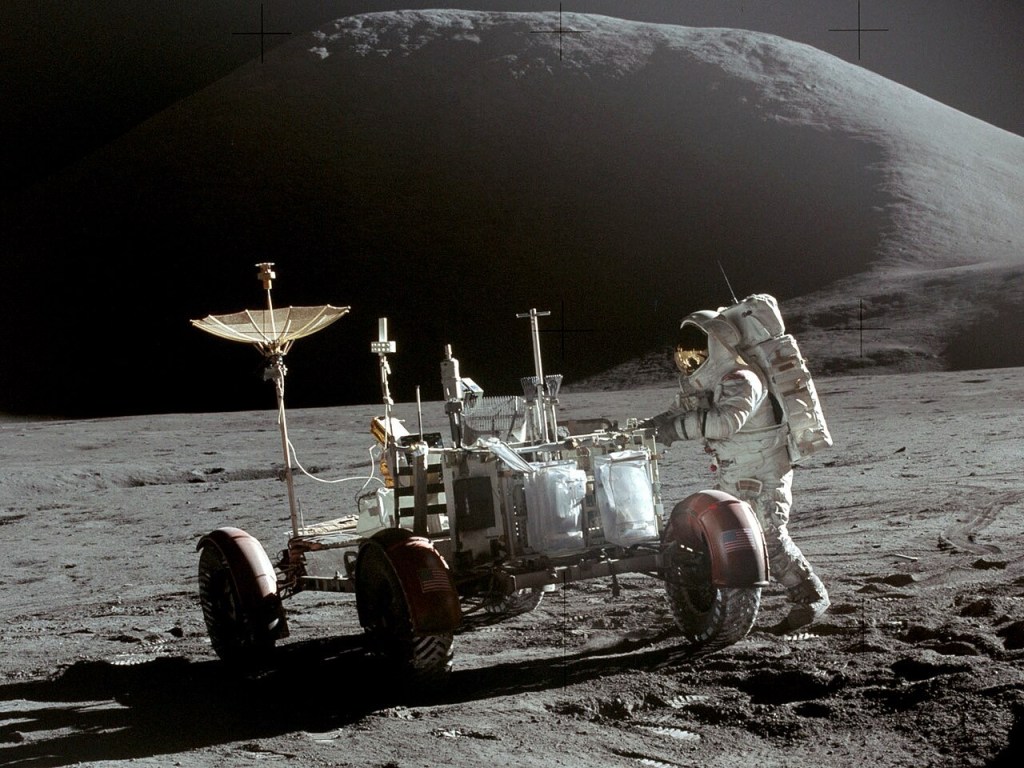
James Irwin with the Lunar Roving Vehicle on the Moon. Mons Hadley is in the background. Image NASA/David Scott via Wikimedia Commons
One to five as usual today, but you need to find ten answers. The first question is related to today’s date, 31 July, while the subsequent ones follow on from the theme created by the first.
One
On this day in 1971, Apollo 15’s astronauts first used the Lunar Roving Vehicle, which is also colloquially known as a Moon Buggy, on the Lunar surface. By the end of the Apollo program how many of these vehicles were left behind on the Moon?
Answer: Three.
The Lunar Roving Vehicle (LRV), built by Boeing Co., enabled extended travel, speed, and greater scientific activity on the Moon during the Apollo era. The first surface mission to use the LRV, Apollo 15 astronauts covered a total 17.5 miles of exploration and discovery. The historic Apollo Program sent the first U.S. astronauts into orbit around the Moon in 1968 and landed a dozen astronauts on the lunar surface between 1969 and 1972. The reach of initial Apollo surface missions was restricted to short walking distances. During each of the last three Apollo missions, between 1971 and 1972, a battery powered LRV provided transportation for two crew members and supplies several miles beyond the landing site. — NASA
Two
Set on the Moon in 1996, a short story first published in 1951 describes the discovery of a mysterious pyramid which had been placed by aliens several billion years previously. This story has an influential role in the development of a 1968 film. Three questions:
What is the story’s title?
Who was its author?
What was the title of the 1968 film?
Answers
The Sentinal
Arthur C. Clarke
2001: A Space Odyssey
The Sentinel (1951) by Arthur C. Clarke, set in 1996, follows selenologist Wilson discovering a mysterious alien structure on the Moon. After breaching its shield with atomic energy, the structure is destroyed, revealing advanced technology. Wilson theorises it was a sentinel alerting aliens to the emergence of intelligent life.
Three
The Huygens lander was the first man made object to land on a world in the outer Solar System. Where did it land?
Answer: Titan.
The Cassini–Huygens mission, a collaboration between NASA, ESA, and ASI, aimed to study Saturn and its system. It included NASA’s Cassini probe and ESA’s Huygens lander. Launched in 1997, Cassini orbited Saturn from 2004 to 2017, providing extensive data on the planet and Huygens landed on Titan. The mission included flybys of Venus, Earth, asteroid 2685 Masursky, and Jupiter, ending on September 15, 2017, by burning up in Saturn’s atmosphere to prevent contamination. It was a ‘mission of firsts’, revolutionising understanding of Saturn’s system and potential life-supporting environments in the Solar System and landing on on a world in the outer Solar System the first time.
Four
In ancient Greek mythology who was the goddess and personification of the Moon who drives her Moon chariot across the heavens?
Answer: Salene.
The air, unlit before, glows with the light of her golden crown, and her rays beam clear, whensoever bright Selene having bathed her lovely body in the waters of Ocean, and donned her far-gleaming raiment, and yoked her strong-necked, shining team, drives on her long-maned horses at full speed, at eventime in the mid-month: then her great orbit is full and then her beams shine brightest as she increases. So she is a sure token and a sign to mortal men. — Homeric Hymn to SaleneWikipedia
Five
Moon River featured in a 1961 film and won the Academy Award for Best Original Song. Four questions:
Who composed the song?
Who wrote the lyrics?
What was the 1961 film?
Who sang it in the film?
Answers
Henry Mancini
Johnny Mercer
Breakfast at Tiffany’s
Audrey Hepburn
Moon River, composed by Henry Mancini with lyrics by Johnny Mercer, was performed by Audrey Hepburn in Breakfast at Tiffany’s (1961), winning an Academy Award and two Grammys. The song relaunched Mercer’s songwriting career, stalled by rock and roll’s rise. The lyrics reflect Mercer’s Southern youth and wanderlust and an inlet near Savannah, Georgia, was named Moon River in his honour. Andy Williams made it his theme song, recording it in 1962 and in 2022, his version was preserved in the U.S. Library of Congress.
James Irwin with the Lunar Roving Vehicle on the Moon. Mons Hadley is in the background. Image NASA/David Scott via Wikimedia Commons
One to five as usual today, but you need to find ten answers. The first question is related to today’s date, 31 July, while the subsequent ones follow on from the theme created by the first.
One
On this day in 1971, Apollo 15’s astronauts first used the Lunar Roving Vehicle, which is also colloquially known as a Moon Buggy, on the Lunar surface. By the end of the Apollo program how many of these vehicles were left behind on the Moon?
Two
Set on the Moon in 1996, a short story first published in 1951 describes the discovery of a mysterious pyramid which had been placed by aliens several billion years previously. This story has an influential role in the development of a 1968 film. Three questions:
What is the story’s title?
Who was its author?
What was the title of the 1968 film?
Three
The Huygens lander was the first man made object to land on a world in the outer Solar System. Where did it land?
Four
In ancient Greek mythology who was the goddess and personification of the Moon who drives her Moon chariot across the heavens?
Five
Moon River featured in a 1961 film and won the Academy Award for Best Original Song. Four questions:
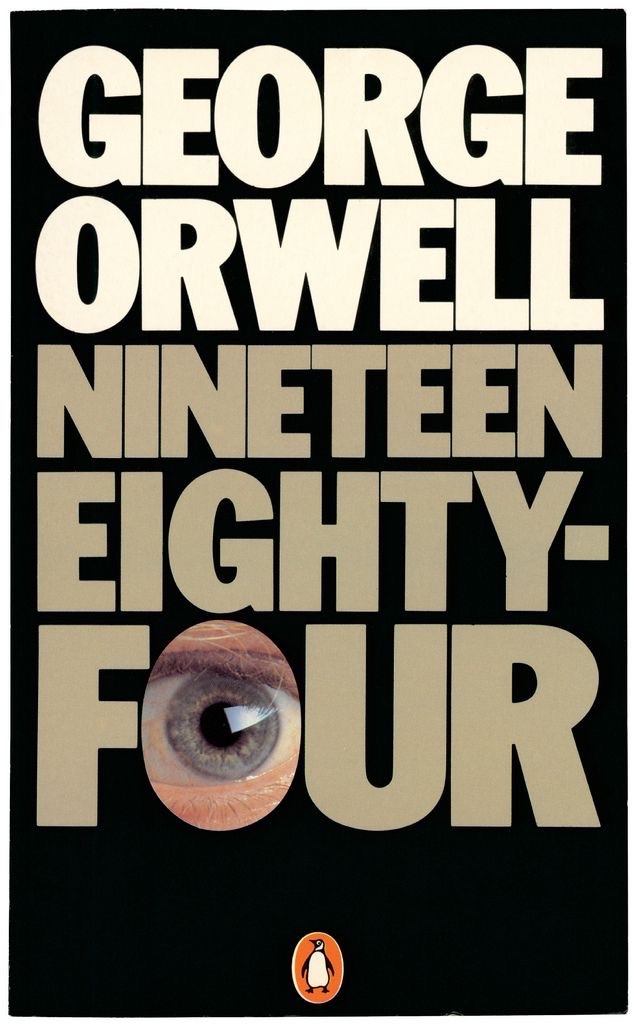
George Orwell’s Nineteen Eighty-four. Image Pinterest
Today’s questions are not related to the date; instead, they share a theme linked to the title in a subtle or hidden manner.
One
ZZ9 Plural Z Alpha, an appreciation society and their publication Mostly Harmless is connected to what science fiction franchise?
Answer: The Hitchhikers Guide to the Galaxy.
ZZ9 Plural Z Alpha organises gatherings and social events, produces the magazine Mostly Harmless and sells Beeblebears modelled on Zaphod Beeblebrox. It celebrates The Hitchhiker’s Guide to the Galaxy and Douglas Adams’s works.
Two
What single word can mean nought, a strong-lined fabric, a quick immersion, a bivalve mollusc, a lowering of the head or a bird and in which sport did the meaning ‘nought’ originate?
Answer: Duck: cricket.
All of the above are from definitions of duck.
Nought: in cricket a batter’s score of zero. Origin mid 19th century: short for duck’s egg, used for the figure 0 because of its similar outline.
Fabric: a strong cotton or linen fabric. Origin mid 17th century: from Middle Dutch doek ‘linen, linen cloth’; related to German Tuch ‘cloth’.
Immersion: to dip under water. Origin Middle English: of Germanic origin; related to Dutch duiken and German tauchen ‘dive, dip, plunge’.
Mollusc: a pure white thin-shelled bivalve mollusc found off the Atlantic coasts of America. Genus Anatina, family Mactridae.
Lowering head: lower the head or the body quickly. Origin Middle English: of Germanic origin; related to Dutch duiken and German tauchen ‘dive, dip, plunge’.
Bird: a waterbird with a broad blunt bill. Origin Old English duce, from the Germanic German tauchen ‘dive, dip, plunge’.
Three
Where is the mythical Snow Lion a celestial emblem?
Answer: Tibet.
The Snow Lion, Tibet’s celestial emblem, symbolises power, strength, fearlessness, joy, east, and earth. Featured on Tibet’s flag from 1916 to 1950, it remains used by the Tibetan Government-in-Exile. Depicted as white with a turquoise mane, it represents hermits and yogis, and is prominent in Tibetan culture.
Four
What character is named when symbols for sulphur, nobelium, oxygen, phosphorus and yttrium are placed together in order?
What are the three super-states in the novel Nineteen Eighty-four, and in which of these is London located?
Answers: Oceania, Eurasia and Eastasia; Oceania.
In April 1984, Winston Smith lives in Airstrip One (previously Great Britain), a province of Oceania, under totalitarian rule by ‘the Party’ and Big Brother. The Party enforces conformity through surveillance and Thought Police, erasing dissenters as “unpersons”. Winston, an Outer Party member at the Ministry of Truth, secretly rebels against the regime.
42-0-20-(Z 16-102–8-15-39)-13
The numbers in the title offer clues, perhaps obscure, to each of the questions in the correct order. The information breaks down like this
42: In The Hitchhiker’s Guide to the Galaxy 42 is the answer to the ultimate question of life, the universe, and everything.
0: A duck is 0 as explained above, see ‘Nought’ under the second answer.
20: The 20th letter of the alphabet ‘T’ is the initial to this answer.
(Z 16-102–8-15-39): Z is the symbol for atomic numbers and 16 is the atomic number for sulphur, 102 is nobelium 8 is oxygen 15 is phosphorus and 39 is yttrium each of which make Snoopy.
13: : ‘It was a bright cold day in April, and the clocks were striking thirteen.’ Thirteen concludes the opening line of George Orwell’s Nineteen Eighty-four.
George Orwell’s Nineteen Eighty-four. Image Pinterest
Today’s questions are not related to the date; instead, they share a theme linked to the title in a subtle or hidden manner.
One
ZZ9 Plural Z Alpha, an appreciation society and their publication Mostly Harmless is connected to what science fiction franchise?
Two
What single word can mean nought, a strong-lined fabric, a quick immersion, a bivalve mollusc, a lowering of the head or a bird and in which sport did the meaning ‘nought’ originate?
Three
Where is the mythical Snow Lion a celestial emblem?
Four
What character is named when symbols for sulphur, nobelium, oxygen, phosphorus and yttrium are placed together in order?
Five
What are the three super-states in the novel Nineteen Eighty-four, and in which of these is London located?
The first question is connected to today, 29 July. The remainder are not date-related but continue a theme leading you on a quest through the fantasy worlds of fiction.
One
In 1954, the first volume of J.R.R. Tolkien’s epic The Lord of the Rings was published. What was the title of this volume?
Answer: The Fellowship of the Ring.
In 1954, J.R.R. Tolkien published The Fellowship of the Ring and The Two Towers, the first parts of The Lord of the Rings, followed by The Return of the King in 1955. The Fellowship of the Ring refers to the company made up by Frodo, Merry, Sam and Pippin: all Hobbits; Aragorn and Boromir: both men; Legolas, an Elf; Gimli, a Dwarf; and Gandalf, a Wizard.
Two
What author’s work is home to the battle poet William the Gonnagle?
Answer: Terry Pratchett.
In Pratchett’s Discworld series, William the Gonnagle, a 96-year-old battle poet and musician, speaks in the lowland Scots of Robert Burns and with a slow careful voice. He plays mouse pipes that drive Grimhounds mad. Unlike bards, gonnagles compose poems to frighten enemies during battles causing their ears to explode. His name is derived from the notoriously poor poet William Topaz McGonagall.
Three
What series of books, the first published in 1995, included the character Fra Pavel Rašek, an alethiometrist of the Consistorial Court of Discipline (CCD), and of what organisation is the CCD a branch?
Answers: His Dark Materials; Magisterium.
Philip Pullman’s trilogy unfolds across a multiverse, with Northern Lights set in a world akin to Edwardian Britain, featuring zeppelins instead of cars or planes. The Church, led by the Magisterium, mirrors the Catholic Church’s authority, with the CCD as one of its most active branches.
Four
Who were Paul and Alia’s parents in the novel Dune?
Answer: Lord Leto Atreides and Lady Jessica
Dune, a 1965 novel by Frank Herbert, is set in a feudal interstellar society where noble houses vie for control of Arrakis, the sole source of the valuable spice melange. The story follows Paul Atreides as he navigates politics, religion, and ecology in this epic science fiction tale.
Five
In the world of Harry Potter, the Killing Curse (Avada Kedavra), the Cruciatus Curse (Crucio), and the Imperius Curse (Imperio) are known collectively as what?
Answer: Unforgivable Curses.
The Unforgivable Curses, Avada Kedavra, Crucio, and Imperio, are the most powerful and sinister Dark spells in the wizarding world. First classified as ‘Unforgivable’ in 1717, they carry the strictest penalties for their use, being tools of the Dark Arts.
Enchanted Forest
The title refers to a common feature in fiction: an enchanted forest.
The first question is connected to today, 29 July. The remainder are not date-related but continue a theme leading you on a quest through the fantasy worlds of fiction.
One
In 1954, the first volume of J.R.R. Tolkien’s epic The Lord of the Rings was published. What was the title of this volume?
Two
What author’s work is home to the battle poet William the Gonnagle?
Three
What series of books, the first published in 1995, included the character Fra Pavel Rašek, an alethiometrist of the Consistorial Court of Discipline (CCD), and of what organisation is the CCD a branch?
Four
Who were Paul and Alia’s parents in the novel Dune?
Five
In the world of Harry Potter, the Killing Curse (Avada Kedavra), the Cruciatus Curse (Crucio), and the Imperius Curse (Imperio) are known collectively as what?
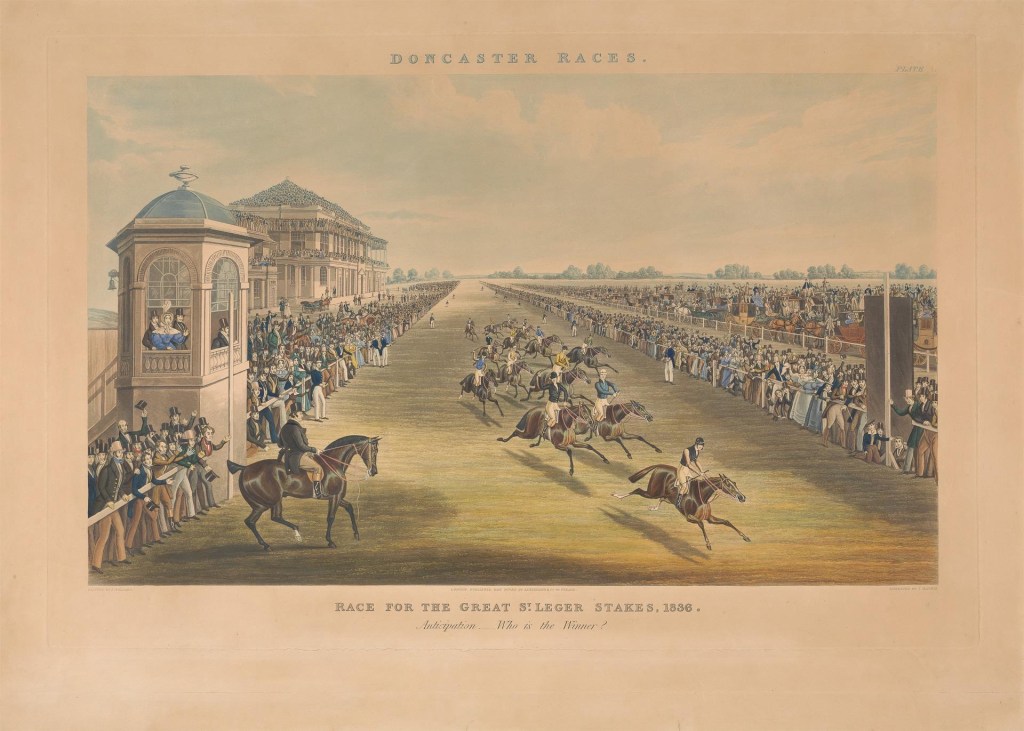
The St Leger, the oldest of Britain’s five Classic races, is the last of the five to be run each year, and its distance is longer than any of the other four. In what decade was it first ran?
Answer: 1770s (1776).
The St Leger Stakes, established in 1776, is Great Britain’s oldest Group 1 flat horse race, held annually in September at Doncaster. It concludes the English and Fillies Triple Crowns. The race spans 2,921 metres and is the longest of Britain’s five Classic races, with Camelot being a recent notable contender.
Two
What J.K. Rowling book was first published in the U.K. in June 1997, and under what title was the same book published the following year in the U.S.?
Answers: Harry Potter and the Philosopher’s Stone and Harry Potter and the Sorcerer’s Stone.
Harry Potter and the Philosopher’s Stone, J.K. Rowling’s debut, follows young wizard Harry Potter discovering his magical heritage. Published in 1997, it became a bestseller, translated into 85 languages, and adapted into a film. Praised for imagination and plot, it sold over 120 million copies, influencing education and marketing.
Three
What geometric shape is also the path of the Earth around the Sun, and how far approximately, in miles or km, does the Earth travel on that path in a year?
Answer: Ellipse; 584 million miles or 940 million km.
Earth orbits the Sun every 365.256 days in a counterclockwise, elliptical path at an average distance of 149.6 million km. Travelling at 29.78 km/s, it appears to move 1° eastward daily relative to the stars. This orbit’s near-circular eccentricity keeps the Sun close to its centre.
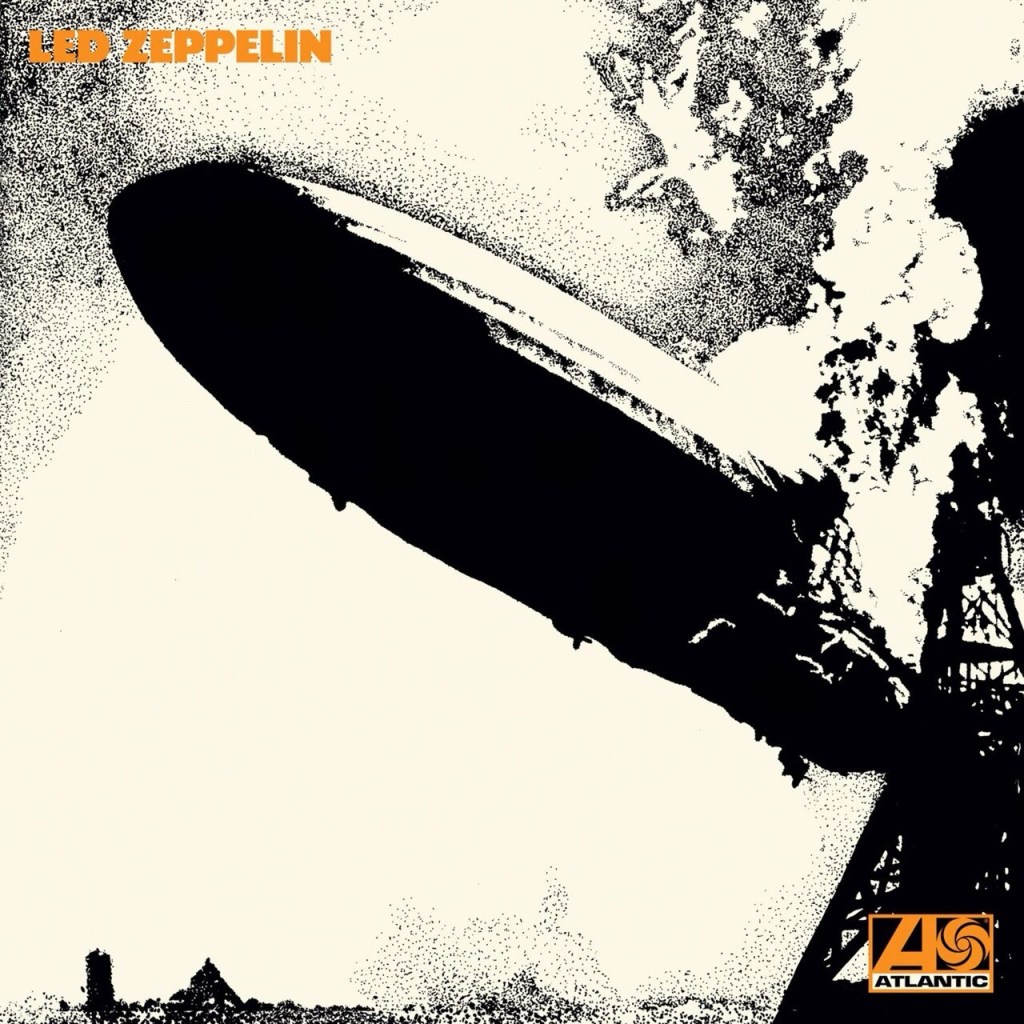
The cover of which debut studio album from 1969 depicts the Hindenburg exploding?
Answer: Led Zeppelin
Led Zeppelin, the debut album by the English rock band of the same name, was released in January 1969 in the US and March 1969 in the UK. Recorded in 36 hours at Olympic Studios, London, it features a mix of original and rearranged blues and folk songs. The album achieved top 10 success in the UK and US.
Five
What tennis Grand Slam takes place in a stadium which is named after a World War 1 fighter pilot who was killed in action?
Answer: French Open.
Eugène Adrien Roland Georges Garros, a French aviation pioneer, first crossed the Mediterranean by airplane in 1913. A self-taught pilot, he joined the French Army in World War I and helped to developed a forward-firing machine gun. He was killed in action in 1918. The Roland Garros tennis stadium in Paris, opened in 1928, honours him and the French Open is alternatively called Roland-Garros.
Off the Shelf
Today’s answers were straight off the ‘shelf’ in that the letters from that word provided the initial letter of each answer.
The St Leger, the oldest of Britain’s five Classic races, is the last of the five to be run each year, and its distance is longer than any of the other four. In what decade was it first ran?
Two
What J.K. Rowling book was first published in the U.K. in June 1997, and under what title was the same book published the following year in the U.S.?
Three
What geometric shape is also the path of the Earth around the Sun, and how far approximately, in miles or km, does the Earth travel on that path in a year?
Four
The cover of which debut studio album from 1969 depicts the Hindenburg exploding?
Five
What tennis Grand Slam takes place in a stadium which is named after a World War 1 fighter pilot who was killed in action?
Amundsen-Scott South Pole Station. Image Marine Oceans
Today’s questions follow a theme, but I don’t have the remotest intention of mentioning it.
One
The Amundsen–Scott South Pole Station sits on the Antarctic ice at the South Pole. At approximately what elevation above sea level is this base? (The answer can be either feet or metres.)
Answer: 9,301 feet or 2,835 metres.
The station, which supports scientific exploration, is isolated in a polar desert with extreme cold with the annual average temperature is −49°C (−56°F), though winter conditions can push readings below −80°C (−112°F). Opened in 1956, named after explorers Roald Amundsen and Robert F. Scott, it was rebuilt in 1975 and expanded in the 1990s. Completed in 2008, it includes 47 buildings, housing offices, laboratories, observatories, accommodation, dining, recreation and medical facilities. The station accommodates up to 150 people a week in the summer but this drops to 42 in the winter.
Two
An Antarctic Mystery was a two-volume novel written in 1897 which is a continuation of a novel, The Narrative of Arthur Gordon Pym of Nantucket, written in 1838 by another author. Who were the authors of these novels?
Answers: Jules Verne (wrote the 1897 work); Edgar Allan Poe (wrote the 1838 novel).
Jules Verne’s 1897 two-volume novel An Antarctic Mystery continues Edgar Allan Poe’s 1838 work, following the narrator’s voyage from the Kerguelen Islands aboard Halbrane.
Three
The Kerguelen Islands, which are a World Heritage Site, part of the French Southern and Austral Lands and Seas, lie in what ocean?
Answer: Indian Ocean.
The Kerguelen Islands, also known as the Desolation Islands, are a remote sub-Antarctic archipelago administered by France. The islands, part of the Kerguelen Plateau, have a harsh climate and are home to a permanent French presence of 45 to 100 people.
Four
A part of a U.K. overseas territory holds the title of the world’s most remote human settlement. What is this settlement and where it’s located?
Answers: Tristan da Cunha; South Atlantic Ocean.
The remotest inhabited island in the world is Tristan da Cunha, discovered in the South Atlantic by Tristao da Cunha, a Portuguese admiral, in March 1506. It has an area of 98km² (38 miles²). After evacuation in 1961 (due to volcanic activity), 198 islanders returned in November 1963. The nearest inhabited land to the group is the island of St Helena, 2,435 km (1,315 nautical miles) to the north-east.
In The Guardian, 8 August 2005: “Tristan Da Cunha, an overseas territory of the UK which takes six days to reach by boat from Cape Town, was assigned the postcode TDCU 1ZZ when the 276 inhabitants asked the UK’s Royal Mail for help after being unable to shop online without a postcode.”
In 1726, an Anglo-Irish clergyman and writer wrote a satirical novel which contains the word ‘remote’ in its original title. By what title is the novel commonly known today?
Answer: Gulliver’s Travels.
The original title of Jonathan Swift’s Gulliver’s Travels is: Travels into Several Remote Nations of the World. In Four Parts. By Lemuel Gulliver, First a Surgeon, and then a Captain of Several Ships.