Here are the answers to today’s questions.
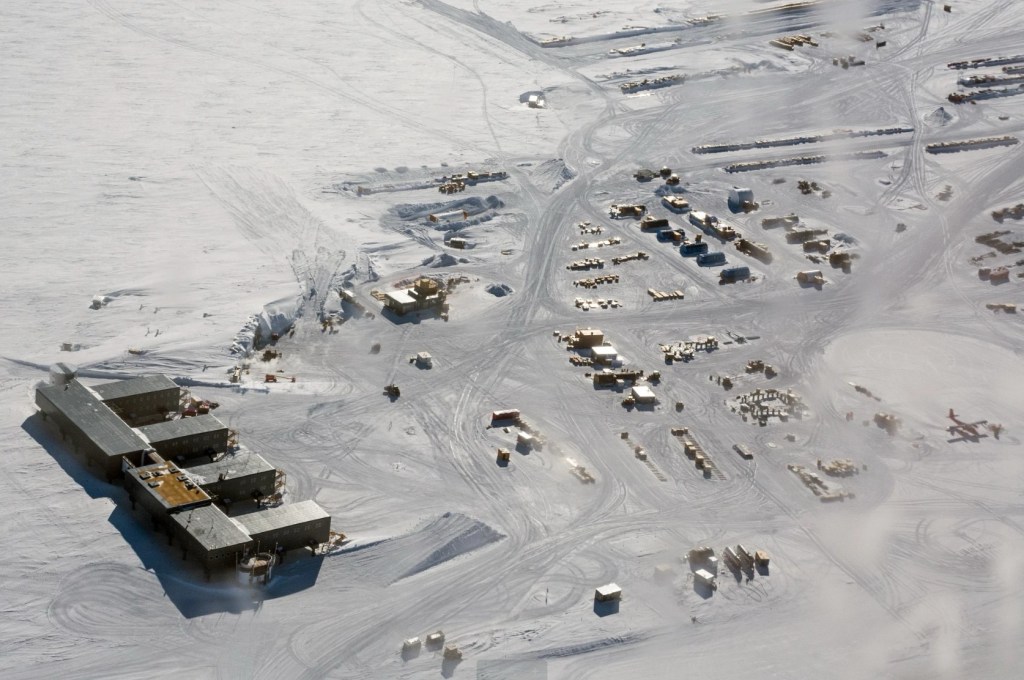
Image Marine Oceans
Today’s questions follow a theme, but I don’t have the remotest intention of mentioning it.
One
The Amundsen–Scott South Pole Station sits on the Antarctic ice at the South Pole. At approximately what elevation above sea level is this base? (The answer can be either feet or metres.)
Answer: 9,301 feet or 2,835 metres.
The station, which supports scientific exploration, is isolated in a polar desert with extreme cold with the annual average temperature is −49°C (−56°F), though winter conditions can push readings below −80°C (−112°F). Opened in 1956, named after explorers Roald Amundsen and Robert F. Scott, it was rebuilt in 1975 and expanded in the 1990s. Completed in 2008, it includes 47 buildings, housing offices, laboratories, observatories, accommodation, dining, recreation and medical facilities. The station accommodates up to 150 people a week in the summer but this drops to 42 in the winter.
Two
An Antarctic Mystery was a two-volume novel written in 1897 which is a continuation of a novel, The Narrative of Arthur Gordon Pym of Nantucket, written in 1838 by another author. Who were the authors of these novels?
Answers: Jules Verne (wrote the 1897 work); Edgar Allan Poe (wrote the 1838 novel).
Jules Verne’s 1897 two-volume novel An Antarctic Mystery continues Edgar Allan Poe’s 1838 work, following the narrator’s voyage from the Kerguelen Islands aboard Halbrane.
Three
The Kerguelen Islands, which are a World Heritage Site, part of the French Southern and Austral Lands and Seas, lie in what ocean?
Answer: Indian Ocean.
The Kerguelen Islands, also known as the Desolation Islands, are a remote sub-Antarctic archipelago administered by France. The islands, part of the Kerguelen Plateau, have a harsh climate and are home to a permanent French presence of 45 to 100 people.
Four
A part of a U.K. overseas territory holds the title of the world’s most remote human settlement. What is this settlement and where it’s located?
Answers: Tristan da Cunha; South Atlantic Ocean.
The remotest inhabited island in the world is Tristan da Cunha, discovered in the South Atlantic by Tristao da Cunha, a Portuguese admiral, in March 1506. It has an area of 98km² (38 miles²). After evacuation in 1961 (due to volcanic activity), 198 islanders returned in November 1963. The nearest inhabited land to the group is the island of St Helena, 2,435 km (1,315 nautical miles) to the north-east.
In The Guardian, 8 August 2005: “Tristan Da Cunha, an overseas territory of the UK which takes six days to reach by boat from Cape Town, was assigned the postcode TDCU 1ZZ when the 276 inhabitants asked the UK’s Royal Mail for help after being unable to shop online without a postcode.”
Five
In 1726, an Anglo-Irish clergyman and writer wrote a satirical novel which contains the word ‘remote’ in its original title. By what title is the novel commonly known today?
Answer: Gulliver’s Travels.
The original title of Jonathan Swift’s Gulliver’s Travels is:
Travels into Several Remote Nations of the World. In Four Parts. By Lemuel Gulliver, First a Surgeon, and then a Captain of Several Ships.
Remote Sensing
The theme was simply remoteness.


Leave a Reply