These are five questions which are related to today, February 5th.
Section of the border between East and West Germany. Image Wikimedia Commons
One
The term ‘Iron Curtain’ described the political and physical boundary dividing Europe from the end of World War II until the end of the Cold War. Who popularised its use in a speech at Westminster College, Fulton, Missouri, on 5 March 1946?
Two
A 31-year-old American country singer, who was born Virginia Patterson Hensley in Virginia, died in a 1963 plane crash in Tennessee. She had enjoyed an eight-year recording career, which included two number ones as well as other major chart hits. By what name was she known professionally?
Three
In 1616, 73 years after publication, On the Revolutions of the Heavenly Spheres (De revolutionibus orbium coelestium) was added to the Index of Forbidden Books (Index Librorum Prohibitorum) by the Sacred Congregation of the Index. Which astronomer had written On the Revolutions of the Heavenly Spheres?
Four
In 1942 Japanese forces captured what is now Jakarta, Indonesia. At that time, what was the city called and of where was it the capital?
Five
In 1496, England’s Henry VII issued letters patent authorising a navigator and his sons to explore unknown lands. This led to what is the earliest known exploration of the North American Atlantic coast since the Norse visits to Vinland in the eleventh century. Who was Henry VII’s explorer?
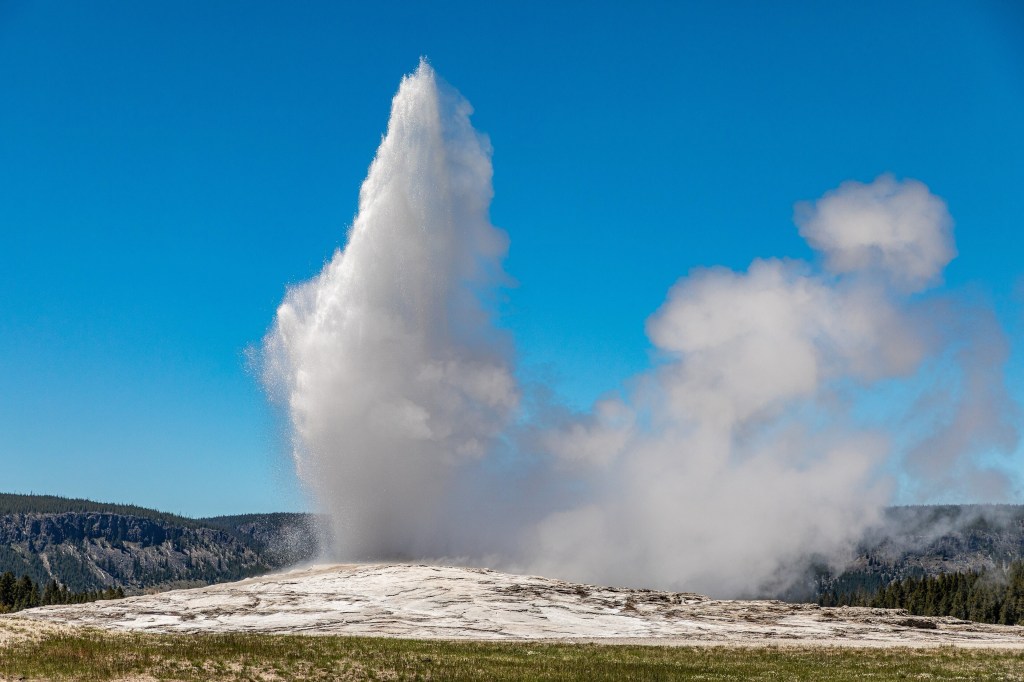
On 1 March, the President of the United States signed the Act of Dedication, which established Yellowstone National Park. Which president signed it and in which decade did this occur?
Answers: President Ulysses S. Grant; 1870s.
Yellowstone National Park, established in 1872, is the first national park in the US and the world. It spans three states and is renowned for its geothermal features, diverse wildlife, and the Yellowstone Caldera.
Two
The Massacre of Vassy (French: massacre de Wassy) was the murder of … worshippers and citizens in an armed action by troops of the Duke of Guise, in Wassy, France on 1 March 1562.— Wikipedia
A word has been omitted from the text ‘murder of the … worshippers’ in the above edited version of the opening sequence of the Wikipedia article The Massacre of Vassy. This omission is a noun describing the worshippers as being of the Reformed (Calvinist) tradition of Protestantism. What is this missing word?
Answer: Huguenot.
The Massacre of Vassy in 1562, where about 60 Huguenot worshippers were murdered, marked the start of the French Wars of Religion. The conflict ended with the Peace of Amboise in 1563.
Three
On 1 March 1936, after five years of construction, the Hoover Dam was officially handed over to the US government. The reservoir it created was named Lake Mead. Here are three statements about Lake Mead: two are true and one is false. Which one is false?
Lake Mead is named after Fort Mead
Lake Mead provides water to Mexico
Lake Mead stretches for 115 miles (185 km) upstream from the Hoover Dam
Answer: No. 1 is false.
The dam created Lake Mead which was named after Elwood Mead, Commissioner of the Bureau of Reclamation from 1924 to 1936. It supplies water to the states of Arizona, California and Nevada as well as some parts of Mexico. It stretches for 115 miles (185 km) upstream from the dam.
Four
In 1956, the International Air Transport Association finalised the Radiotelephony spelling alphabet for the International Civil Aviation Organization which implemented it on this date. It was later adopted by the International Telecommunications Union and is still in place today. Spelling of the words in this alphabet is important to assist with correct pronunciation over the air. What words represent these six letters: A — F — J — Q — W — Z?
Alfa is spelled with an f as it is in most European languages. This is because the spelling Alpha may not be pronounced properly by some who do not realise that ph should be pronounced as f. Similarly, Juliett is used rather than Juliet for French speakers, because they might otherwise treat a single final t as silent.
Five
On this day, a U.S. president established the Peace Corps by executive order. Which decade saw this event and who was the president involved?
Answers: 1960s; John F. Kennedy.
The Peace Corps, established in 1961 by President John F. Kennedy, is a U.S. government agency that trains and deploys volunteers to assist developing countries in fields like education, agriculture, and health. Typically American citizens with a college degree, volunteers serve for at least two years, living and working alongside local communities. Since its inception, the Peace Corps has grown significantly, expanding its reach to 141 countries by 2018.
On 1 March, the President of the United States signed the Act of Dedication, which established Yellowstone National Park. Which president signed it and in which decade did this occur?
Two
The Massacre of Vassy (French: massacre de Wassy) was the murder of … worshippers and citizens in an armed action by troops of the Duke of Guise, in Wassy, France on 1 March 1562.— Wikipedia
A word has been omitted from the text ‘murder of the … worshippers’ in the above edited version of the opening sequence of the Wikipedia article The Massacre of Vassy. This omission is a noun describing the worshippers as being of the Reformed (Calvinist) tradition of Protestantism. What is this missing word?
Three
On 1 March 1936, after five years of construction, the Hoover Dam was officially handed over to the US government. The reservoir it created was named Lake Mead. Here are three statements about Lake Mead: two are true and one is false. Which one is false?
Lake Mead is named after Fort Mead
Lake Mead provides water to Mexico
Lake Mead stretches for 115 miles (185 km) upstream from the Hoover Dam
Four
In 1956, the International Air Transport Association finalised the Radiotelephony spelling alphabet for the International Civil Aviation Organization which implemented it on this date. It was later adopted by the International Telecommunications Union and is still in place today. Spelling of the words in this alphabet is important to assist with correct pronunciation over the air. What words represent these six letters: A — F — J — Q — W — Z?
Five
On this day, a U.S. president established the Peace Corps by executive order. Which decade saw this event and who was the president involved?
On this date sometime during the 20th century, the country which is currently represented by the flag above gained independence. Which decade did this independence occur in, and from what empire was independence gained?
Answers: 1920s; British Empire
Egypt, a de facto independent state under Ottoman rule, became a British protectorate in 1914. Despite the 1919 revolution and subsequent negotiations, British control persisted, leading to dissatisfaction, partial independence in 1922 and the ‘reserved points’ clause in the 1923 Egyptian constitution.
Two
In 1983 the final episode of M*A*S*H aired. Who was the only actor to appear in every single episode and what character did they play?
Answer: Alan Alda; Captain Benjamin Franklin ‘Hawkeye’ Pierce.
An American television comedy drama series, aired on CBS for 11 seasons (1972–83), a total of 256 episodes. The show, set during the Korean War, followed the medical staff at a mobile army surgical hospital and received critical acclaim, winning 14 Emmy Awards and a Peabody Award. Despite cast changes, the series maintained its continuity through strong performances and writing, with a unique use of multiple plot lines and an antiwar message.
Three
Olaf Palme, a globally recognised politician, was assassinated in 1986. At the time of his death he was prime minister of which country?
Answer: Sweden.
Olof Palme, a Swedish Social Democratic leader, served as Prime Minister twice and was known for his pacifist stance and criticism of U.S. war policy. He was assassinated in 1986, and the case remained unsolved until 2020 when Stig Engström, who died in 2000, was identified as the likely perpetrator although this is widely disputed with many believing the true identity of his assassin is still unknown.
Four
In 2013 Pope Benedict XVI resigned. How many years to the nearest hundred had elapsed since a previous pope had resigned?
Answer: 600 years
Pope Gregory XII had resigned in 1415, 598 years before Benedict. Pope Benedict XVI, born Joseph Ratzinger, led the Catholic Church from 2005 to 2013. A renowned theologian, he was appointed Pope after John Paul II’s death. During his papacy, he faced challenges such as declining church attendance and the sexual abuse scandal, for which he received criticism. He also advocated for traditional Catholic values and opposed condom use. Benedict resigned in 2013, citing health issues.
Five
Before filming Goldfinger, in which Bond would have to play golf, Sean Connery received golf lessons from which former golf professional and television golf commentator who was born on this day?
Answer: Peter Alliss
Born this day in 1931, Peter Alliss, an English golfer and broadcaster, was inducted into the World Golf Hall of Fame in 2012. He won 20 professional tournaments, including three British PGA Championships, and played on eight Ryder Cup teams. Alliss worked for the BBC, ESPN and ABC Sports, and designed over 70 golf courses, including The Belfry, contributing significantly to golf course architecture. He received numerous honours, such as honorary degrees and the Golf Foundation’s ‘Spirit of Golf award’. Before the filming of Goldfinger, Alliss gave Sean Connery golf lessons, which sparked Connery’s lifelong love for the sport.
Post Title
‘Through early morning fog I see’ is the first line from the theme to M*A*S*H, Suicide is Painless, the lyrics are at AZ Lyrics.
On this date sometime during the 20th century, the country which is currently represented by the flag above gained independence. Which decade did this independence occur in, and from what empire was independence gained?
Two
In 1983 the final episode of M*A*S*H aired. Who was the only actor to appear in every single episode and what character did they play?
Three
Olaf Palme, a globally recognised politician, was assassinated in 1986. At the time of his death he was prime minister of which country?
Four
In 2013 Pope Benedict XVI resigned. How many years to the nearest hundred had elapsed since a previous pope had resigned?
Five
Before filming Goldfinger, in which Bond would have to play golf, Sean Connery received golf lessons from which former golf professional and television golf commentator who was born on this day?
These questions all relate to today’s date, February 26th.
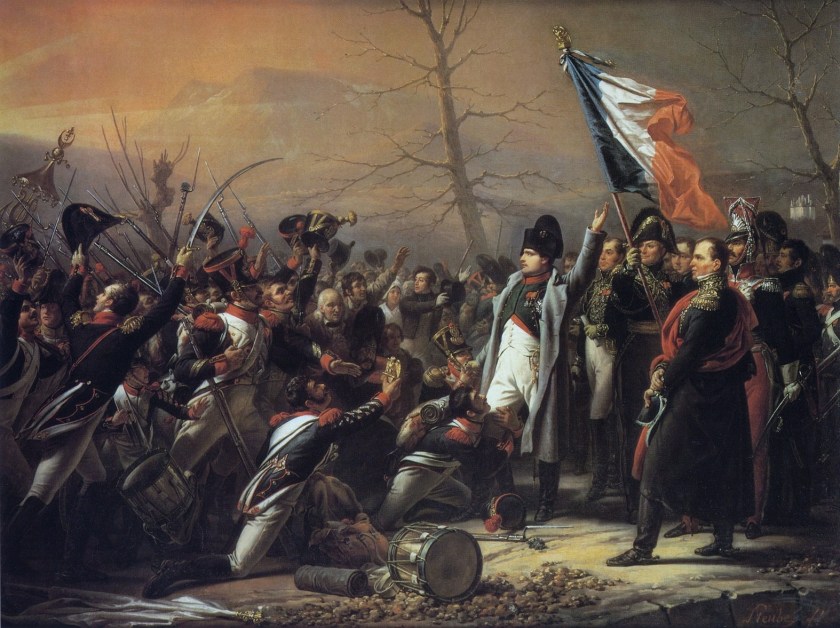
Napoleon’s Return from Elba 1815 by Charles de Steuben. Image Wikimedia Commons
One
On this day in 1815, Napoleon escaping from captivity ushered in the Hundred Days. From where had he escaped?
Answer: Elba.
The Hundred Days in French history refers to the period between Napoleon’s return to Paris on 20 March 1815 and Louis XVIII’s return on 8 July 1815. This period marked Napoleon’s return from exile, his subsequent defeat at Waterloo, and his permanent exile, which led to the restoration of the French monarchy. After escaping from Elba, Napoleon regained power but faced opposition from the Fourth Coalition, resulting in his final defeat at Waterloo and second abdication.
Two
Who, born in Arkansas in 1932, often sang railroad songs such as Orange Blossom Special; Hey, Porter and Rock Island Line?
Answer: Johnny Cash.
Johnny Cash, the ‘Man in Black’, was an American singer-songwriter known for his deep voice, rebellious spirit, and songs about sorrow, redemption and prison life. He sold over 90 million records and was inducted into the Country Music, Rock and Roll and Gospel Music Halls of Fame.
Three
On this day in 1914, less than two years since Titanic sank, her sister ship was launched in Belfast. What was the name of the sister ship?
Answer: Britannic
HMHS (His Majesties Hospital Ship) Britannic, the largest hospital ship of its time, was the third and final vessel of the White Star Line’s Olympic class. Launched just before World War I, it operated between the UK and the Dardanelles until it sank in 1916 after hitting a mine, resulting in 30 fatalities. The wreck, the largest intact passenger ship on the seabed, was located by Jacques Cousteau in 1975.
Four
Born in Besançon, eastern France, in 1802, this novelist, poet and dramatist was one of France’s foremost Romantic writers. His characters include Oliver Cromwell, Archdeacon Claude Frollo and Bishop Muriel. Who is he?
Answer: Victor Hugo.
The characters mentioned in the question are in order from his works Oliver Cromwell, The Hunchback of Notre-Dame and Les Misérables. Victor Hugo (1802–1885) was a French Romantic author, poet, and playwright. He was a prominent political figure, advocating for republicanism and social causes. Hugo’s legacy includes his influence on music and his role as a national hero
Five
The first non-stop circumnavigation of the globe began on this day in what decade?
Answer: 1940s
In 1949, the Lucky Lady II, a Boeing B-50 Superfortress, became the first aircraft to circumnavigate the globe nonstop. The 94-hour and one minute journey, assisted by in-flight refuelling, showcased the potential of aerial refuelling for long-range missions. The crew received the Distinguished Flying Cross and prestigious aviation awards for their achievement.
These questions all relate to today’s date, February 26th.
Napoleon’s Return from … 1815 by Charles de Steuben. Image Wikimedia Commons
One
On this day in 1815, Napoleon escaping from captivity ushered in the Hundred Days. From where had he escaped?
Two
Who, born in Arkansas in 1932, often sang railroad songs such as Orange Blossom Special; Hey, Porter and Rock Island Line?
Three
On this day in 1914, less than two years since Titanic sank, her sister ship was launched in Belfast. What was the name of the sister ship?
Four
Born in Besançon, eastern France, in 1802, this novelist, poet and dramatist was one of France’s foremost Romantic writers. His characters include Oliver Cromwell, Archdeacon Claude Frollo and Bishop Muriel. Who is he?
Five
The first non-stop circumnavigation of the globe began on this day in what decade?
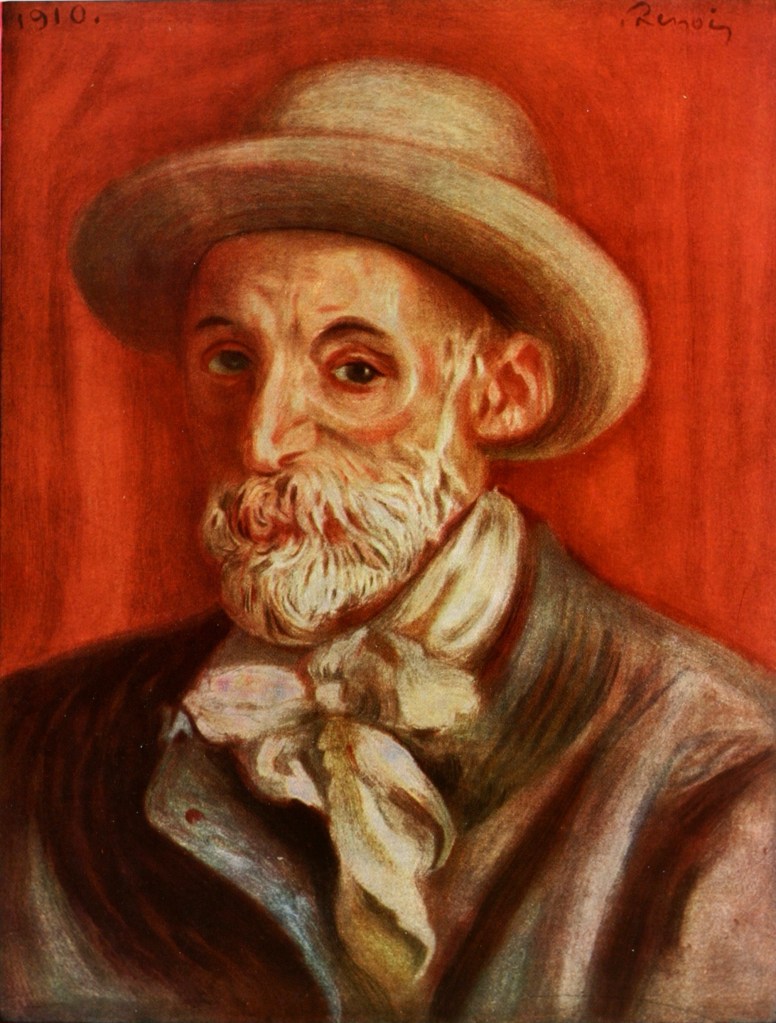
The painter of the above self-portrait was born in Limoges, France, on 25 February 1841. He became an early Impressionist but later adopted a more traditional style. Who is he?
Answer: Pierre-Auguste Renoir.
Pierre-Auguste Renoir (1841-1919) was a French artist and leading Impressionist painter. He later developed a more disciplined technique, focusing on portraits and figure paintings, particularly of women.
Two
This author, best known by a pen name but also using another — Joseph Kell, was born John Burgess Wilson on this day in 1917 in an inner-city suburb of Manchester, England. After wartime service, he left the British army in 1946 with the rank of sergeant-major. His most famous work, a dystopian satire published in 1962, was adapted into a controversial film in 1971. What is his best-known pen name?
Answer: Anthony Burgess.
Anthony Burgess (1917-1993) was an English novelist, critic, and man of letters renowned for his fictional explorations of modern dilemmas. He wrote over 50 books, including novels, literary criticism, biographies, and musical compositions. Burgess’s works often combined linguistic ingenuity, witty erudition, and sharp social satire. He is best known for his dystopian satire A Clockwork Orange and was also a versatile linguist and literary critic, writing numerous novels, librettos and screenplays.
Three
In 1986, after claiming victory in a fraudulent election which led to a military coup and revolution, President Ferdinand Marcos fled his country. Of what country was Marcos president, and which opposition leader replaced him as president?
Answers: Philippines; Corazon Aquino.
Ferdinand Marcos fled the Philippines on 25 February 1986, seeking refuge in Hawaii with his family and a vast fortune, in part consisting of 22 crates of cash valued at $717 million, 300 crates of assorted jewellery, $4 million worth of unset precious gems, 65 Seiko and Cartier watches, a 12 by 4 ft box full of pearls, a 3 ft solid gold statue covered in diamonds and other precious stones, $200,000 in gold bullion, nearly $1 million in Philippine pesos, and deposit slips to banks in the United States, Switzerland, and the Cayman Islands worth $124 million. While enjoying a lavish lifestyle, Filipinos back home grappled with the economic consequences of his rule. Amongst other things, Imelda Marcos, the ousted First Lady, was found to have a collection of 2,700 pairs of shoes. The revolution that ousted Marcos was fuelled by widespread discontent, with protests erupting not only in Manila but also in the provinces and islands. Source: Wikipedia.
Four
Born in 1943, this musician was a prominent figure in the music world during the swinging sixties. He was originally part of a band where he wrote hits like Here Comes the Sun and While My Guitar Gently Weeps. His sitar teacher was singer Norah Jones’ father. He later enjoyed a successful solo career. Who was he and who taught him to play the sitar?
Answers: George Harrison; Ravi Shankar.
George Harrison, lead guitarist of the Beatles, was known for his significant contributions to the band’s musical direction and his successful solo career. He incorporated non-Western musical influences, particularly Indian classical music, into the Beatles’ sound and later established himself as a solo artist with hits like My Sweet Lord. Harrison was also a prolific music and film producer, co-founding HandMade Films and producing acts for Apple Records. He produced the Monty Python’s troupe’s comedy film The Life of Brian (1979).
Five
In 1570, Pope Pius V excommunicated the English monarch from the Roman Catholic Church. Who was this monarch?
Answer: Elizabeth I.
Elizabeth I, the last Tudor monarch, ruled England and Ireland from 1558 to 1603. Her reign, marked by religious tolerance and cautious foreign policy, saw the establishment of the Church of England and the defeat of the Spanish Armada. Despite numerous courtships, Elizabeth remained unmarried, earning her the moniker ‘Virgin Queen’.
The painter of the above self-portrait was born in Limoges, France, on 25 February 1841. He became an early Impressionist but later adopted a more traditional style. Who is he?
Two
This author, best known by a pen name but also using another — Joseph Kell, was born John Burgess Wilson on this day in 1917 in an inner-city suburb of Manchester, England. After wartime service, he left the British army in 1946 with the rank of sergeant-major. His most famous work, a dystopian satire published in 1962, was adapted into a controversial film in 1971. What is his best-known pen name?
Three
In 1986, after claiming victory in a fraudulent election which led to a military coup and revolution, President Ferdinand Marcos fled his country. Of what country was Marcos president, and which opposition leader replaced him as president?
Four
Born in 1943, this musician was a prominent figure in the music world during the swinging sixties. He was originally part of a band where he wrote hits like Here Comes the Sun and While My Guitar Gently Weeps. His sitar teacher was singer Norah Jones’ father. He later enjoyed a successful solo career. Who was he and who taught him to play the sitar?
Five
In 1570, Pope Pius V excommunicated the English monarch from the Roman Catholic Church. Who was this monarch?
These questions all relate to today, February 24th.
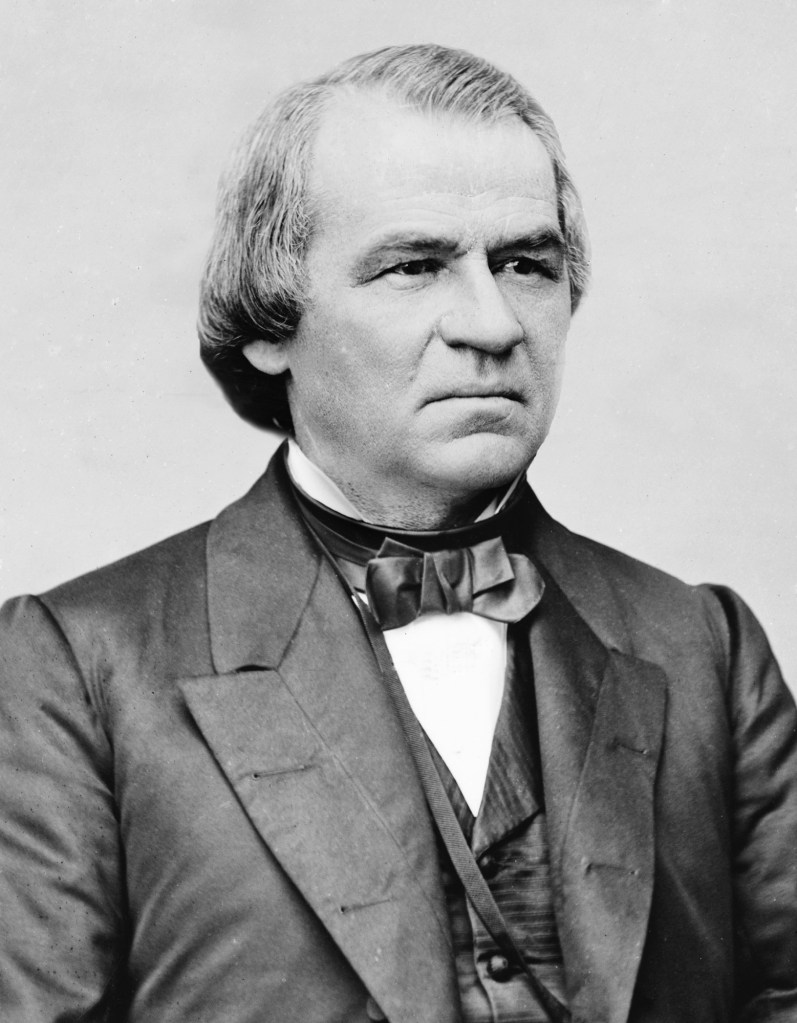
Photograph of President Johnson, by Mathew Brady, circa 1870. Image Wikimedia Commons
One
Born in North Carolina in 1808, Andrew Johnson became the seventeenth president of the United States. Already notable as the first president to take office after an assassination and the first to be impeached, he achieved another unique milestone in 1875 — one no other president has matched. What was it?
Answer: He was elected to the US Senate.
Andrew Johnson, the 17th president of the United States, assumed office after Abraham Lincoln’s assassination. His lenient Reconstruction policies led to his impeachment by the Radical Republicans in Congress, though he was acquitted. A self-taught man who rose from poverty, Johnson was a skilled orator and a staunch advocate for states’ rights and the Constitution. Following his presidency, he was elected in 1875 to the Senate, representing Tennessee, although he served only a short time before his death later that year. To date, he is the only president to have entered the Senate after his presidential term.
Two
On this day, two earthquakes struck with a maximum Mercalli intensities of VIII (Severe) and IX (Violent). The 1981 Gulf of Corinth earthquake affected the central region of a country while the 2004 Al Hoceima earthquake impacted the northern areas of another. Which two countries were affected?
Answers: Greece and Morocco.
In early 1981, the eastern part of the Gulf of Corinth in Greece experienced three earthquakes with magnitudes greater than 6 Ms over 11 days and maximum Mercalli intensity of VIII (Severe), causing widespread damage in the Corinth–Athens area. Nearly 8,000 houses were destroyed, and 20–22 people lost their lives. On 24 February 2004, a 6.3 magnitude earthquake struck Morocco’s Al Hoceïma Province at 03:27 CET, with a maximum Mercalli intensity of IX (Violent). The epicentre was located about 13 km south-southwest of Al Hoceima. The earthquake resulted in 631 deaths, 926 injuries, and the destruction of over 2,500 homes, primarily in villages within the Rif Mountains.
Three
In men’s singles tennis, what Australian defeated Pete Sampras to win the 2001 U.S. Open, his first Grand Slam title, and ten months later overcame David Nalbandian on the All-England Club’s grass courts to win the 2002 Wimbledon tournament?
Answer: Lleyton Hewitt.
Lleyton Hewitt, born in 1981 in Adelaide, Australia, is a retired professional tennis player known for his court speed and determination. He won the U.S. Open in 2001 and Wimbledon in 2002, becoming the youngest man to finish a year at number one in the ATP rankings. Despite injuries, he returned to compete in doubles events after retiring in 2016.
Four
Born in 1955, this future billionaire acquired a controlling interest in Pixar in 1986. He played a key role in transforming it into a major animation studio, ultimately leading to the creation of the first fully computer-animated feature film Toy Story in 1995. Later, he sold the company to Disney in 2006. Who is this future billionaire?
Answer: Steve Jobs.
Steve Jobs, a charismatic pioneer of the personal computer era, co-founded Apple Inc. in 1976 and oversaw the launch of revolutionary products like the iPod and iPhone. Despite battling pancreatic cancer, he remained a visionary leader until his death in 2011.
Five
In which modern country was Charles V, Holy Roman Emperor, King of Spain, and Archduke of Austria, born in 1500?
Answer: Belgium
Born in Prinsenhof, Ghent, Flanders (now Belgium), Charles V, Holy Roman Emperor, King of Spain, and Archduke of Austria, inherited a vast empire spanning Europe and the Americas at a young age. Throughout his reign, he faced significant challenges, including defending against Protestantism, Ottoman and French pressure, and papal hostility. Despite his efforts, he eventually conceded the Peace of Augsburg and abdicated in favour of his son and brother.