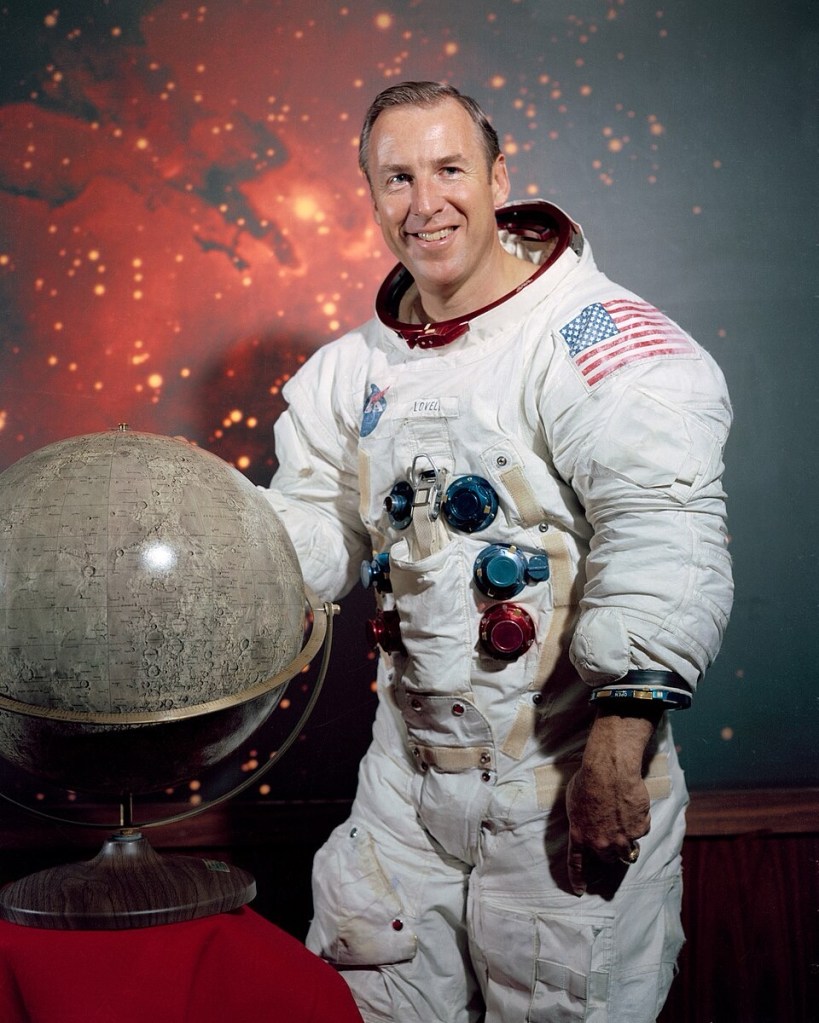
(March 25, 1928—August 7, 2025).
Image Wikipedia
One
In 1968, what became the first crewed spacecraft to reach the Moon, orbit it and return?
Answer: Apollo 8
Apollo 8, launched on 21 December 1968, became the first human spaceflight to reach the Moon. During its mission, the crew orbited the Moon ten times, conducting various tasks such as photography and navigation, while also transmitting telecasts worldwide. The spacecraft safely splashed down in the Pacific Ocean on 27 December, 147 hours after launch.
This question was prompted by the death of Jim Lovell, aged 97, on 7 August 2025. He flew to the Moon and back twice but never landed.
Two
The 1999 Open Championship was decided in a play-off between Jean Van de Velde and which two other players?
Answer: Justin Leonard and Paul Lawrie
Jean Van de Velde, ranked 152nd, nearly won the 1999 Open Championship but famously collapsed on the 18th hole. His triple-bogey seven led to a playoff, which he lost to Paul Lawrie.
Three
The two great European narcotics, alcohol and…
— Friedrich Nietzsche: Twilight of the Idols
What word is missing from the end of the above quote?
Answer: Christianity
Nietzsche’s quote suggests that he viewed both Christianity and alcohol as ‘narcotics’, substances or influences that dull the senses and provide an escape from reality.
Four
Which Canadian province is named after the fourth daughter of Queen Victoria, born in 1848?
Answer: Alberta
Alberta was named after Princess Louise Caroline Alberta, the wife of John Campbell, Marquess of Lorne, who served as Governor General of Canada from 1878 to 1883. The name was originally given to the District of Alberta in 1882. The Princess also gave her name to Mount Alberta and Lake Louise.
Five
What passing-bells for these who die as cattle?
— Wilfred Owen
The above quote is the opening line of which poem?
Answer: Anthem for Doomed Youth
Wilfred Owen’s poem Anthem for Doomed Youth, written in 1917, vividly captures the horrors of war. Enlisting in the British army in 1915, Owen was sent to France with the Lancashire Fusiliers to fight in the trenches during World War I. In 1917, during his first six months of battle, his troop was gassed and forced to sleep in an open field of snow. One incident involved Owen spending several days huddled in a foxhole near the body of a fallen soldier. These experiences profoundly impacted Owen as a poet, leading to rapid maturity. The poems written after January 1917 are characterised by anger at war’s brutality, and pity for those who ‘die as cattle’.
Anthem for Doomed Youth
BY WILFRED OWEN
What passing-bells for these who die as cattle?
— Only the monstrous anger of the guns.
Only the stuttering rifles’ rapid rattle
Can patter out their hasty orisons.
No mockeries now for them; no prayers nor bells;
Nor any voice of mourning save the choirs,—
The shrill, demented choirs of wailing shells;
And bugles calling for them from sad shires.
What candles may be held to speed them all?
Not in the hands of boys, but in their eyes
Shall shine the holy glimmers of goodbyes.
The pallor of girls’ brows shall be their pall;
Their flowers the tenderness of patient minds,
And each slow dusk a drawing-down of blinds.
— Wilfred Owen
 Quizology.Online
Leave a comment