Here are the answers to my earlier post,
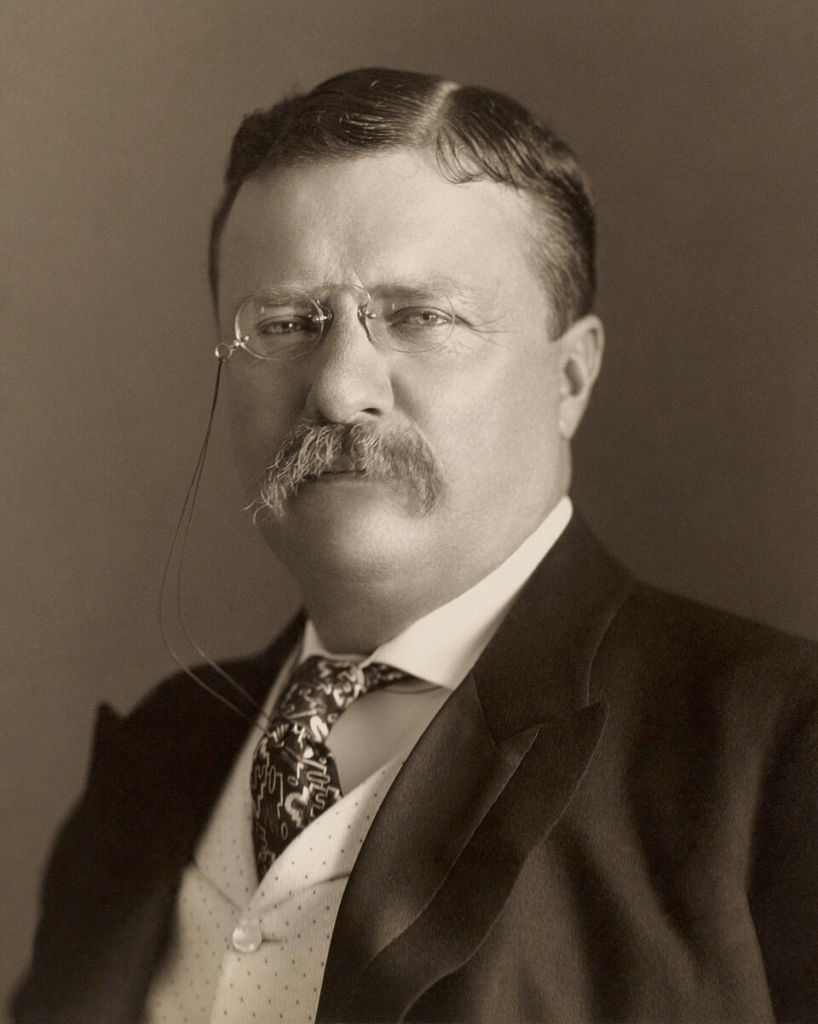
Image Wikipedia
One
Could you please identify the missing names in the following quote from Encyclopædia Britannica? It mentions a president’s name and a building’s name but both have been removed.
1901 President … officially changed the name of the president’s residence at 1600 Pennsylvania Avenue in Washington, D.C. from … to the White House — Encyclopædia Britannica
Answer: Theodore Roosevelt and Executive Mansion
Originally called the “President’s Palace” on early maps, the building was officially named the Executive Mansion in 1810 to avoid connotations of royalty. Although the name White House was commonly used from about the same time (because the mansion’s white-gray sandstone contrasted strikingly with the red brick of nearby buildings), it did not become the official name of the building until 1901, when it was adopted by Pres. Theodore Roosevelt (1901–09). The White House is the oldest federally built building in the country’s capital. — Encyclopædia Britannica
Two
In 1748, the British Royal Navy secured a tactical victory over the Spanish near Havana in the Caribbean during the War of ….
Which of the following completes the above statement: Barnard’s Nose; Jenkins’ Ear or Nelson’s Eye?
Answer: Jenkins’ Ear
The War of Jenkins’ Ear (1739-1748)—the name derives from Robert Jenkins, a British sea captain whose ear was allegedly severed by Spanish coast guards in 1731—between Great Britain and Spain, centred in New Granada and the Caribbean, was a precursor to the War of the Austrian Succession. The war ended with the Treaty of Aix-la-Chapelle, leaving Britain’s territorial ambitions largely unmet.
Three
In 2001, the centennial Nobel Prize was awarded to the United Nations and the organisations secretary-general. Who was this secretary-general?
Answer: Kofi Annan
In 2001, the Nobel Committee awarded the Peace Prize to the UN and Kofi Annan for their work towards a more peaceful world. Annan was also honoured with a chieftaincy title by the Asantehene for his contributions to humanity and peace.
Four
An island once named Fernando Pó is part of a country which achieved its independence from Spain in 1968. What country is this, and on what continent is it located?
Answer: Equatorial Guinea and Africa
Bioko, historically Fernando Pó after a Portuguese explorer, is an island in Equatorial Guinea. Located 32 kilometres south of Cameroon’s coast and 160 kilometres northwest of mainland Equatorial Guinea, its capital city Malabo sits on the island’s north coast. With an area of 2,017 km² it is the fourth largest island in Africa and is part of the Cameroon line of volcanoes, with its highest peak being Pico Basile at 3,012 m. In the Bube language, Bioko is called Ëtulá a Ëri.

Image Wikipedia
Five
In 1916, a British nurse was executed by a German firing squad for aiding Allied soldiers in their escape. Who was the nurse, and what was the name of the country?
Answer: Edith Cavell
Edith Cavell, a British nurse, was executed on 12 October 1915 by the Germans during WWI for helping Allied soldiers escape. Her selfless actions and words, ‘Patriotism is not enough’, inspired many and are commemorated on her memorial.
 Quizology.Online
Leave a comment