Here are the answers to today’s questions.
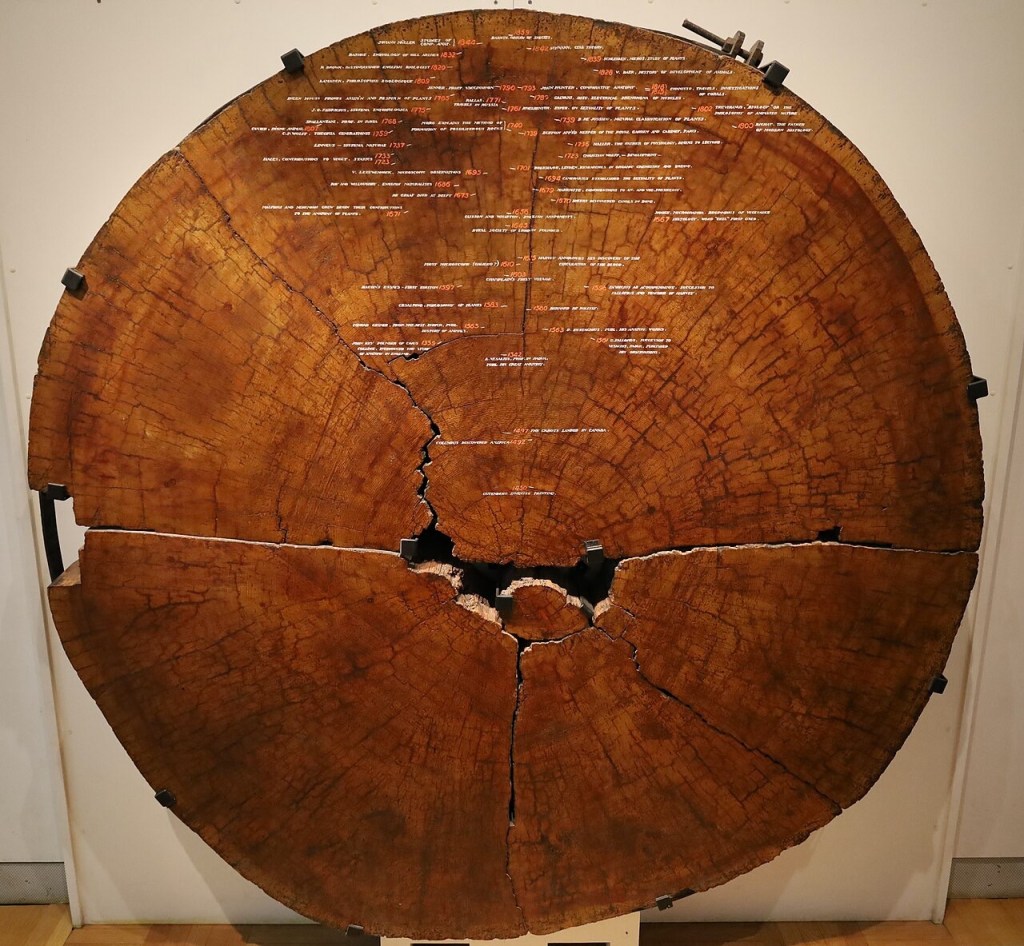
A cross-section of a Coast Douglas-fir tree.
Royal Ontario Museum, Canada.
Image Wikimedia Commons
Today’s questions are further study of Ologies.
One
What is defined as ‘the study of the mechanics of body movements’ (Oxford English Dictionary)?
Answer: Kinesiology.
kinesiology /kɪˌniːsiˈɒlədʒi , kʌɪˌniːsiˈɒlədʒi /
▸ noun [mass noun] the study of the mechanics of body movements.– ORIGIN
late 19th century: from Greek kinēsis ‘movement’ (from kinein ‘to move’) + -logy.
– DERIVATIVES
kinesiological ▸ adjective
kinesiologist ▸ noun— Oxford English Dictionary
Two
What does an ichthyologist study?
Answer: Fish.
An ichthyologist is a scientist who studies fish, while ichthyology is the branch of zoology devoted to the study of fish. The word ichthyology comes from the Greek ichthys, meaning ‘fish’, and –logia, meaning ‘study of’. An ichthyologist may study the anatomy, behaviour, evolution, classification, ecology, distribution, or conservation of all major groups of fish, including bony fish (Osteichthyes), cartilaginous fish (such as sharks and rays), and jawless fish (such as lampreys and hagfish). Because fish make up more than half of all known vertebrate species, ichthyology is one of the largest and most diverse fields within zoology.
Three
Nosology is the scientific study of which of these?
- Diseases
- Nasal biology
- Negativity
Answer: Diseases.
nosology /nɒˈsɒlədʒi /
▸ noun [mass noun] the branch of medical science dealing with the classification of diseases.– ORIGIN
early 18th century: from Greek nosos ‘disease’ + –logy.
– DERIVATIVES
nosological /ˌnɒsəˈlɒdʒɪkl / ▸ adjective
nosologist /nɒˈsɒlədʒɪst / ▸ noun
— Oxford English Dictionary
Four
What is defined by the Oxford English Dictionary as the ‘science or technique of dating events, environmental change, and archaeological artefacts by using the characteristic patterns of annual growth rings in timber and tree trunks’?
Answer: Dendrochronology.
Dendrochronology, or tree-ring dating, is the scientific method of dating tree rings to the exact year they formed. Because trees produce one growth ring per year, the technique can precisely determine the age of wood and the timing of environmental changes, particularly past climate conditions. It is widely used in archaeology, art history, architecture, and to calibrate radiocarbon dating. Continuous tree-ring records in some regions extend back nearly 14,000 years, while newer isotope-based methods can date samples unsuitable for traditional ring analysis.
Five
Selenology is the scientific study of what?
Answer: The moon.
Selenology is derived from the Greek words Selēnē, meaning “Moon”, and –logia, meaning ‘the study of’ or ‘discourse concerning’. Literally, selenology means ‘the study of the Moon’. Selene was the ancient Greek goddess of the Moon, and her name became the root for several lunar-related scientific terms, including selenography (mapping or describing the Moon’s surface) and selenophysics (the physical study of the Moon). The term selenology came into scientific use in the 19th century, when lunar observation and mapping were becoming increasingly systematic. Today it refers to the branch of planetary science that studies the Moon’s geology, surface features, internal structure, origin, and evolution.


Leave a comment