Continuing the recent trend, today’s first question is connected to today’s date, 9 June. The remainder of the questions are not date-related but follow on a theme begun in question one.
One
In 1781, an English engineer who Encyclopædia Britannica describes as ‘the principal inventor of the railroad locomotive’ was born. Who is he, and which of his locomotives inaugurated public rail travel in September 1828?
Two
Tea bags were reportedly invented by accident. Modern tea bags are made from paper but what material were the early ones made from?
Three
(Note, in this question, the word ‘houghing’ is an obsolete form of ‘hoeing’ as done with a horse-drawn hoe (hough)).
What name links the book The New Horse Houghing Husbandry: Or an Essay on the Principles of Tillage and Vegetation, which was published in 1731, with the 1978 album Heavy Horses?
Four
Adolphe Sax, best known for inventing the saxophone, was born in which present-day country, and in what decade did he patent the saxophone?
Five
What are the ‘Four Great Inventions’ traditionally attributed to ancient China?
The post title might sound a bit obvious but it is simply a follow-on to yesterday’s, Islands Surrounded by Land. The first question relates to today’s date, 8 June, and also to an island. The other questions are not date related but all are about islands.
One
In 1946, George Orwell left London and moved to Scotland, where he stayed at a remote house called Barnhill on a Hebridean island to finish his novel, Nineteen Eighty-Four. What island was Barnhill on, and what chronic illness was Orwell suffering as he wrote the novel?
Answer: Isle of Jura; Tuberculosis.
In May 1946, Orwell retreated to Jura to draft Nineteen Eighty-Four at Barnhill. Despite slow progress and health issues, including lung inflammation and tuberculosis, he completed the first draft on 7 November 1947. Miranda Christen typed a clean version, and Orwell sought medical treatment at Hairmyres Hospital, East Kilbride. Orwell was discharged in summer 1948, returned to Jura, and completed a second draft of Nineteen Eighty-Four by November. Unable to find a typist, he retyped it himself despite illness. He left Barnhill in January 1949, and recovered in a sanatorium in the Cotswolds. On June 8, 1949, Nineteen Eighty-four was published.
Two
In what ocean is the Chagos Archipelago located?
Answer: Indian Ocean.
The Chagos Archipelago, over 60 islands in the Indian Ocean, was under French and then British control. In 1965, the UK expelled its Chagossian population for a US military base. Mauritius claimed the islands, with the ICJ and ITLOS ruling in 2019 and 2021 that the UK must return them. A 2025 treaty transferring sovereignty to Mauritius is on hold due to US, UK, and public opposition, citing UNCLOS Article 298 (b).
Three
What island extending from approximately 76° N to 83° N is world’s largest island entirely within the Arctic Circle?
Answer: Ellesmere Island.
Ellesmere Island, Canada’s northernmost and third largest island, spans 196,236 square kilometres, slightly smaller than Great Britain. Part of the Queen Elizabeth Islands, it features Cape Columbia, Canada’s northernmost point, and the north geomagnetic pole. The Arctic Cordillera dominates its landscape, with over one-fifth designated as Quttinirpaaq National Park. In 2021, its population was 144, residing in Alert, Eureka, and Grise Fiord, within Nunavut’s Qikiqtaaluk Region. Canada’s other northern islands, which are larger than Ellesmere, such as Baffin Island, extend south of the Arctic Circle and therefore do not answer the question.
Four
After the British Imperial Trans-Antarctic Expedition ship was trapped by pack ice, a small group in an open boat, the James Caird, attempted an 810-mile winter crossing of the South Atlantic Ocean to organise a rescue. What two islands were the starting and ending points of this epic journey?
Answer: Elephant Island and South Georgia Island.
In August 1914, Shackleton led the British Imperial Trans-Antarctic Expedition. The Endurance was trapped in pack ice, drifting for ten months before being crushed. The crew survived on ice floes for five months, reaching Elephant Island. Shackleton and five others sailed 810 miles (700 nautical miles; 1,300 km) to South Georgia in 17 days aboard the open boat, James Caird. The journey saw Atlantic winter storms, including ‘one of the worst hurricanes any of us had ever experienced‘. After four months and four relief expeditions, Shackleton rescued his crew, with none perishing, showcasing his exceptional leadership and resilience. The James Caird is on display at Dulwich College, London, UK, which is Shackleton’s alms mater.
Five
What is the largest island in the geographic entity of Europe?
Answer: Great Britain.
The designation ‘Great Britain‘ ultimately reflects classical Greek geographic terminology. In the 2nd century CE, Ptolemy referred to the larger island in the British Isles as Megálē Brettanía (‘Great Britain‘), using a descriptive term meaning ‘great‘ or ‘large’. The modern English name developed later from this classical tradition of distinguishing the larger island within the archipelago.
Islands Surrounded by Water
The post title might sound a bit obvious but it is simply a follow-on to yesterday’s, Islands Surrounded by Land. The first question relates to today’s date, 8 June, and also to an island. The other questions are not date related but all are about islands.
The post title might sound a bit obvious but it is simply a follow-on to yesterday’s, Islands Surrounded by Land. The first question relates to today’s date, 8 June, and also to an island. The other questions are not date related but all are about islands.
One
In 1946, George Orwell left London and moved to Scotland, where he stayed at a remote house called Barnhill on a Hebridean island to finish his novel, Nineteen Eighty-Four. What island was Barnhill on, and what chronic illness was Orwell suffering as he wrote the novel?
Two
In what ocean is the Chagos Archipelago located?
Three
What island extending from approximately 76° N to 83° N is world’s largest island entirely within the Arctic Circle?
Four
After the British Imperial Trans-Antarctic Expedition ship was trapped by pack ice, a small group in an open boat, the James Caird, attempted an 810-mile winter crossing of the South Atlantic Ocean to organise a rescue. What two islands were the starting and ending points of this epic journey?
Five
What is the largest island in the geographic entity of Europe?
The first question relates to today’s date, 7 June, and also to an ‘enclave’. The other questions are not date related but all are about enclaves.
One
What enclave became a sovereign state on this day in 1929 as a result of the Lateran Treaty taking effect?
Answer: Vatican City.
On this day in 1929, the Lateran Treaty came into effect, establishing Vatican City as a sovereign state and the world’s smallest nation. Covering a mere 0.44 square km (0.17 square miles), it’s roughly one-eighth the size of New York City’s Central Park. Completely encircled by Rome, Vatican City is a tiny enclave within the city.
Two
Measuring approximately one mile by one mile, this city dates back to Roman times and can trace its charter back almost a thousand years. It is now an enclave within another (much larger) city. What three words form the name of this city?
Answer: City of London.
Surrounded by Greater London, the City of London, also known as the Square Mile, is a historic and financial centre in England. It is the smallest city in the UK by area, with a population of 8,583, yet it serves as a major employment hub with over 500,000 workers. Its unique government system, rooted in pre-Norman Conquest rights, has influenced parliamentary government. The Court of Husting, established by 1032, was the supreme court of medieval London, with Aldermen playing a key role in municipal authority.
Three
ACT, which became a federal area in 1911, is an enclave of another area (which is not a nation). What is ACT, and what area surrounds it, making it an enclave?
Answer: Australian Capital Territory; New South Wales.
The Australian Capital Territory (ACT), an internal Australian territory, encloses Canberra, the nation’s capital. Established in 1911, it hosts key political institutions like the Parliament and High Court. The ACT, landlocked and mostly comprising Namadgi National Park, includes smaller towns and experiences a dry, continental climate.
Four
Maseru is the capital of this landlocked sovereign state in the southern hemisphere, which is an enclave totally surrounded by another country. What is the name of this enclave, and that of the surrounding country?
Answer: Lesotho; South Africa.
Lesotho, a landlocked country in Southern Africa, is surrounded by South Africa and is the largest sovereign enclave. Formed in 1824, it gained independence in 1966. The Sotho ethnic group dominates, with Sesotho as an official language. Despite socioeconomic challenges, it boasts high literacy and is part of several international organisations.
Five
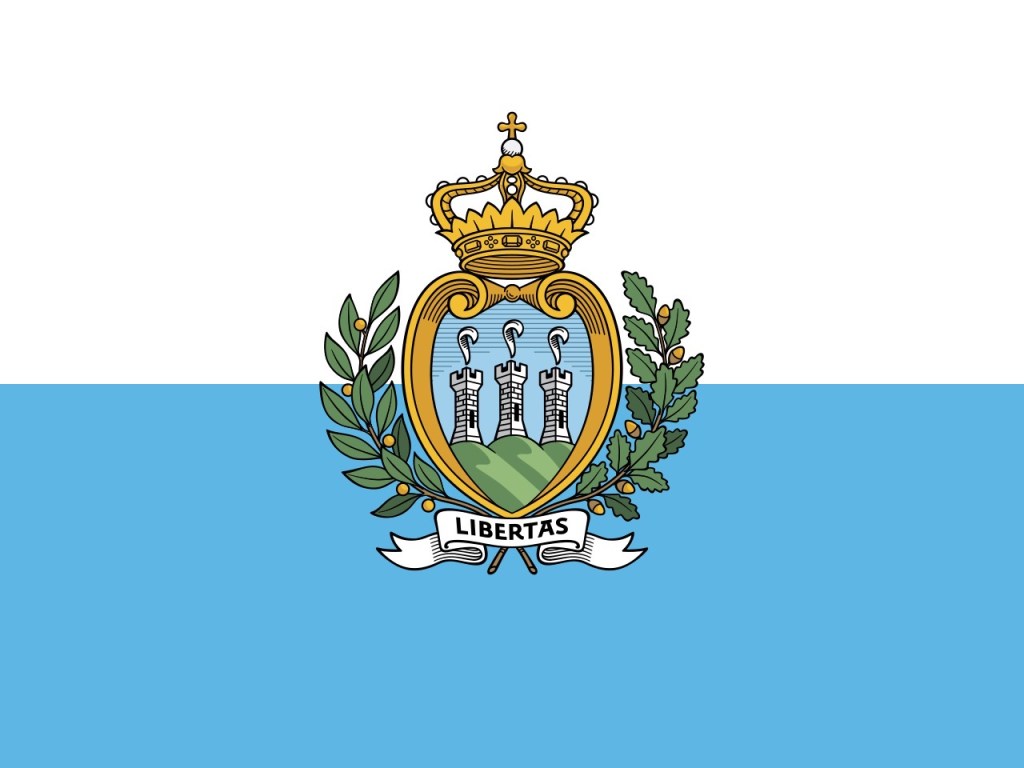
The flag shown at the top of this post is that of yet another enclave; a European sovereign state totally surrounded by another. What country is the enclave mentioned, and what country surrounds it?
Answer: San Marino; Italy.
San Marino, officially the Republic of San Marino, is a landlocked microstate in Southern Europe, surrounded by Italy. It is the fifth-smallest country globally, with a land area of over 61 square kilometres and a population of 34,042 as of 2025. Founded in AD 301, it claims to be the oldest sovereign state and constitutional republic, named after Saint Marinus. It has a unique constitutional structure with two Captains Regent, elected every six months, and the oldest Constitution, dating from 1600.
Islands Surrounded by Land
An enclave is described by Wikipedia as ‘An enclave is a territory that is entirely surrounded by the territory of only one other state or entity’. Like an island totally surrounded by water, an enclave is totally surrounded by land.
See question five. Flag of ? Image Wikimedia Commons
The first question relates to today’s date, 7 June, and also to an ‘enclave’. The other questions are not date related but all are about enclaves.
One
What enclave became a sovereign state on this day in 1929 as a result of the Lateran Treaty taking effect?
Two
Measuring approximately one mile by one mile, this city dates back to Roman times and can trace its charter back almost a thousand years. It is now an enclave within another (much larger) city. What three words form the name of this city?
Three
ACT, which became a federal area in 1911, is an enclave of another area (which is not a nation). What is ACT, and what area surrounds it, making it an enclave?
Four
Maseru is the capital of this landlocked sovereign state in the southern hemisphere, which is an enclave totally surrounded by another country. What is the name of this enclave, and that of the surrounding country?
Five
The flag shown at the top of this post is that of yet another enclave; a European sovereign state totally surrounded by another. What country is the enclave mentioned, and what country surrounds it?
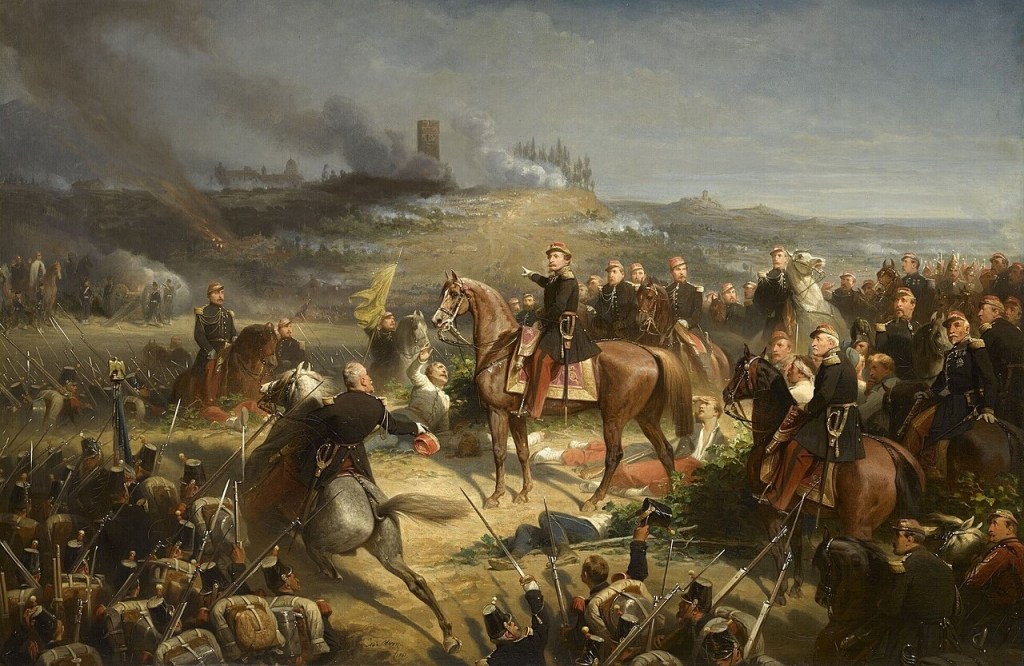
See question two. Napoleon III at the decisive moment of the Battle of Solferino, 1859. Image Wikimedia Commons
Today’s first question centres around the date 6th June, and the subsequent questions build on a theme established by the first.
One
The YMCA was founded on this day. Which decade and major city was it established in?
Answers: 1840s; London, UK.
The YMCA, founded in London in 1844 by George Williams, is a nonsectarian Christian movement promoting Christian character through activities. It spread globally, reaching North America in 1851. Programs include sports, education, and public affairs. In 2010, the U.S. branch rebranded as ‘the Y’, while some branches retained YMCA.
Two
The aftermath of the Battle of Solferino on 24 June 1859, during the Second War of Italian Independence, resulted in the 1863 formation of what organisation?
Answer: International Committee of the Red Cross (aka Red Cross).
Until the mid-19th century, army nursing systems were unorganised. In June 1859, Swiss businessman Jean-Henri Dunant witnessed the aftermath of the Battle of Solferino, where 40,000 soldiers were casualties, and was shocked by the lack of medical care. He organised relief efforts and wrote A Memory of Solferino in 1862, advocating for national and international relief organisations. In 1863, Geneva lawyer Gustave Moynier initiated discussions on Dunant’s ideas, leading to an investigatory commission and plans for an international conference which resulted in the formation of the International Red Cross.
Three
By what name were the Poor Fellow-Soldiers of Christ and of the Temple of Solomon commonly known by; in what century were they founded and where were their headquarters?
The Knights Templar, founded in 1119 to protect pilgrims in the Holy Land, evolved into a wealthy and powerful religious military order. Endorsed by the Church, they grew rapidly, becoming skilled Crusaders and prominent in finance. With innovative banking techniques, they managed a vast economic network of nearly 1,000 commanderies across Europe and the Holy Land. Their influence bred envy, and as they lost support due to their failure to hold the Holy Land, King Philip IV of France arrested and tortured them in 1307. This led Pope Clement V to disband the order in 1312. Some assets merged into the Portuguese Order of Christ and Spanish Order of Montesa. Accused of heresy, they were brutally suppressed by Philip IV.
Four
What organisation founded in 1945 has major offices in New York City, Geneva, Nairobi, Vienna and The Hague; and, to the nearest ten, how many of the world’s states are members of it?
Answers: United Nations; 190.
The United Nations (UN), established on 26 June 1945, aims to maintain peace, develop friendly relations, and promote cooperation. Headquartered in New York City, it includes six principal organisations, 193 member states, and two observer states. The UN operates 11 peacekeeping missions and has received both praise and criticism for its efforts.
Five
The British branch of an international organisation founded in 1961 began running charity fundraising shows in 1976 to support the organisation’s wider mission. These shows gained popularity and became known as The Secret Policeman’s Balls. What is the name of the international organisation founded in 1961?
Answer: Amnesty International.
Amnesty International, founded in London in 1961 by Peter Benenson, is a global NGO advocating for human rights, especially freedom of speech and against torture. It campaigns for political prisoners’ release and collaborates internationally. Awarded the 1977 Nobel Peace Prize, it operates in over 150 countries, led by an international executive committee. With over ten million members, it focuses on justice, torture issues, and awareness campaigns.
See question two. Napoleon III at the decisive moment of the Battle of Solferino, 1859. Image Wikimedia Commons
Today’s first question centres around the date 6th June, and the subsequent questions build on a theme established by the first.
One
The YMCA was founded on this day. Which decade and major city was it established in?
Two
The aftermath of the Battle of Solferino on 24 June 1859, during the Second War of Italian Independence, resulted in the 1863 formation of what organisation?
Three
By what name were the Poor Fellow-Soldiers of Christ and of the Temple of Solomon commonly known by; in what century were they founded and where were their headquarters?
Four
What organisation founded in 1945 has major offices in New York City, Geneva, Nairobi, Vienna and The Hague; and, to the nearest ten, how many of the world’s states are members of it?
Five
The British branch of an international organisation founded in 1961 began running charity fundraising shows in 1976 to support the organisation’s wider mission. These shows gained popularity and became known as The Secret Policeman’s Balls. What is the name of the international organisation founded in 1961?
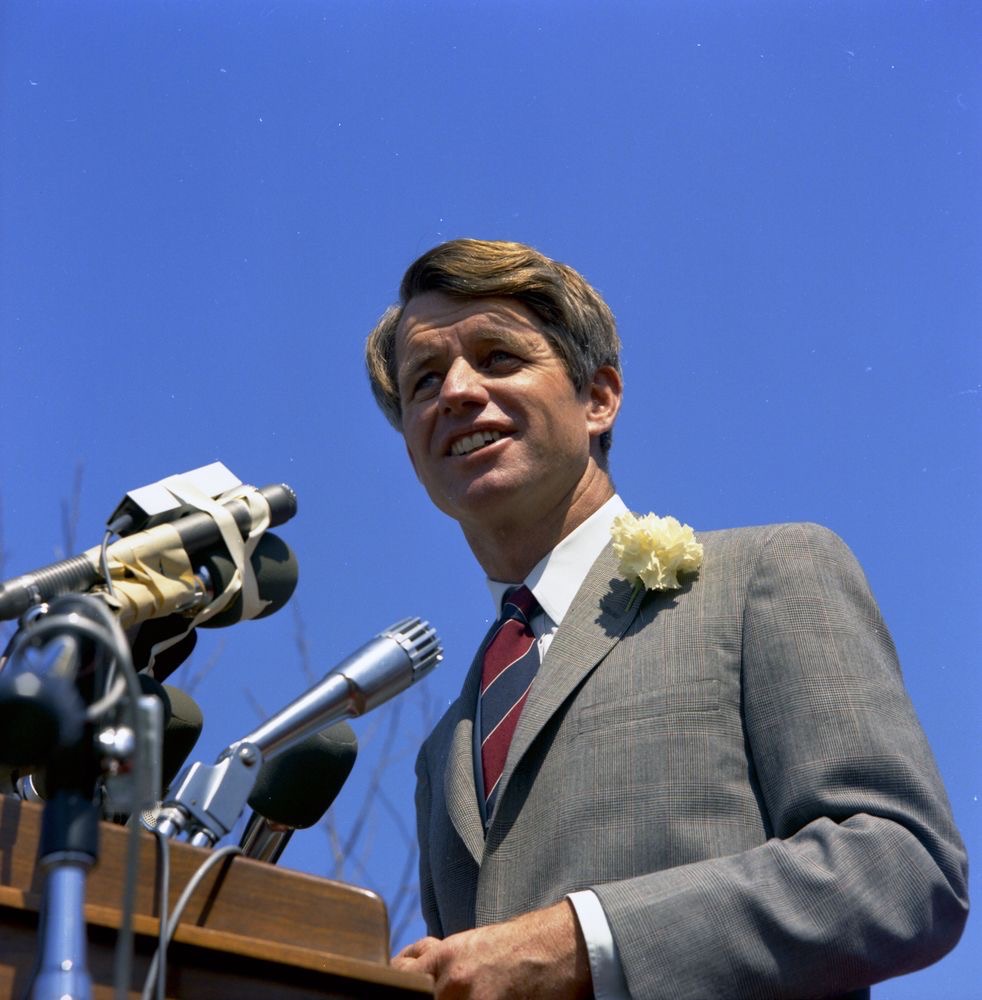
On 5 June 1968, U.S. presidential candidate Robert F. Kennedy was fatally shot? Who shot him, and in what building and in what city was he shot?
Answer: Sirhan Sirhan; Ambassador Hotel, Los Angeles.
In March 1968, Robert F Kennedy announced his presidential candidacy. By June 4th he had secured five out of six primaries including a victory in California that day. Shortly after midnight on June 5th he addressed his supporters at the Ambassador Hotel in Los Angeles. As he exited through a kitchen corridor he was fatally shot by Sirhan Sirhan, a Palestinian immigrant. Kennedy was interred near his brother John at Arlington National Cemetery.
Two
AIDS was reported for the first time after a rare form of pneumonia was found in five homosexual men. In what year was this, and in what city was the pneumonia detected?
Answer: 1981; Los Angeles, U.S.A.
HIV is a retrovirus attacking the immune system, potentially leading to AIDS without treatment. It is preventable and manageable with antiretroviral therapy, extending life expectancy to nearly normal levels. Early testing and treatment prevent progression and transmission. HIV spreads through unprotected sex, contaminated needles, and mother-to-child transmission. Recognised in the 1980s, HIV/AIDS has significant societal, economic, and political impacts. Originating from primates in west-central Africa, AIDS was first identified in 1981. By 2024, AIDS caused at least 42.3 million deaths globally, with 630,000 deaths in 2023 and 39.9 million living with HIV, 65% in the WHO African Region.
Three
Born this day in 1939, this man would become Canada’s 16th and youngest prime minister 40 years later. Who is he?
Answer: Joe Clark.
Joe Clark, Canada’s youngest Prime Minister, led the Progressive Conservative Party from 1976 to 1983 and again from 1998 to 2003. His brief tenure as Prime Minister saw the introduction of freedom of information legislation and the ‘Canadian Caper’ rescue. After losing the 1980 election, he served in Brian Mulroney’s cabinet and later as a UN Special Representative for Cyprus.
Four
This author was born in Wales in 1949, and had a breakthrough with his 1978 novel Eye of the Needle. His successful Kingsbridge series began with The Pillars of the Earth (1989). Who is this author?
Answer: Ken Follett.
Welsh author Ken Follett, born in 1949, is known for his thrillers and historical novels, selling nearly 200 million copies. His breakthrough came with Eye of the Needle (1978), and he later achieved success with The Pillars of the Earth (1989).
Five
This actor turned politician had his first screen credit in a starring role in 1937 as Andy McCaine in Love Is on the Air and 20 years later he was Cdr. Casey Abbott in Hellcats of the Navy. Who is he?
Answer: Ronald Reagan.
Ronald Reagan, the 40th president of the United States, was a former movie actor known for his conservative Republicanism and anticommunism. He served as president from 1981 to 1989 and was nicknamed ‘the Great Communicator’ for his oratory skills. Reagan’s policies are credited with contributing to the downfall of Soviet communism. Ronald Reagan died on 5 June 2004.
On 5 June 1968, U.S. presidential candidate Robert F. Kennedy was fatally shot? Who shot him, and in what building and in what city was he shot?
Two
AIDS was reported for the first time after a rare form of pneumonia was found in five homosexual men. In what year was this, and in what city was the pneumonia detected?
Three
Born this day in 1939, this man would become Canada’s 16th and youngest prime minister 40 years later. Who is he?
Four
This author was born in Wales in 1949, and had a breakthrough with his 1978 novel Eye of the Needle. His successful Kingsbridge series began with The Pillars of the Earth (1989). Who is this author?
Five
This actor turned politician had his first screen credit in a starring role in 1937 as Andy McCaine in Love Is on the Air and 20 years later he was Cdr. Casey Abbott in Hellcats of the Navy. Who is he?
What does the name of the dinosaur Falcarius mean?
Ground scraper
Sickle cutter
Wood driller
Answer: Sickle cutter.
Falcarius, meaning ‘sickle cutter’, is a primitive therizinosaur from the Early Cretaceous in North America. Discovered in the Cedar Mountain Formation, it was a 4 m long bipedal herbivore with a small head, elongated neck, and tail. It is considered a transitional form between theropods and Therizinosauridae.
Three
Spectrophobia, catoptrophobia and eisoptrophobia can all relate to what household item?
Kettle
Linoleum
Mirror
Answer: Mirror.
Catoptrophobia, eisoptrophobia and spectrophobia are terms related to fear of mirrors, but they have distinct meanings. Catoptrophobia is the fear of mirrors themselves, eisoptrophobia is the fear of seeing one’s reflection, and spectrophobia can mean fear of mirrors or ghosts. Etymologically, catoptro– and eisoptron– mean ‘mirror’, whereas spectrum means ‘apparition’, explaining spectrophobia’s dual association.
Four
What word can be added to crow to complete this plants name: crow …?
Foot
Quill
Steps
Answer:
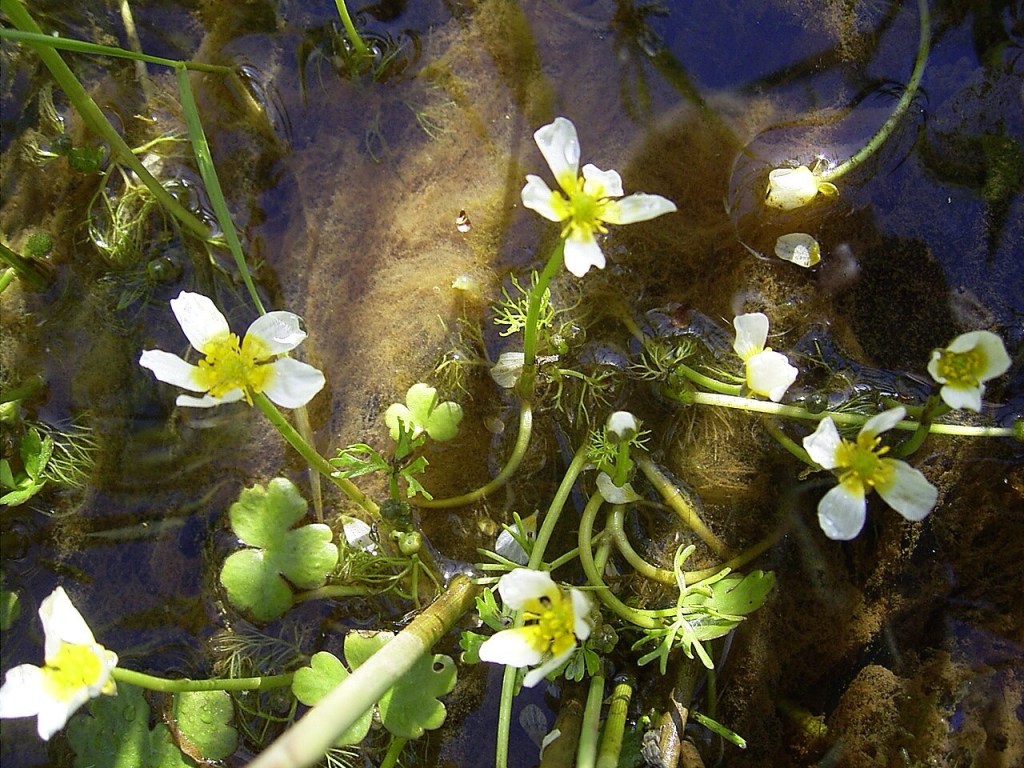
Crowfoot is a herbaceous plant of the genus Ranunculus, related to the buttercups, typically having lobed or divided leaves and white or yellow flowers.
Many kinds are aquatic with flowers held above the water. Crow quill is a quill pen made from a large feather of a crow’s wing and used in fine writing. Crow steps are projections resembling steps on the sloping part of a gable, common in Flemish architecture and in 16th- and 17th-century Scottish buildings. Also called corbie steps. — all three definitions from Oxford English Dictionary.
Five
Which of these words means the 1938 annexation of Austria by Hitler’s Nazi Germany?
Anschluss
Rindereintopf
Schlafwandeln
Answer: Anschluss.
Anschluss /ˈanʃlʊs / ▸ the annexation of Austria by Germany in 1938. Hitler had forced the resignation of the Austrian Chancellor by demanding that he admit Nazis into his cabinet. The new Chancellor, a pro-Nazi, invited German troops to enter the country on the pretext of restoring law and order. – ORIGIN German, from anschliessen ‘to join’. — Oxford English Dictionary
Rindereintopf is a beef stew, and Schlafwandeln is sleepwalking.
 Quizology.Online