Here are the answers to the questions posted earlier.
Continuing the alphabetical theme with today’s questions having answers beginning with the letters from P to T, with each letter being used only once. Please note they are not in alphabetical order. If a question has more than one part it is only the first that conforms to the theme.
See question four. Muggle quidditch or quadball. Image Wikimedia Commons
One
In Tolkien’s The Lord of the Rings, by what twelve-letter word does Éowyn, a noblewoman of Rohan, describe herself?
Answer: Shieldmaiden
Éowyn, a noblewoman of Rohan and shieldmaiden, kills the Witch-King of Angmar in the Battle of the Pelennor Fields, fulfilling a prophecy. Her brief courtship by Faramir is seen as influenced by Tolkien’s experience with war brides. In Nordic folklore and Norse mythology Shield-maidens are female warriors.
Two
What three words completes this sentence from Encyclopædia Britannica: ’At the summer solstice in the Northern Hemisphere, around June 21, the Sun attains its greatest declination north and is directly over the …’
At what latitude does the above answer lie?
Answers
Tropic of Cancer.
23°26’
The Tropic of Cancer, the northernmost circle of latitude where the Sun can be seen directly overhead, is currently 23°26′09.2″ north of the Equator. Its position changes due to the tilt of Earth’s axis. The Tropic of Capricorn is its southern equivalent.
Three
Which fairy tale features a miller, his daughter, a king and the transformation of straw into gold?
Answer: Rumpelstiltskin.
Rumpelstiltskin, a gnomelike man, spins straw into gold for a miller’s daughter in exchange for her firstborn child. When the miller’s daughter, now the queen, begs for her child’s release from the bargain, he gives her three days to guess his name.
Four
In 2022, the sport formerly known as muggle quidditch changed its name to what?
Answer: Quadball.
Quadball, formerly known as muggle quidditch, is a team sport inspired by the Harry Potter series. Two teams of seven players compete to score points by passing a ball through hoops while defending their own.
Five
Cobblepot: does he live in a rookery?
Answer: Penguin.
Oswald Chesterfield Cobblepot, aka The Penguin, a Gotham City criminal and Batman adversary, is known for his distinctive appearance and criminal activities centred around his nightclub, the Iceberg Lounge. Created by Bob Kane and Bill Finger, he is one of Batman’s most enduring enemies and has been featured in various media adaptations. Penguin colonies are known as rookeries.
Posing Questions Referencing Selected Trivia
The post title is simply representing the five letters for today’s answers as I’m sure you all noticed.
Continuing the alphabetical theme with today’s questions having answers beginning with the letters from P to T, with each letter being used only once. Please note they are not in alphabetical order. If a question has more than one part it is only the first that conforms to the theme.
In Tolkien’s The Lord of the Rings, by what twelve-letter word does Éowyn, a noblewoman of Rohan, describe herself?
Two
What three words completes this sentence from Encyclopædia Britannica: ’At the summer solstice in the Northern Hemisphere, around June 21, the Sun attains its greatest declination north and is directly over the …’
At what latitude does the above answer lie?
Three
Which fairy tale features a miller, his daughter, a king and the transformation of straw into gold?
Four
In 2022, the sport formerly known as muggle quidditch changed its name to what?
Here are the answers to my earlier posted questions.
Mario Andretti in the lead with Ronnie Petterson behind, 1978 Dutch GP. Image Wikimedia Commons
Five questions with the answers beginning with the letters from F to J —Foxtrot to Juliett — with each letter being used only once, but they are not in alphabetical order.
One
What one word can be all of these: a mythical creature which pulled Poseidon’s sea-chariot; an area of the human brain; and a genus of small marine bony fish?
Answer: Hippocampus.
The hippocampus, located in the temporal lobe and part of the limbic system, is essential for memory and spatial navigation and is one of the first areas affected in Alzheimer’s disease, causing memory loss and disorientation. In mythology, the hippocampus is a creature with a horse’s upper body and a fish’s lower body, often depicted with Poseidon, the god of the sea, driving a chariot drawn by hippocampi and accompanied by dolphins. The Romans associated it with Neptune, the sea god. Additionally, Hippocampus refers to a genus of 46 species of small marine bony fish, known as seahorses, which have a horse-like head, segmented bony armour, and a curled prehensile tail. Found in shallow coastal waters worldwide, seahorses belong to the family Syngnathidae, along with pipefishes and seadragons, and vary in size from 2 to 35 cm.
Two
Who was the next North American to win Formula 1’s World Championship, and be crowned World Drivers’ Champion, after Mario Andretti?
Answer: Jacques Villeneuve.
Mario Andretti, an American racing driver, competed in Formula One and IndyCar, winning numerous races and championships, including the 1978 F1 championship. Jacques Villeneuve, a Canadian racing driver, competed in IndyCar and Formula One. He won the 1997 Formula One World Drivers’ Championship and the 1995 IndyCar World Series and Indianapolis 500.
Three
In what television sitcom did characters have surnames beginning with the these letters: 3 x G plus 2 x B and 1 x T?
‘When I saw Finn waiting for me at the corner of the street, I knew at once that something had gone wrong.’ This is the opening line of a work by what author, and what was the work?
Answers: Iris Murdoch; Under the Net.
Irish-British novelist and philosopher Dame Jean Iris Murdoch, known for her works exploring good and evil, sexual relationships, morality, and the unconscious, won the Booker Prize for The Sea, The Sea and was made a Dame in 1987. Her first published novel, Under the Net, is a philosophical story about a struggling writer in London. The novel, dedicated to Raymond Queneau, was named one of the best English-language novels since 1923 by Time magazine.
Five
Which double-Oscar-winning actress became a UK Member of Parliament in 1992, and for what two films did she win Best Actress Oscars?
Answer: Glenda Jackson; Women in Love and A Touch of Class
Glenda Jackson (1936–2023) was a British actress and Labour Party politician. She was a member of the House of Commons from 1992 to 2015. Jackson won two Academy Awards for best actress, the first in 1970 for Women in Love and the second in 1973 for A Touch of Class. Other notable roles include her portrayals of Queen Elizabeth I in both the BBC television miniseries Elizabeth R (1971) and the film Mary, Queen of Scots (1971). After retiring from politics, Jackson returned to acting, earning a Tony Award in 2018 for her performance in Three Tall Women.
Post Title
Dancing a Foxtrot with Juliett
Juliett is spelled as it is in radio communications, as Wikipedia explains…
The spelling Juliett is used rather than Juliet for the benefit of French speakers, because they may otherwise treat a single final t as silent.
Mario Andretti in the lead with Ronnie Petterson behind, 1978 Dutch GP. Image Wikimedia Commons
Five questions with the answers beginning with the letters from F to J —Foxtrot to Juliett — with each letter being used only once, but they are not in alphabetical order.
One
What one word can be all of these: a mythical creature which pulled Poseidon’s sea-chariot; an area of the human brain; and a genus of small marine bony fish?
Two
Who was the next North American to win Formula 1’s World Championship, and be crowned World Drivers’ Champion, after Mario Andretti?
Three
In what television sitcom did characters have surnames beginning with the these letters: 3 x G plus 2 x B and 1 x T?
Four
‘When I saw Finn waiting for me at the corner of the street, I knew at once that something had gone wrong.’ This is the opening line of a work by what author, and what was the work?
Five
Which double-Oscar-winning actress became a UK Member of Parliament in 1992, and for what two films did she win Best Actress Oscars?
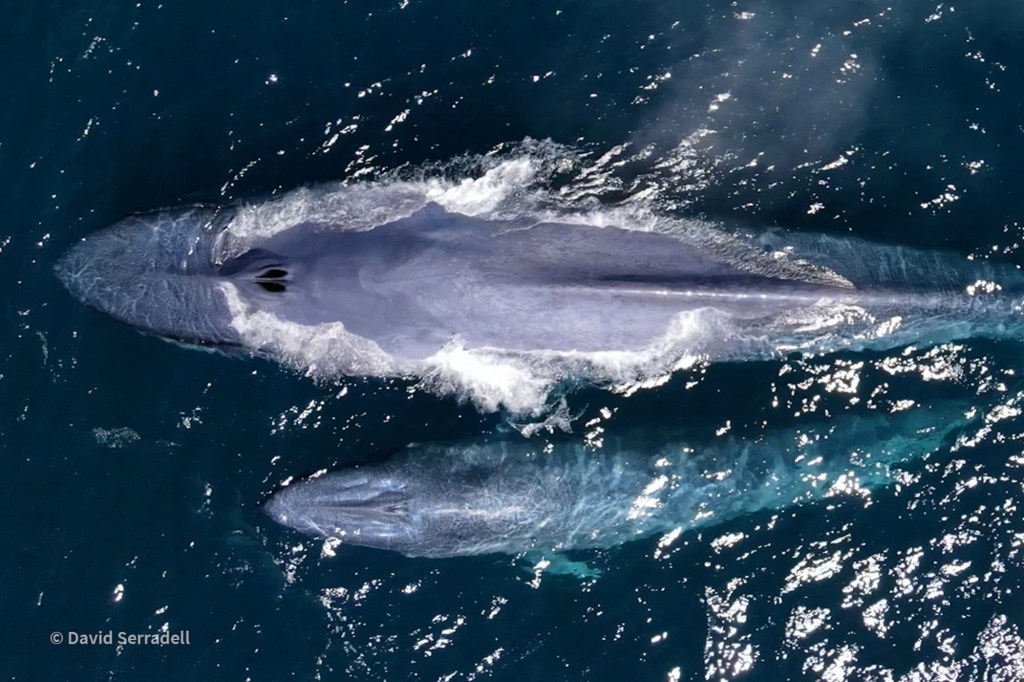
The term ’calf’, when referring to a young whale, is derived from the same root as the word for a young cow, which comes from Old English cealf and Proto-Germanic kalbam. This usage has been extended to marine mammals, where the adults are called bulls and cows, and the young are referred to as calves/calves.
Two
What were the first names of Mason and Dixon, after whom the Mason-Dixon Line is named?
Answer: Charles and Jeremiah.
The Mason-Dixon Line, surveyed by Charles Mason and Jeremiah Dixon from 1763 to 1767, initially served to resolve a land dispute between the Penn and Calvert families by marking the boundary between Maryland and Pennsylvania. It later became a symbolic boundary between slave and free states in the United States before the Civil War.
Three
What eight letter word means ‘the study of Chinese language, history, customs, and politics’, and from what does the first three letters of the word ultimately derive?
Answers: Sinology; Qin.
The terms sinology and sinologist were coined around 1838, Sinae, in turn from the GreekSinae, from the ArabicSin—which ultimately derive from Qin, i.e. the Qin dynasty. — Wikipedia ultimately the American Heritage Dictionary of the English Language (Boston: Houghton Mifflin, 3rd edition 1992): 1686.
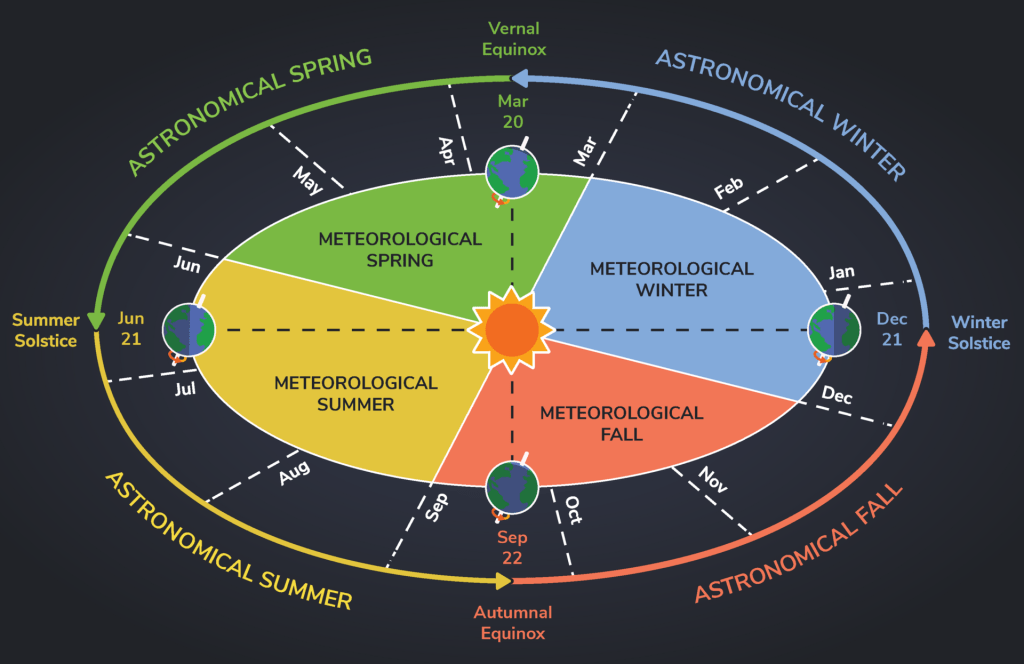
The astronomical seasons are based on the position of the Earth in relation to the sun. The equivalent meteorological seasons are also shown. This image is for the northern hemisphere. Image Wikimedia Commons
Four
In the northern hemisphere, what astronomical season ends at the vernal equinox and what three months form the equivalent meteorological season?
Answers: Astronomical winter; December, January and February.
Astronomical winter starts with the Winter Solstice about December 21st in the northern hemisphere and ends with the Vernal Equinox about March 20th. Meteorological winter covers the months of December, January and February.
Five
Ours is essentially a tragic age, so we refuse to take it tragically.
The opening words of which English novel, first published in Florence Italy in 1928, are quoted above. What is the novel’s title and who is the author?
Answer: Lady Chatterley’s Lover; D.H. Lawrence.
Lady Chatterley’s Lover, D. H. Lawrence’s final novel, explores the relationship between a working-class man and an upper-class woman. The novel, influenced by Lawrence’s life and the story of Lady Ottoline Morrell, faced obscenity trials in the UK and US before becoming a bestseller. It was not published fully and openly in the UK until 1960.
Sailing to Philadelphia – The Post Title
The title refers to Mark Knopfler’s album from 2000, and its title track which was inspired by Mason & Dixon by Thomas Pynchon, a novel about Mason and Dixon. The track features American singer-songwriter James Taylor.
Sailing to Philadelphia
Mark Knopfler
I am Jeremiah Dixon I am a Geordie Boy A glass of wine with you, sir And the ladies I’ll enjoy
All Durham and Northumberland Is measured up by my own hand It was my fate from birth To make my mark upon the earth…
He calls me Charlie Mason A stargazer am I It seems that I was born To chart the evening sky
They’d cut me out for baking bread But I had other dreams instead This baker’s boy from the west country Would join the Royal Society…
We are sailing to Philadelphia A world away from the coaly Tyne Sailing to Philadelphia To draw the line The Mason-Dixon line
Now you’re a good surveyor, Dixon But I swear you’ll make me mad The West will kill us both You gullible Geordie lad
You talk of liberty How can America be free A Geordie and a baker’s boy In the forest of the Iroquois…
Now hold your head up, Mason See America lies there The morning tide has raised The capes of Delaware
Come up and feel the sun A new morning is begun Another day will make it clear Why your stars should guide us here…
We are sailing to Philadelphia A world away from the coaly Tyne Sailing to Philadelphia To draw the line The Mason-Dixon Line
What were the first names of Mason and Dixon, after whom the Mason-Dixon Line is named?
Three
What eight letter word means ‘the study of Chinese language, history, customs, and politics’, and from what does the first three letters of the word ultimately derive?
Four
In the northern hemisphere, what astronomical season ends at the vernal equinox and what three months form the equivalent meteorological season?
Five
Ours is essentially a tragic age, so we refuse to take it tragically.
The opening words of which English novel, first published in Florence Italy in 1928, are quoted above. What is the novel’s title and who is the author?
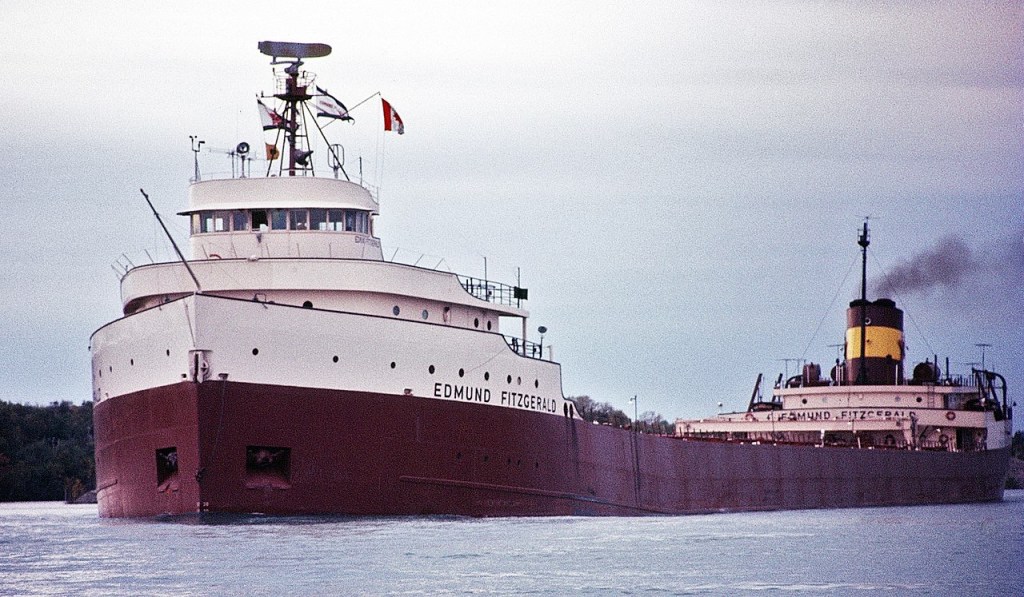
On which of the Great Lakes did the SS Edmund Fitzgerald sink with the loss of her entire crew in 1975?
Lake Michigan
Lake Ontario
Lake Superior
Answer: 3. Lake Superior.
The SS Edmund Fitzgerald, the largest ship on the Great Lakes, sank during a storm on November 10, 1975, with all 29 crew members lost. The cause of the sinking remains unknown, though it is believed to have been due to a combination of factors such as structural failure and high waves. The disaster led to changes in Great Lakes shipping regulations and practices. The Edmund Fitzgerald disaster, immortalised in Gordon Lightfoot’s ballad, led to significant changes in Great Lakes shipping regulations, including mandatory survival suits and increased inspections.
Two
This Eurasian woodland plant, Allium uranium, with broad shiny leaves and round heads of flowers, producing a strong aroma of garlic is also called wild garlic. What is it?
Larsons
Ramsons
Tamsons
Answer: 2. Ramsoms.
Allium ursinum, or wild garlic, is a bulbous perennial flowering plant native to Eurasia. It is a wild relative of onion and garlic. It has several names including ramsons; it is also known as buckrams, broad-leaved garlic, cowleekes, cows’s leek, cowleek, wood garlic, Eurasian wild garlic, onion grass, bear leek and bear’s garlic.
Three
What letter(s) is the symbol which represents the element tungsten?
T
Gs
W
Answer: 3. W.
Tungsten, also known as wolfram, is a chemical element with the symbol W and atomic number 74. It is a metal found naturally in compounds and was first isolated as a metal in 1783.
Four
Who, on a sixties album, released a version of the Christmas carol Silent Night with a simulated 7 O’clock News, which featured real events from the preceding summer, being read over it?
Crosby, Stills and Nash
Joni Mitchell
Simon & Garfunkel
Answer: 3. Simon & Garfunkel.
7 O’Clock News/Silent Night by Simon & Garfunkel is a sound collage from their 1966 album, combining Silent Nightwith a simulated news bulletin. A sound collage juxtaposes Silent Night with a news report, highlighting social issues like civil rights, Lenny Bruce’s death, and the Vietnam War. The track’s mix emphasises the contrast between the news and the Christmas song.
Five
In which Scottish body of water was the German High Seas Fleet scuttled in June 1919?
Loch Ness
Scapa Flow
Firth of Lorn
Andwer: 2. Scapa Flow.
Scapa Flow is a strait in the Orkney Islands, Scotland. It was an important British naval base, especially in the First World War. The German High Seas Fleet was interned there after its surrender, and was scuttled in 1919 as an act of defiance against the terms of the Versailles peace settlement.
The Wind in the Wires Made a Tattle-tale Sound — Post Title
The post title is a line from The Wreck of the Edmund Fitzgerald by Gordon Lightfoot. Full lyrics below from AZ Lyrics.
The Wreck Of The Edmund Fitzgerald
By Gordon Lightfoot.
The legend lives on from the Chippewa on down Of the big lake they call Gitche Gumee The lake, it is said, never gives up her dead When the skies of November turn gloomy With a load of iron ore twenty-six thousand tons more Than the Edmund Fitzgerald weighed empty [Former version:] That good ship and true was a bone to be chewed [Latter version:] That good ship and crew was a bone to be chewed When the gales of November came early
The ship was the pride of the American side Coming back from some mill in Wisconsin As the big freighters go, it was bigger than most With a crew and good captain well seasoned Concluding some terms with a couple of steel firms When they left fully loaded for Cleveland Then later that night when the ship’s bell rang Could it be the north wind they’d been feelin’?
The wind in the wires made a tattle-tale sound When the wave broke over the railing And every man knew, as the captain did too ‘Twas the witch of November come stealin’ The dawn came late and the breakfast had to wait When the gales of November came slashin’ When afternoon came it was freezing rain In the face of a hurricane west wind
When suppertime came, the old cook came on deck Saying, “Fellas, it’s too rough to feed ya.” [Former version:] At seven PM a main hatchway caved in [Latter version:] At seven PM it grew dark, it was then He said, “Fellas, it’s been good to know ya.” The captain wired in he had water comin’ in And the good ship and crew was in peril And later that night when his lights went out of sight Came the wreck of the Edmund Fitzgerald
Does anyone know where the love of God goes When the waves turn the minutes to hours? The searchers all say they’d have made Whitefish Bay If they’d put fifteen more miles behind her They might have split up or they might have capsized They may have broke deep and took water And all that remains is the faces and the names Of the wives and the sons and the daughters
Lake Huron rolls, Superior sings In the rooms of her ice-water mansion Old Michigan steams like a young man’s dreams The islands and bays are for sportsmen And farther below, Lake Ontario Takes in what Lake Erie can send her And the iron boats go as the mariners all know With the gales of November remembered
[Former version:] In a musty old hall in Detroit they prayed [Latter version:] In a rustic old hall in Detroit they prayed In the Maritime Sailors’ Cathedral The church bell chimed ’til it rang twenty-nine times For each man on the Edmund Fitzgerald The legend lives on from the Chippewa on down Of the big lake they call Gitche Gumee Superior, they said, never gives up her dead When the gales of November come early. AZ Lyrics.
On which of the Great Lakes did the SS Edmund Fitzgerald sink with the loss of her entire crew in 1975?
Lake Michigan
Lake Ontario
Lake Superior
Two
This Eurasian woodland plant, Allium uranium, with broad shiny leaves and round heads of flowers, producing a strong aroma of garlic is also called wild garlic. What is it?
Larsons
Ramsons
Tamsons
Three
What letter(s) is the symbol which represents the element tungsten?
T
Gs
W
Four
Who, on a sixties album, released a version of the Christmas carol Silent Night with a simulated 7 O’clock News, which featured events from the preceding summer, being read over it?
Crosby, Stills and Nash
Joni Mitchell
Simon & Garfunkel
Five
In which Scottish body of water was the German High Seas Fleet scuttled in June 1919?
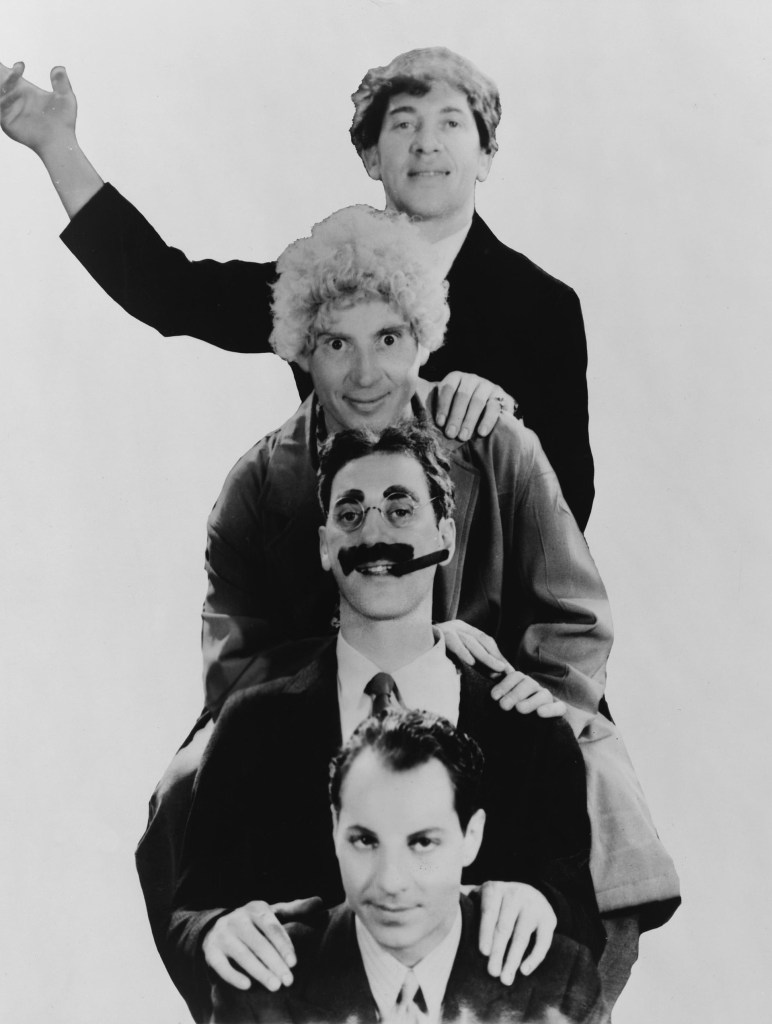
Chico, born Leonard Joseph Marx in 1887, was the eldest. Harpo, born Adolph Marx in 1888, followed. Groucho, born Julius Henry Marx in 1890, then came Gummo, born Milton Marx in 1893. Finally, Zeppo, born Herbert Manfred Marx in 1901, was the youngest and last of the five Marx brothers. The picture shows them in age order but missing Gummo. From top: Chico, Harpo, Groucho and Zeppo.
Two
The African polecat is also known as a …
Zimbal
Zorilla
Zugerro
Answer: 3. Zorilla.
The striped polecat, native to sub-Saharan Africa, is a nocturnal, mostly carnivorous mammal with distinctive black and white fur. It uses its long claws to dig for prey and its spray to deter predators. While mostly solitary, females tolerate males during breeding season, and the species is not considered threatened.
Three
What movement which flourished in the early twentieth century was also referred to as Style Moderne?
Art Deco
Naturalism
Realism
Answer: 1. Art Deco.
Art Deco, a style of visual arts, architecture, and product design, emerged in Paris in the 1910s and flourished internationally during the 1920s and 1930s. Influenced by various artistic movements and cultures, it represented luxury and progress, utilising both rare and new materials. While its popularity waned after World War II, Art Deco remains a significant architectural and design style.
Four
At what age did Alexander the Great die?
32 years old
41 years old
49 years old
Answer: 1. 32 years old.
Alexander the Great, king of Macedon (20/21 July 356 BCE – 10/11 June 323 BCE), created one of the largest empires in history through a decade-long military campaign. He conquered the Persian Empire, invaded India, and founded numerous cities, spreading Greek culture and initiating the Hellenistic period. His legacy includes cultural diffusion, military tactics, and legendary status in both Greek and non-Greek cultures.
Five
Florida
Louisiana
Texas
Answer: 3. Texas.
The latitude of the three cities listed are as follows with the southernmost first…
Austin, Texas (30.2672° N)
Tallahassee, Florida (30.4383° N)
Baton Rouge, Louisiana (30.4571° N)
Why a Duck? — Post Title
Why a Duck? is a well-known comedy routine from the Marx Brothers’ movie The Cocoanuts (1929). The scene, features Groucho mentioning an ‘viaduct’ and Chico asking ‘Why a duck?’. This turns into a prolonged routine which is a favourite among fans and has been analysed in Richard Anobile’s book of the same name. The script for the scene is on the Marx Brothers website here.


 Quizology.Online